

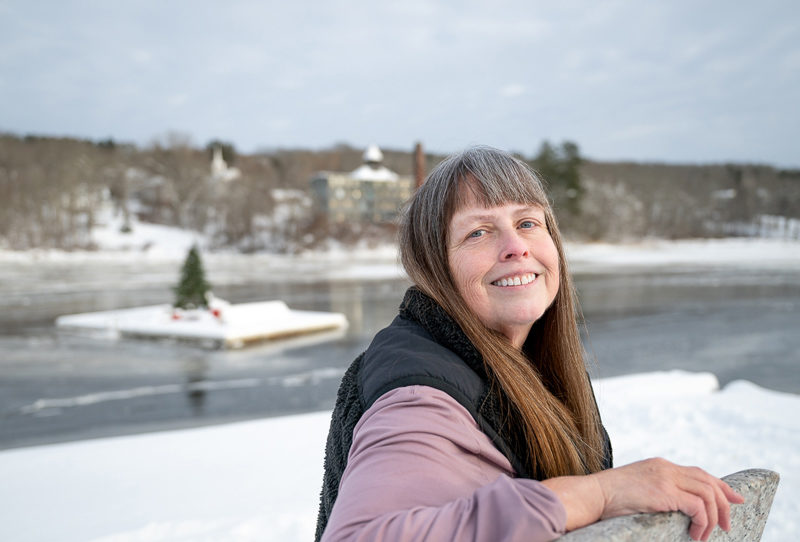
Rebecca Smith Waddell smiles from a stone bench at the snow-covered Pine Street Landing in Waldoboro on Saturday, Dec. 27. Behind her the towns floating Christmas tree is hemmed in by ice on the Medomak River. (Bisi Cameron Yee photo)
As an administrator for the What’s New in Waldoboro Facebook group, Rebecca Smith Waddell sees her role as both a communicator and a protector.
It’s a delicate balance sometimes.
Online communities are facing a number of challenges from the spread of misinformation to bullying or harassing behavior to bots and trolls and scam artists.
They are also a resource that can provide assistance when needed or help grow a business. They can enable dialogue, promote understanding, and foster connection.
Smith Waddell wants members of What’s New in Waldoboro to feel comfortable expressing themselves, but not to the detriment of others.
“I don’t actually want to censor anybody but I want people to feel safe posting,” she said. “I’ve annoyed a lot of people over time. People get upset that I don’t let them say everything.”
But, as she said in a featured post on the group’s page, “These are our neighbors – the same people waiting on you at Dunkin, baking pies at Moody’s, checking you out at Hannaford, helping you find the right supplies at RZR, etc.”
Waldoboro is the largest town in Lincoln County in both population and in geographic size. Smith Waddell likens it to a large lobster claw, with pincers formed by the opposing banks of the Medomak River. She has lived here for almost 40 years.
“It’s always been sort of the town in between,” she said. “(People think) there’s nothing in Waldoboro – well there is. There’s plenty here.”
But with no town square or central community gathering space, it can be hard to bring the town together. What’s New in Waldoboro was devised in response to that challenge.
The public Facebook group, which now numbers in excess of 8,000 members, originated in 2019 as a way to alert residents to the local businesses and community events found around town.
Smith Waddell is one of four volunteer moderators who manage the group, a role that she takes to heart. For her the group represents a necessary service for every person who engages, whether they do so out of pride or generosity, or out of frustration or pain or need.
“We’re all people. We all make mistakes. We all need some kind of support,” she said. “We all have trauma.”
Smith Waddell was born in Brooklyn, the youngest of three children. Her parents were first and second generation Jewish immigrants. Her mother’s family fled Eastern Europe during the early days of WWII and Smith Waddell grew up on their tales of great tragedy and great heroism.
Some relatives did not escape. Some died trying. Some were young children. Her stepgrandfather, an Olympic skier, guided people to safety across the snow-covered countryside.
The family holdings were taken over by the Nazis, with their namesake bank, the Petschek Palace, becoming the Gestapo’s grim headquarters.
For Smith Waddell, being Jewish means acknowledging that history and holding those memories.
“It brings it home for you when its family members who can tell you real stories,” she said.
Smith Waddell’s mother, Marion Petschek, grew up in Scarsdale, a wealthy area just outside New York City. She attended Pembroke College, the coordinate women’s college for Brown University in Providence, R.I., and earned a master’s degree in psychology from the New School in New York City. A feminist during the early days of the women’s movement, she wrote for the Village Voice during its heyday.
Smith Waddell’s father, Harry Smith, grew up on Long Island and also graduated from Brown University. Harry Smith was a renowned poet and publisher, a force in the small press movement of the 1960s and 1970s and along with literary luminaries like Buckminster Fuller, Joyce Carol Oates, and Anaïs Nin, one of the founding editors of the Pushcart Prize for small press writing.
Smith Waddell describes her childhood as idyllic in many ways. Her parents bought a farm in Downeast Maine and an island off the coast where the family spent their summers. They would drive into Canada for dinner or fly to San Francisco for the weekend.
Alone on the island without electricity or friends her age she took up guitar and tried her hand at songwriting.
“I always looked forward to coming to Maine. I cried my eyes out going back to Brooklyn,” she said.
In Brooklyn, life was less pleasant. Her parents were distant, her mother cold and her father frequently absent. Her siblings were older and she was often alone. Her family members belittled her – she wasn’t considered as smart, as talented, as attractive as her older brother and sister and they let her know it.
She also didn’t really care much for city living. She recalled the white socks she wore when she walked to school and the dark rings that formed around her ankles from the grime on the sidewalks.
“I hated that,” she said. “I preferred being outside in the country, being quieter, seeing nature. You don’t see real nature in Brooklyn.
When Smith Waddell was 13, her mother was diagnosed with a brain tumor. Radiation treatments used higher doses back then and there was lasting damage. Her mother never really recovered although she lived another 17 years.
Caroline Petschek Smith’s illness was a turning point for Smith Waddell. She remembers coming home from school and receiving a call that her mother had been taken to the hospital and that she would need to tell her brother and sister when they got home. She didn’t know what actually happened, even when she was sent to stay with distant relatives in New Mexico or Kansas, people with whom she had little connection. When she finally came home, her mother no longer recognized her.
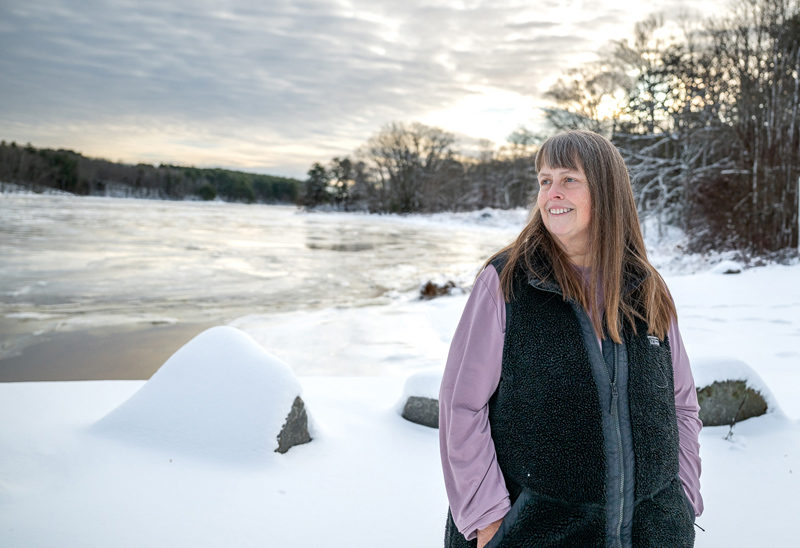
Rebecca Smith Waddell looks toward the heart of Waldoboro from the Pine Street Landing in Waldoboro. Smith Waddell has been an administrator for the 8,000-plus member Whats New in Waldoboro Facebook group since 2022. (Bisi Cameron Yee photo)
The next year Smith Waddell was sent to boarding school in Connecticut, a change she welcomed. After graduating from the Loomis-Chaffee School, she took summer courses at Cornell and Pace University.
Smith Waddell had ambitions of being a First Amendment lawyer and started at the Cardozo School of Law in New York City. But she quickly dropped out. It seemed to her that people were more interested in getting around the law than in upholding it.
“I was too idealistic,” she said.
She completed her education at the University of Maine in Orono with degrees in journalism and political science. There she spent three years on the staff of The Daily Maine Campus, including stints as editor and managing editor. And there she met her husband, David.
The two were married shortly after graduating and moved to Midcoast Maine when David Waddell found work with the Maine Department of Environmental Protection.
The couple moved to Waldoboro in 1987 with an eye to starting a family. They chose the town for its schools and its affordability in comparison to Camden or Damariscotta. They appreciated its small-town charm and access to services.
With the graphic design and publishing skills she had learned during her time on the college paper, Smith Waddell took a job as a typesetter with the Free Press in Rockland in 1988.
That same year she started her own company offering typesetting and book design for small press publishers, mostly poetry books, including those of her father.
But she had additional ambitions. She wanted to be a mother.
“I just always had this picture in my head,” she said. “College … married … kids by 24. I was going to have it all.”
It wasn’t that easy. After a series of miscarriages over the course of years, Smith Waddell underwent testing and was diagnosed with Turner syndrome, a condition in which one of a woman’s two X chromosomes is missing or partially missing. One symptom of Turner syndrome is difficulty getting pregnant.
Over time she had sought and found a support system online and in 1996 she initiated her own internet bulletin board groups and email listservs around topics of fertility, pregnancy, and eventually parenting.
After a year of fertility treatments she finally gave birth to a son.
“I actually spent the first year wondering if he was real,” she said.
Two more miscarriages followed before she became pregnant with her second child. That pregnancy wasn’t an easy one and when her youngest son was born he was diagnosed with failure to thrive and autism. As a child he was developmentally delayed with a limited vocabulary. After researching food allergies Smith Waddell switched him to a gluten-free diet and by the end of high school he was taking college-level English classes and volunteering at the library.
Smith Waddell worries about his future though. While he is high functioning and creative, sensory issues limit his ability to drive a car or to be comfortable in social situations.
“Autism isn’t a diagnosis that’s going away,” she said.
So she became a certified direct support professional and is now a paid shared living provider for her son.
It’s an approach that she believes can help other local families with autistic or developmentally delayed family members. The program is self paced and primarily online, costs are minimal, and it relieves some of the financial pressures associated with having a family member in need of specialized care.
In her 38 years as a resident of Waldoboro, Smith Waddell has been active in many facets of her community. She was a member of The Waldo Theatre’s board of directors, helping champion the theater’s return to prominence in the Midcoast. She volunteers with the Waldoboro Free Clothing Closet and delivers food for the Waldoboro Food Pantry.
She served on the Waldoboro Day Committee and was a member of the Miller School PTO.
She was active with the Cub Scouts when her boys were younger.
And she plans to continue to do what she can to help Waldoboro live up to its potential and fulfill its dreams while staying rooted in its own character and history.
“I didn’t move here to change it,” she said. “I moved here to be a part of it.”
Near the top of her to-do list for 2026 is preparing for the next holiday season. She sees opportunities to highlight local businesses, to plan events that will draw people in from neighboring communities. And she knows residents want a community Christmas tree lighting.
For now she likes to visit the tree floating on the icy Medomak River. “Gavin’s tree” she calls it after Gavin Martin, a young member of the Waldoboro public works crew who died in a car crash on Dec. 16.
“He helped put it in the water,” she said. “It looks better than ever this year.”
(Do you have a suggestion for a “Characters of the County” subject? Email info@lcnme.com with the subject line “Characters of the County” with the name and contact information of your nominee.)

