

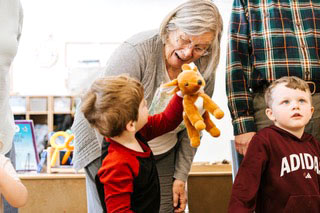
The Mainely Memory Foundation is promoting cognitive well-being through intergenerational activities. The nonprofit organizations hopes to improve the lives of those living with dementia and their caretakers. (Courtesy photo)
A new cognitive memory care service has started in Lincoln County, focused on building intergenerational relationships to improve the lives of dementia patients.
The Mainely Memory Foundation is a nonprofit organization with the mission of supporting families through every stage of dementia. This is done through early detection, education, advocacy, and respite programs.
“I love to work with families. Family centered therapy is my thing, and I’ve been doing it for 25 years,” said Jennifer Bryce, founder of Mainely Memory.
Bryce is a speech language pathologist at MaineHealth and wanted to provide care for people with dementia while also lightening the loads of caregivers. She said she realized how little time caregivers had for themselves, which often leads to burnout or isolation. To tackle this problem, Bryce initially started a private practice where she would go into the homes to relieve the caregiver for a few hours.
Shortly after starting her business, Bryce said she saw a major issue in this plan: it wasn’t accessible. She said a majority of the people who would need this help wouldn’t have the resources or money to pay for it. So in November 2025 she started the paperwork to create a nonprofit.
In February, the Mainely Memory Foundation was officially deemed a nonprofit organization.
The Mainely Memory Foundation will provide memory screenings, which are 15-minute tests that evaluate whether or not the patient needs further assessment or information. This is so dementia symptoms can be tracked as early as possible.
Education tools will include different activities promoting brain health and lessons on what is considered typical memory loss versus nontypical memory loss. Typical memory loss is often a normal part of aging while nontypical memory loss can indicate cognitive impairment, dementia, and sometimes mental health issues.
Bryce said there will also be tips and tricks to help those with dementia maintain independence and learn safety skills. There will also be education tools for caregivers, including strategies for managing difficult behaviors.
Early assessment and education also helps Bryce and her team determine what tools to use to help.
There are over 100 different types of dementia, Alzheimer’s being one of the more common correlations people make with the disease, Bryce said. By completing early screenings, Bryce said they can figure out how to care for people in a personal, specialized way. Care can be dependent on a person’s interests or the severity of their impairment.
“We would be tailoring activities and things to the person’s interests, and they would be going to just share time, share activities, share stories,” Bryce said.
The care provided by Mainely Memory is not considered medical care but companionship, Bryce said. This means volunteers would be completing activities such as sharing stories, playing cards, listening to music, and more with a patient. Bryce said the patient must be able to take care of themselves physically while the caregiver is out in order for a volunteer to be left alone with them.
While volunteers visit, caretakers are able to take a few hours off to either get other work done or rest.
“Caregivers oftentimes don’t even have time to go to a doctor’s appointment or get a haircut or anything to take care of themselves,” Bryce said. “That’s what we’re hoping we can do, is add a few hours a week that could give that little bit of reprieve that they so desperately need.”
The organization recently partnered with the Central Lincoln County YMCA and Merry Gen, Inc. to pilot an eight week intergeneration program. MerryGen provides consultation, program development, and training focused on building intergeneration relationships.
Older adults and pre-school aged children were brought together to share stories, play, and connect. Bryce said in this program, they used MerryGen’s MAINELY-7 Method, which teaches participants different tools for mindfulness and techniques for calming themselves.
The four older participants came from a mix of backgrounds, some having mild cognitive impairment and other participating to take early action against dementia. Bryce said she considers the program a success because of how well the two age groups worked with each other.
Intergenerational activities like this help promote cognitive health, Bryce said. For the children, it helps them slow down. For the older participants, she said the activities help stimulate their minds and keep them active.
“Every week we had family members letting us know how much that their loved one was enjoying it. One gentleman said that it helps to replace the void that he has from not being able to see his grandchildren who live out of state,” Bryce said.
Alongside vice president of the Mainely Memory Foundation, Meredith Blakely, Bryce co-authored a book for younger children and older adults with dementia. The book draws inspiration from the MAINELY-7 Method, and is being used as a tool for the older adults to read something that is simple and repetitive to the children.
“With all of the crazy in the world and the digital world, we are hoping to get people connected and telling stories and having experiences,” Bryce said.
In the future, the Mainely Memory Foundation plans on hosting a senior-to-senior program, which will bring together upper-class high school students and older adults. Similar to the Calm Together program, these groups will focus on giving the older adult someone to talk to.
For more information on the Mainely Memory Foundation, go to mainelymemory.com.

