

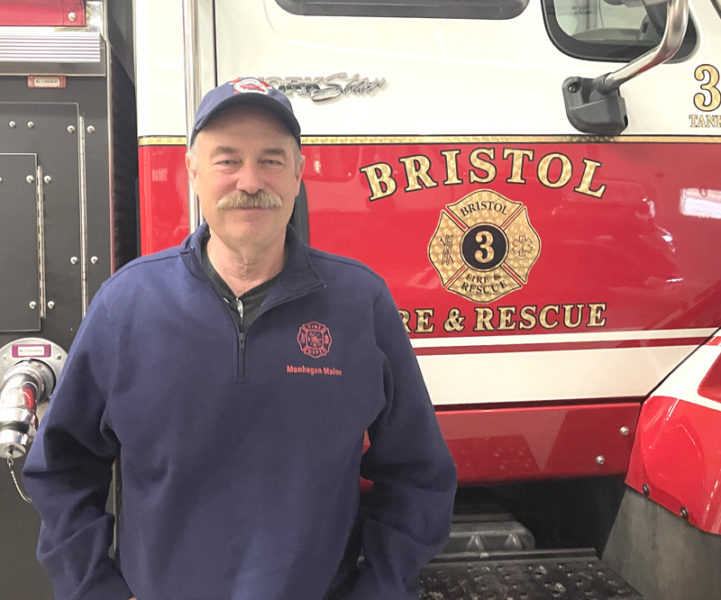
Bristol Fire and Rescue Captain Scott Pendleton stands in Bristol Mills fire station. In the next month Scott and his wife Wendy will relocate to Monhegan Island for the summer where Scott serves as chief of the Monhegan Volunteer Fire Department. (Sherwood Olin photo)
Scott Pendleton was commanding a 780-foot long freighter, located about 36 miles inland on the Shatt al Arab, one Iraq’s major tidal rivers. He’d spent the previous evening drinking beer with British marines and now the local pilot hired to get the vessel back to the open ocean was proving to be no help.
“This is a 780-foot ship in a tidal river that’s running about three knots,” Pendleton said. “Single screw; had a bow thruster. So I start backing and filling and there’s ships docked on one side and anchored on the other side.
“I got turned 90 degrees, and I went to give the engine one more kick and it didn’t start, because you only have so much air pressure to start. The generators and air compressors are trying to fill it back up as fast as you can. But I got a failed start, and I’m drifting down the river sideways, 90 degrees from the dock, and I’m getting distances. ‘Well, we’ll clear by two meters on the bow and eight meters on the stern.’
“As we’re going down the river sideways, the third mate’s looking at me panicking. ‘What are we going to do?’ I said ‘we’re going to wait a couple minutes and then we’re going to start the engine again, but until that point, we’re just going for a ride.”
Pendleton survived his harrowing experience, but the hair-raising tale is just one experience gained during a near 35-year career on the high seas.
Born and raised in New Harbor, Pendleton always knew he wanted to work on the water. He was 12 years old when he started lobster fishing on his own with a little skiff. By the time he was in high school he was working for Lee Reilly on an 83-foot dragger.
After graduating from Lincoln Academy in 1981, Pendleton was considering marine biology and perhaps marine archeology when someone recommended he look at the Maine Maritime Academy in Castine. It turned out to be the only school he applied to.
Pendleton was employed as third officer onboard a ship as one of his first jobs out of college. He patrolled the North Atlantic towing a three mile long cable behind the ship, which is used to listen for Russian submarines.
“We would go out for 90 days,” he said. “You just troll along at four knots, listening with a three-mile acoustic cable, just with hydrophones. They were so long they could actually triangulate. They had several of these ships around the Atlantic, and they would use them to triangulate Russian subs.”
Pendleton said he was planning to go back to the ship during 1986, but he bought his owner lobster boat instead. He got married, built his first house, and went into business for himself. By 1990, the lobster industry was weighing on him and he wanted to begin the career he studied for.
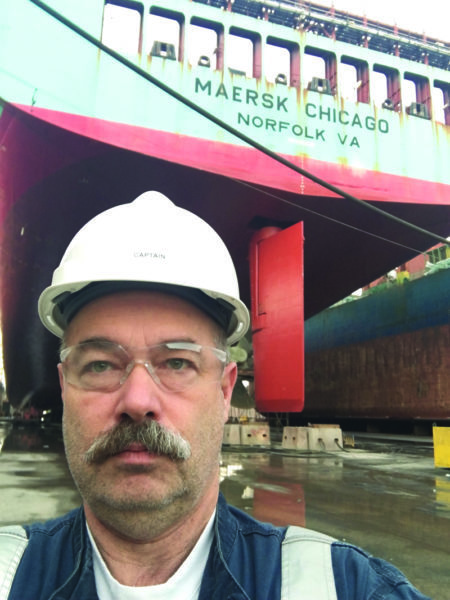
Captain Scott Pendleton takes a self image with the final ship in his career, Maersk Chicago, in the background. (Courtesy photo)
That year he took a job as third officer on the USNS Algol, a 946-foot containership. Pendleton joined just in time for the ship’s third transit to the Middle East, arriving at the outset of the first Gulf War in January 1991.
He rode out the outbreak of hostilities on a container ship in a Saudi Arabian port.
“We loaded the ship Christmas Eve in Houston, and we were in Saudi Arabia, I think it was Jan. 17,” he said. “We watched some of the Patriot missiles that we had unloaded that day. They set up right on the end of the pier, and we watched some of them go off that night. Scud missiles tumbled down into the harbor and stuff. It was an interesting night.”
Over the course of his career at sea, Pendleton has weathered big storms, including at least two hurricanes, but the only time he truly feared for his life, he said, was that one night in 1990.
“That was a little intense,” he said. “I went to sleep with a gas mask on. Woke up a couple hours later; it’s like, should I take the gas mask off, or should I look around see if anybody else is moving?”
In 1990 Pendleton went to work for Maersk, one of the world’s largest shipping companies. He was promoted to second officer around 1997, and spent a good part of the next five years working on the west coast of South America. In 2002, he was promoted to chief officer, and then in 2004, he was tapped to be captain.
“I started sailing captain on a shuttle ship between Salalah, Oman and Karachi, Pakistan, and then sometimes up into the Persian Gulf, sometimes down into India and Sri Lanka,” he said. “Then I moved on back to the 950 foot ships as captain in 2008. In 2013, we got the 986’s, and that’s where I stayed until I got done.”
As a senior officer, Pendleton typically worked four months on and four months off. Most transatlantic voyages typically took 80-90 days to complete, he said.
Despite having sailed over the world, most of Pendleton’s overseas experience was limited to the foreign ports. Almost always, he said, when the choice was sightseeing or squeezing in nap, he chose the opportunity to rest.
International shipping runs on a complex schedule with a lot of moving parts that require each ship to get in and out on a designated schedule, he said.
“When we were in South America, I averaged 16 hours a day work time, and that was just the way it was,” he said. “I had to get the job done. I was chief officer. I had to supervise the other officers. I had to supervise the crew. There was just a lot going on.”
Years ago, a cargo ship would pull into port and could spend a week or more unloading and reloading before heading out. Nowadays, ships get and in out in matter of hours.
“We would do as little as six or eight hours, and sometimes we’d be there close to a day,” Pendleton said. “Most of the time it was get in at two o’clock in the morning, leave at three o’clock in the afternoon. … We might be five hours getting to the dock and five hours leaving the dock to get back out. So it makes for a really long day, and you’re on duty that whole time just about.”
In addition, the captain is responsible for doing the paperwork for customs and immigrations and depending on the officials involved and what kind of gratuity they wanted, the process could be onerous, Pendleton said
“Some of them would be looking for any spelling mistake on one of 300 pieces of paper that I’d have to fill out for that port,” Pendleton said. “I’d go through a ream of paper in two or three ports in India and Pakistan, because they have very British paperwork. They were the masters of creating this god awful paperwork.”
Pendleton had planned to work for another year or two than he did, but decided to take time off in 2024 as his father’s health was failing and he remembered just how much he liked being home.
“I stayed home a trip, and then just said, no, I’m not going to go back. I kind of like staying home,” he said. “My wife was like, ‘you were supposed to work one more year’ and I said, ‘no, I’m done.’”
For the Pendleton family, participating in Bristol Fire and Rescue is very much a family tradition. Scott’s grandfather, Ken Sawyer, was one of the founders of the Bristol Fire Department and served as Bristol Fire Chief for 39 years. His father Ron was a department member for virtually 70 years and fire chief for 20 years himself. In 1982, both of his parents were founding members of the Bristol First Responders and his mother Jeri is still the chief of Bristol Emergency Medical Services.
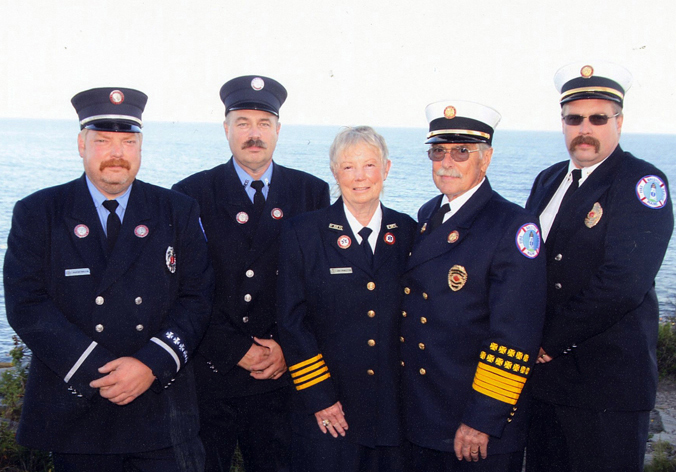
Joining the Bristol Fire and Rescue is virtually a Pendleton family tradition. Shown in their dress uniforms, from left, Brad, Scott, Jeri, Ron, and Jared Pendleton. Today all three Pendleton sons are all officers in Bristol Fire and Rescue. Jeri is the cheif of Bristol EMS. Ron passed in 2024 after a 70 years of service to his town. (Courtesy photo)
Both of his brothers are officers in the department and his nieces, nephews, and sisters-in-law all participate to some extent. For all that, Scott said his parents never pressed him to join the department and he never felt pressured to do so.
“I wanted to join the fire department,” he said. “I was very interested, but I like to say my life doesn’t revolve around it. It’s more around my family and stuff, but it takes a big chunk out of my life.”
He acknowledges it is about to take an even bigger chunk as he recently agreed to become the chief of the Monhegan Fire Department.
Currently, Scott and his wife of 40 years, Wendy Ann Pendleton, are preparing to relocate out to Monhegan Island for the summer. They own a home in Bristol and bought a property on the island nine years ago that they use for a seasonal residence; renting it out in the off season.
“We bought the place with the plan to maybe sustain itself, and we’re close to that,” he said. “That’s how I got involved in Monhegan. I know some of the guys out there, the fishermen, and it’s been good. It’s a good community, but everybody has to wear five hats. Guys have three jobs, plus they’re sitting on this board or that board. It’s just hard with only 40 or 50 year round residents.”
After the previous chief moved off the island, Pendleton was approached a couple of times before he agreed to serve.
“They were hurting for anybody with any real experience, and the guy that had taken it over was getting ready to move off the island,” he said. “He’s gone now and couldn’t find couldn’t find anybody. After they asked four or five times, I was like okay. We’ll see come first of May.”
The problem with Monhegan is they have so few calls annually it is hard to maintain momentum, Pendleton said. The first thing he is working on is increasing interest and activity at the department.
“I got started in the fall with a little bit of training, little bit of reintroducing stuff to people and trying to gather up new and younger people too,” Pendleton said. “That’s the biggest thing, is finding interest. That’s the hard part. Out there it isn’t that they have calls. It’s that they don’t have many calls.”
Looking back over his career, Pendleton said he would like an opportunity to see some of the ports he visited regularly. He visited some beautiful and fascinating places, even if he never got to leisurely enjoy them.
“I wish I could have spent more time ashore in a lot of the places I went, but it always seemed to be, ‘Wait, do I want two hours of sleep or do I want to walk around?’” he said. “The sleep won out more often than not. When you’re working 16 hours days, sleep is important.”
(Do you have a suggestion for a “Characters of the County” subject? Email info@lcnme.com with the subject line “Characters of the County” with the name and contact information of your nominee.)

