


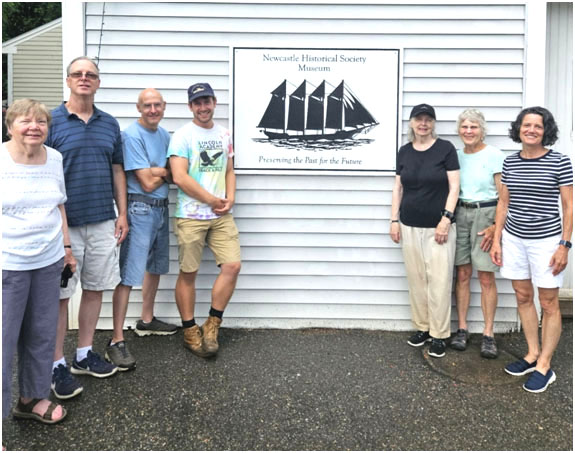
Newcastle Historical Society board members celebrate a recently installed replacement sign designed and created in collaboration with Lincoln Academy faculty member for ATEC, Andrew Jonash. From left: Sandra Barth, Tim Dinsmore, Mike Titus, Andrew Jonash, Karen Campbell, Betsy Evans, and Karen Paz. Not pictured: Bruce Campbell and Arlene Cole. (Photo courtesy Newcastle Historical Society)
Anyone who frequently travels past the Taniscot and Newcastle town office on Main Street might recently have noticed a brightening of its facade in the replacement of the Newcastle Historical Society’s old and sadly degrading sign that hosted messages and announcements of various types.
The sign had, some time ago, passed beyond its attractive appearance and also was very close to the end of its functionality as a message board. The Newcastle Historical Society officers and trustees deliberated thoughtfully for a long time, deciding how to deal with this situation in the best possible way. Many proposals for methods of replacement came and went.
Ultimately, the society settled upon a very logical and positive path forward. Sparked by the suggestion of a carpenter working for one of its members and realizing Lincoln Academy had a very well-appointed and capable woodshop housed in its Applied Technology and Engineering Center building, supportive administrators, and a highly skilled staff, members decided it would be a perfect match to collaborate with LA to construct a replacement sign.
Newcastle Historical Society officers and trustees discussed implementation of this plan during scheduled monthly meetings and on two occasions had on-site meetings at the sign location and with Lincoln Academy staff. Heather D’Ippolito, Jim Letteney, and Maya Crosby heartily endorsed the idea and connected the historical society with ATEC design Engineering and Technology faculty member Andrew Jonash.
Collaborating with Jonash, the Newcastle Historical Society crafted a thematically appropriate, workable, and attractive design along with a set of specifications to guide him in the process. The decision to incorporate an image of a wooden sailing vessel into the sign was an obvious choice given the historical importance that shipbuilding and shipping played in Newcastle.
Designing the procedures and implementing the process of constructing the sign itself was a long and arduous task that was exclusively executed by Jonash in the ATEC building using its available equipment and the raw materials he spec’d out based on historical society guidelines.
Jonash purchased marine-grade plywood from N.C. Hunt in Damariscotta, purchased the required paint, varnish, sealer and other supplies and got to work. Using the ATEC in-house CNC machine, he carved the Newcastle Historical Society design into the plywood.
The process of creating a driver file for and the scheduling, calibrating, and prepping the CNC machine was long. Once the CNC machine was set up, it took a full 24 hours for the design to be carved. After that step, Jonash set upon treating the carved plywood and then hand painting the design.
The completed sign was then installed in place of the old one and this milestone was celebrated with a gathering between Jonash and Newcastle Historical Society officers and trustees the afternoon of Aug. 14.
The officers and trustees at Newcastle Historical Society are extremely pleased with the resulting appearance of the new sign and are most appreciative toward the willingness of Lincoln Academy staff in collaborating on the project. The sign presents a fresh new look that is aesthetically pleasing to the eye and more importantly, compliments the newly arranged exhibits housed within the museum.
The Newcastle Historical Society welcomes visitors to drop by the museum for the remaining Saturdays in August.

