


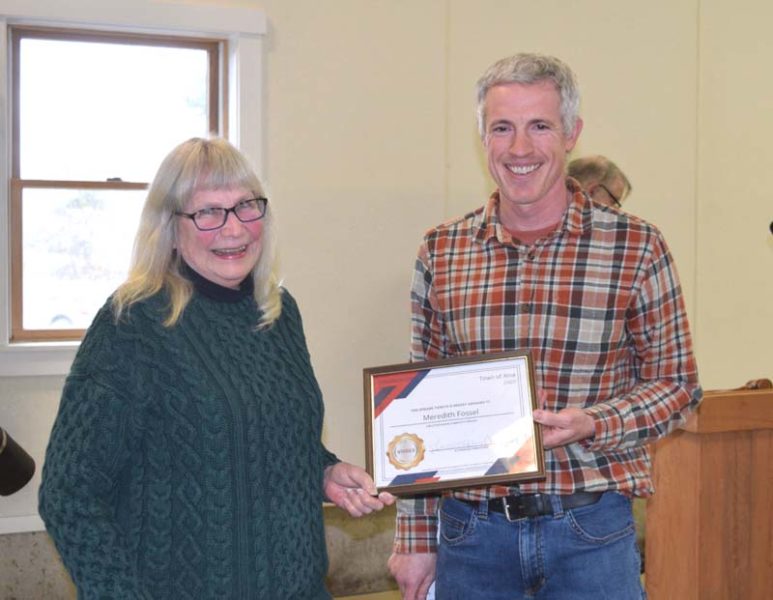
Alna First Selectperson Nick Johnston presents Mary Fossel with Alnas 2026 Spirit of America Award at the conclusion of Alnas annual town meeting on Saturday, March 21. Accepting the community service award, Fossel urged her fellow residents to get involved in their community. I keep volunteering, and I make a plug for everyone to volunteer, Fossel said. (Sherwood Olin photo)
Ultimately, the town of Alna quietly adopted a mining ordinance as proposed at their annual town meeting Saturday, March 21. Approved almost without opposition, the vote was a quiet, yet dramatic, conclusion to an issue that was a hot topic of debate following Alna’s annual town meeting in 2024.
That year a mining and blasting ordinance developed by the planning board was rejected after a heated debate. In the months that followed, town officials agreed to divide the failed mining and blasting ordinance into two parts and develop separate ordinances for each subject.
Following a contentious committee process that developed language over the course of 2024, Alna voters ultimately adopted the blasting ordinance at the annual town meeting in March 2025.
Developed by the select board over the course of 2025, the new mining ordinance codifies the standards foror quarrying operations in town and regulates the type, size, and manner of such operations in an effort to ease the impact on local residents and the environment.
In contrast, some of the most heated debate of the day focused on the adopting of a property tax assistance ordinance, which proposed creating a municipal tax credit program that would provide tax assistance in the form of supplemental cash refund payments to qualified Alna residents the ordinance and funding with $10,000 to assist low income homeowners with getting arrears on taxes.
While the consensus of comments unanimously lauded the concept of ordinance, there was significant opposition to the idea of adding to the tax burden to providing property tax relief.
Speaking for the proposed ordinance, Alna Third Selectperson Coreysha Lothrop described the measure “as a practical, locally controlled way to help all the residents who are feeling the strain of property taxes, especially those on fixed income.”
Lothrop said the ordinance builds directly on the state’s existing systems and only residents who already qualify for the state’s property tax fairness credit would be eligible. Participants in the programs are already qualified for reimbursement from the state and the town is simply matching whatever the state provides. Surrounding towns have had positive results with similar programs
The benefit is it would help keep longtime residents in their homes, Lothrop said.
“It’s a way for us to care for our community in a responsible manner where there are criteria that they have to comply with,” Lothrop said.
Informed by moderator Carl Pease the ordinance could only be voted up or down, but the dollar amount could be amended, Jeff Spinney motioned to amend the dollar amount to $10, saying giving to the fund should be voluntary. Spinney theatrically flashed a $20 bill and offered to walk up to Town Treasurer Amy Stockford and physically hand her a donation for the fund.
“I say we pass this ordinance, whatever it is and fund it in zero and let it be by donation only,” Spinney said. “And everyone that has spoken up in favor of this is more than welcome to take their money, their $15 or more … take that right over to Amy Stockford the town clerk and she will put this in the fund, and everyone will be happy.”
After Spinney’s initial motion was rejected, he motioned limit the appropriation amount to zero dollars. Before his motion could be seconded, another resident moved to call the question. Two-thirds of the body agreed and Pease immediately called the vote.
The article was adopted as written.
Among other articles, voters authorize the closing of a section of Egypt Road for up to 135 days in 2027 to allow for the replacement of the Ben Brook bridge and to give a right-of-way on Egypt Road to the state, and release the state from the requirement to have the of land surveyed in the process.
Commenting on the measure, Alna Second Selectperson Steve Graham indicated the amount of land involved was limited to the abutments on either end of the bridge.
Another flashpoint of debate was a $5,000 warrant article that would found the town animals control services. Stockford attributed the increase to the proposed contract costs from the Lincoln County Sheriff’s Office, which handle animals control issues for Alna.
The largest single expense on the warrant is a $350,000 article that would raise and appropriate funds for the town’s snow removal contract. The figure represents an increase of $25,000 or almost 8% over 2025.
Several voters complained about the quality of Alna’s roads compared to the surrounding towns. Alna Road Commissioner Mike Trask said the town’s plowing uses a mix of sand and salt and getting the mix right for the majority of the public’s satisfaction is an ongoing process.
“If you want to use raw salt, you just say so and we’ll do that,” Trask said. “But before, two years ago, we had complaints because we were using too much salt. So whatever the town wants to do, we’re happy to do, but we’re trying to get a happy medium.”
Before approving a warrant article appropriating $75,000 for a fire truck capital reserve account, voters about the status of the fire truck Alna voters agreed to purchase in 2025, appropriating $125,000 for the purpose.
Speaking in his role as Alna fire chief, Trask said the department was waiting for the manufacturer to purchase the chassis.
“We’re really just waiting at the moment, so we haven’t had to spend any money,” Trask said. “When they get ready and order the chassis and it is delivered to them, we will pay cash for the chassis. That will be paid for, and then we only have to pay for the truck the day we accept it. That’s when we’ll need the town’s money.”
Among other appropriation articles, voters approved a $127,440 budget for the Alna Volunteer Fire Department. The total is down $1,098 or just under 1% from last year.
With little discussion, voters will consider an $115,000 article funding the town’s solid waste disposal contract. The figure is a $10,000 or 8% decrease from 2025.
Voters also approved $125,000 warrant article funding the general highway maintenance account and agreed to raise and appropriate $145,945 for salaries and stipends. The figure is a $6,000 or 4% decrease from 2026, entirely due to a reduction in salaries paid to the town clerk/tax collector and deputy town clerk/tax collector.
Voters also authorized the appropriation of $60,000 to fund the town’s administration agreed to raise and appropriate $20,250 to fund tax assessment, commitment, and related expenses. The figure is a $4,000 or 16.5% reduction from the 2025 request, but this year’s request will be combined with $2,572 carryover.
Stockford told the voters the $1.3 million municipal budget as approved is down $22,000 this year compared to 2025.
In polling results from Friday March 19, all three candidates for municipal were reelected for municipal office unopposed.
Alna First Selectperson Nick Johnston was reelected to a two-year term on the select board, board of assessors, and overseers of the poor with 206 votes. Douglas Morier was returned to the RSU 12 Board of Directors for another three-year term with 221 votes. Trask was reelected as road commissioner for a one year term with 217 votes.

