

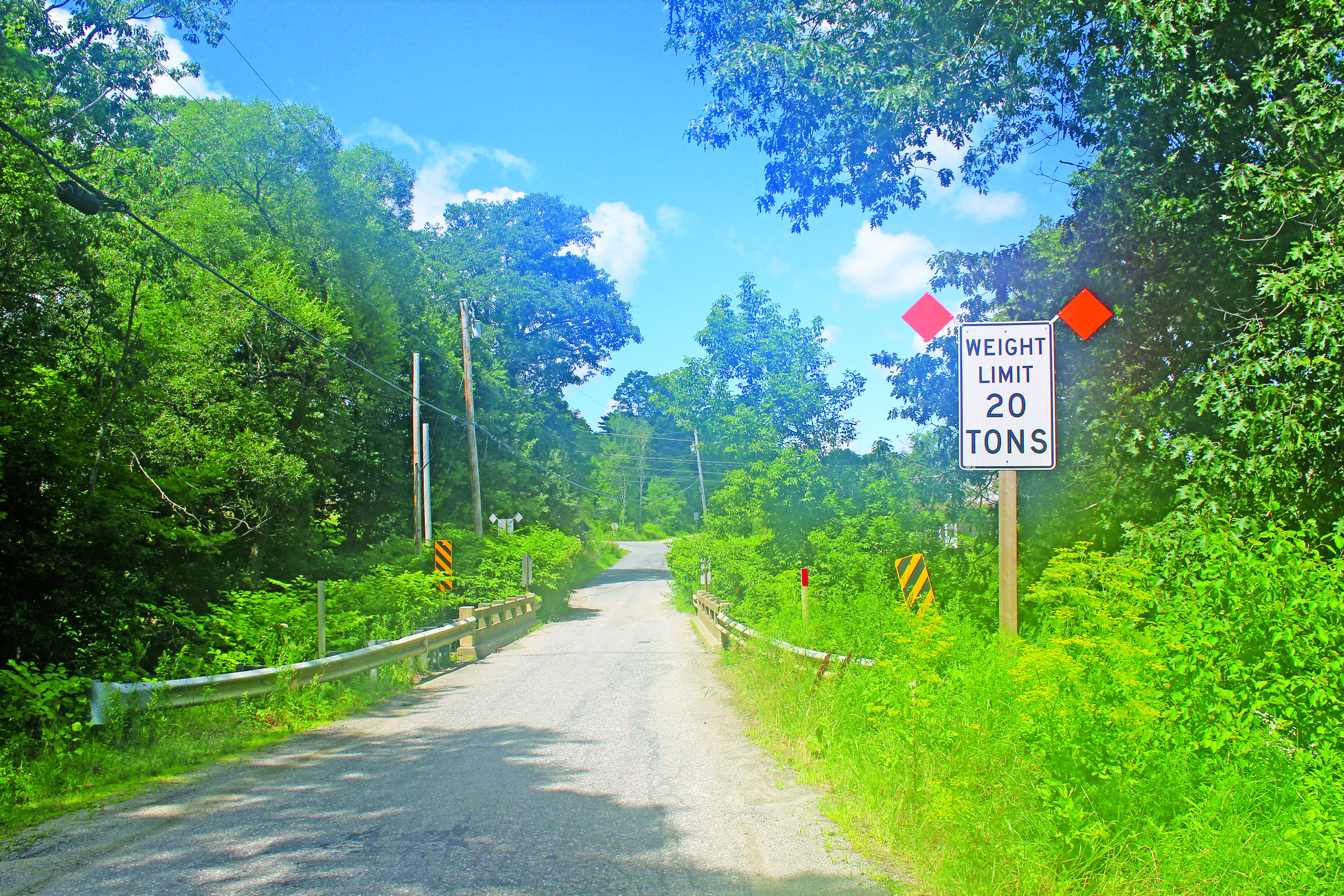
A sign proclaims a 20-ton limit on a Somerville Road bridge in Somerville on Monday, July 21. The bridge has been posted for months while another bridge at the road’s other end was posted by the state earlier this summer, leaving dozens of residents on the road in an “island” that heavy trucks, including some firefighting equipment, is not allowed to enter, according to Jefferson Fire Chief Darin Walker and Somerville Fire Chief Michael Dostie. (Molly Rains photo)
Posted weight limits on bridges at either end of a long stretch of Somerville Road have left upwards of 60 homes technically inaccessible to some firefighting vehicles.
This has left Somerville and Jefferson fire chiefs on edge, they said, and frustrated in attempts to get answers from the Maine Department of Transportation about where liability would fall should they need to cross either bridge with a heavy tanker in the event of a fire.
“Of course, we want to follow the guidelines, but as fire chiefs, it puts us in a terrible position. If somebody’s life is in jeopardy, we’re going to get there,” said Somerville Fire Chief Michael Dostie.
The two posted bridges on the road are located about 3.5 miles apart at either end of Long Pond, with about 60 homes between them, according to Dostie and Jefferson Fire Chief Darin Walker’s estimates.
On the Somerville end, a bridge just south of the junction of Somerville Road and Patricktown Road (Route 105) has been posted with a 20-ton limit since late 2024, according to Somerville Select Board Chair Willard Pierpont. The Maine Department of Transportation posted the weight limit on the bridge, he said.
On the Jefferson end of the road, the Maine Department of Transportation posted a 20-ton limit on a large culvert about 1.4 miles north of the intersection of Somerville Road and Rockland Road (Route 17). A letter from the Maine Department of Transportation, sent to the Jefferson town office and dated May 7, requests that the town post the signs “as soon as practical.” The letter also states the culvert, which the state referred to as a bridge because of its size, will be reevaluated and could face further restrictions.
Walker said he had reached a spokesperson at the Maine Department of Transportation’s bridge unit who said the culvert’s biannual inspection, completed most recently this spring, had triggered the posting.
A DOT representative will come to Jefferson to review the inspection report and help the town plan next steps to repair the culvert, Walker said. Such a repair may be possible without a 100% replacement of the culvert, he said.
Regarding responsibility for repairing the two bridges, the Jefferson culvert falls under the jurisdiction of the town, according to Jefferson Road Commissioner Wayne Johnston. Conversely, responsibility for repairing the Somerville bridge lies with the state, Pierpont said.
Based on his conversation with a DOT representative, Walker was not optimistic that the state would take steps to repair the bridge on the Somerville end of the road.
In a phone interview Tuesday, July 22, Maine Department of Transportation spokesperson Andy Gobeil said the department was in the process of gathering more information before responding to questions from The Lincoln County News about liability and the two bridges’ inspection histories.
Meanwhile, the result of these two postings is effectively an “island” where large trucks cannot travel, Walker said.
The 20-ton weight limit allows most of the Somerville and Jefferson fire departments’ vehicles to cross, but not all. Prohibited vehicles include one kind of vehicle Dostie and Walker said is especially important in the case of a structure fire: a large tanker truck fully loaded with water.
A tanker allows crews to transport water to the scene of a fire from water sources or hydrants at other locations nearby.
“We like to haul water from known sources where we know we have good, adequate water,” Walker said.
“Unfortunately, some of our trucks are over the weight limit, so they would have to dump some water out to make it across,” Dostie said. “You’re going to fight a fire; you don’t want to get rid of your water before you get there.”
Both Walker and Dostie asserted that they would remain committed to providing fire protection to homes across the posted bridges.
“If somebody’s house is on fire, I’m going to go,” Dostie said. “I’m not going to put people’s lives at risk.”
Dostie said he wanted to see the bridge on the Somerville end of the road moved up the Maine Department of Transportation’s list of priorities to recover access to the homes beyond it as soon as possible.
The chiefs said they were continuing to seek answers from the Maine Department of Transportation on matters including the question of who would bear liability for any damage to either of the posted bridges should their departments have to cross them during a fire or, alternatively, should a building in their towns burn down because posted limits prevented firefighters from bringing adequate water to the scene.
“We’re stuck between a rock and a hard place right now,” Walker said.

