

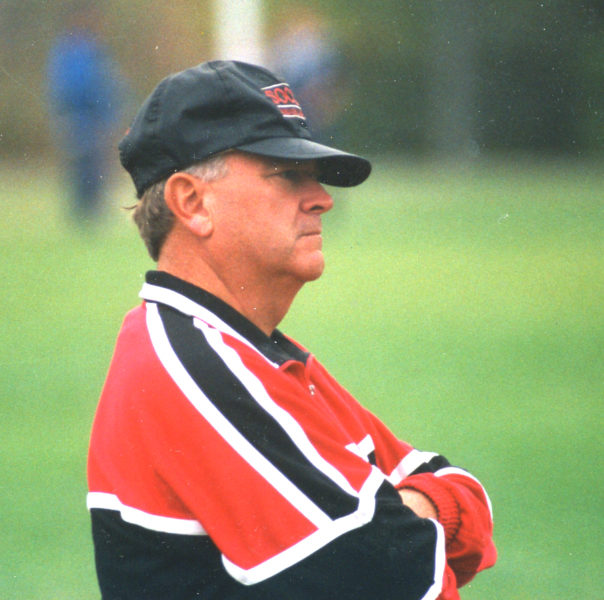
Beloved Wiscasset sports coach and teacher Bob Sommers watches soccer action during his coaching career. Sommers died Jan. 31 after a period of declining health. (LCN file)
Friends and family crowded into the Wiscasset Community Center on Saturday, Feb. 14 to celebrate the life of Robert “Bob” Sommers Jr.
Sommers, a fixture in Wiscasset education and athletics for 38 years, died in Damariscotta Jan. 31 after a period of declining health.
Although a sad occasion, according to some who attended the celebration, there was more than hint of a family reunion in the air as former teammates, classmates, and coworkers gathered together. In some cases, old friends hadn’t seen each other for years.
According to Diana Sommers, her late husband would have been delighted with the proceedings. Bob Sommers enjoyed few things more than friends coming together, sharing conversation, memories, and a few laughs.
“It was a service that he would have wanted because they got to touch base with each other and talk,” Diana Sommers said.
Born in Brunswick on Nov. 2, 1950, Robert “Bob” Sommers Jr. graduated from Freeport High School. He went on to earn a degree from the University of Maine at Presque Isle and a master’s degree in education from Leslie University before joining the faculty at the Wiscasset Elementary School as a fifth grade social studies teacher in 1974.
He moved on to teach the same subject at Wiscasset Middle School and later finished his career as an award-winning technology teacher at the Wiscasset Middle High School, where he worked under the direction of his wife, Wiscasset Schools Technology Director Diana Sommers.
Early converts to computers, Bob and Diana Sommers were considered pioneers in the state for their efforts to integrate technology in the classroom. In 2010, the couple received the John Lunt Friend of Technology Award from the Association of Computer Technology Educators of Maine, a group they coincidentally helped to form.
A avid golfer and a dedicated outdoorsman who loved to fish, Bob Sommers also coached Wiscasset boys and girls teams in basketball, baseball, and soccer at various times in his career.
As a coach he achieved his great success in soccer. He was two-time honoree as the Maine High School Soccer Coach of the Year, earning the award in 1990 and 1994, and leading the Wiscasset boys team to the 1994 Class C state title.
According to Diana Sommers, her husband was always trying to find a way to improve so he could help his students and his athletes improve.
“He just loved seeing people reach their potential and helping them to get there,” she said.
The Wiscasset boys went 16-1 during that 1994 campaign, finishing with three consecutive shutouts in the playoffs to secure Wiscasset’s fifth straight Mid Maine Conference title, its first West Class C title, and its first Class C state title. Bob Sommers, in his ninth year as head coach at the time, picked up his 100th win in the West C championship game as Wiscasset beat Dirigo 4-0 for the chance to play for the state title. In the title game, Wiscasset defeated East C winner Piscataquis, 4-0.
The same fall, the couple’s daughter, Samantha, won her third straight schoolgirl golf championship.
All told, Bob Sommers dedicated 38 years to the Wiscasset School Department before he retired in 2011. In retirement Sommers stayed active. He particularly enjoyed traveling to see his grandchildren play, whether it was in Chicago where Samantha lives and his granddaughter plays hockey on a travel team, or to the Ellsworth area, where his youngest daughter Megan lives and his grandchildren play basketball and baseball.
Throughout their 53-year marriage, it was rare occasion when Bob and Diana Sommers could go anywhere together and Bob wouldn’t find someone he knew, Diana Sommers said. In recent years, as Bob’s health declined, he accompanied Diana to the Wiscasset Community Center on Wednesday mornings where she would play pickleball and he would hold court with whoever stopped by to say hello.
“You couldn’t go anywhere without him knowing someone, whether it was in Virginia, or Florida,” Diana Sommers said. “Wherever he went, he knew somebody.”
Diana Sommers said the family, including daughters Samantha Sommers and Meagan Sommers Facciolo, have been touched by the outpouring of support they have received in the wake of Bob’s passing.
Former Wiscasset physical education teacher Sue Shorey joined the Wiscasset faculty in 1974. The two did not work together while teaching, but Shorey coached the junior varsity soccer team while Bob Sommers was the varsity coach.
“For three or four years I was actually his JV coach for soccer,” Shorey said. “I learned an awful lot when I was under him, about soccer – what to do, how to get to the kids. He was like a dad to a lot of these kids who needed little more structure in their lives and he served that purpose well.”
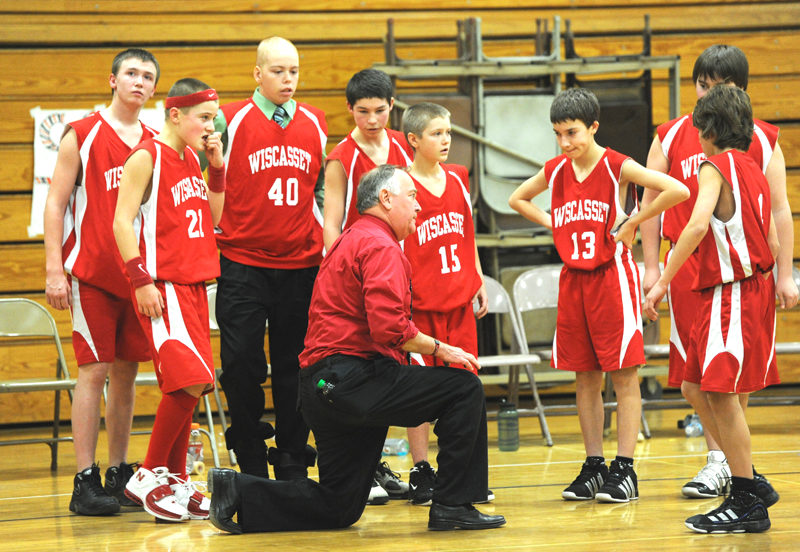
Bob Sommers gives instruction during a Wiscasset Middle High School basketball game. Sommers, who died Jan. 31, also coached soccer and baseball during his 38-year teaching career. Former players said Sommers asked a lot of them, but he knew how to connect with kids and was a paternal figure for generations of Wiscasset students. (LCN file)
According to men who played for him, Sommers had a way of making a connection with his charges. While he was known to raise his voice, and could appear intimidating, how much he cared was instantly obvious to anyone paying attention, according to Wiscasset resident Chris Cossette.
Cossette, a 1990 Wiscasset alum, played a good portion of his high school career under Sommers. Cossette went on to play and coach soccer at the University of Maine at Presque Isle and later returned to coach Wiscasset soccer. Throughout his playing and coaching career, he relied on guidance provided by Sommers.
“I leaned on him quite a bit when I started my coaching career in (the) middle school,” Cossette said. “Many Wednesday mornings I would meet him at the community center by the pickleball courts and I would pick his brain.”
According to Cossette, Sommers’ connection to his students transcended Wiscasset education. More than once Sommers made the trip to see Cossette play in college and he followed other Wiscasset graduates, too. It was always a treat running into Sommers because he seemed to track everybody and always knew what they were up to, Cossette said.
The summer of Cossette’s senior year, he shattered one of his arms during a soccer game. The injury was so severe, it ended his high school athletic career, as he was forced to sit out the entire school year. According to Cossette, after the game, Sommers and several teammates visited him in the hospital, and both Bob and Diana Sommers visited him again the next morning, following surgery on Cossette’s broken arm.
For the rest of the school year, Sommers took pains to make sure Cossette still felt like a member of the teams he coached.
“One of the biggest things I remember from his teaching in Wiscasset was the family atmosphere they had,” Cossette said. “That would just trickle down to the teams I was on. It didn’t matter if we played together. It didn’t matter how long it had been. We were all on the same team.”
While Sommers could be a demanding, intimidating type of coach, he obviously had a huge heart and he served a paternal role for many Wiscasset students who needed one, according to his players.
“He was going to push you,” Cossette said. “He was going to challenge you, but it was always with the biggest heart. He always wanted you to be the best person, the best athlete you could be.”
Keith Hunter, a 1993 Wiscasset graduate, echoed Cossette’s comments. Both Keith and his brother Jason Hunter played for Sommers. Keith Hunter called Sommers the best coach he ever had.
“There isn’t a guy on that team that wouldn’t do something for that man,” Hunter said “I think the biggest thing is he would push us all individually and push us to our max. He expected so much out of us and we wanted to please him. He was a great coach because he was that involved, all the time. He was always thinking of anything he could to make us better.”
No matter how far they traveled to a game, Hunter recalled Sommers would always stand up as the bus approached the destination, tell everybody to be quiet to visualize the game they were about play, and think about the plays they were going to make. The last few miles to the game were quiet time, Hunter said.
“He was much more than a coach,” Hunter said. “He was a second father to many kids. There were kids in our school that didn’t have their father there, around and he filled that void. He pushed us all to be better. You can’t ask for more that … He is going to be beyond missed. This is a hard one.”

