


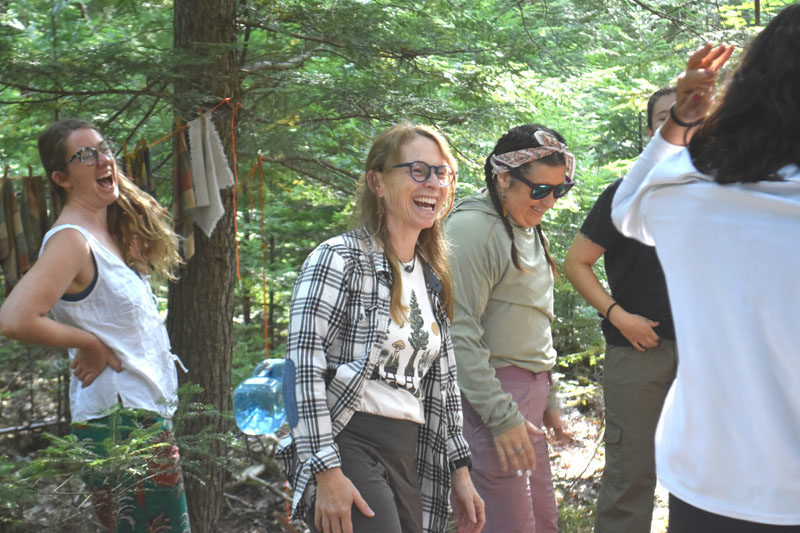
Susan Chlebowski (center) laughs with forest school participants on the morning of Friday, Aug. 15. Chlebowski welcomed accredited forest school instructors and educators to her Waldoboro property that week for an intensive workshop in outdoor education. Forest school, Chlebowski said, “is a chance for (children) to just be, to sink into their childhood and their own interests, and then have all the benefits of nature.” (Molly Rains photo)
Susan Chlebowski, of Waldoboro, believes there’s something essential missing from modern childhood: unstructured playtime in nature.
To help address that gap, she convened a group of educators in north Waldoboro this August to train in the European philosophy of “forest school.” For 10 days, trainees strategized ways to share the joy of nature with children, practiced implementing outdoor safety protocols, and – naturally – played a great deal themselves.
Forest school “is a chance for (children) to just be, to sink into their childhood and their own interests, and then have all the benefits of nature,” Chlebowski said.
The model is described as a child-centered “inspirational learning process” on the website of the Forest School Association, which licenses forest school instructors and programs in the United Kingdom. There, forest schools became a trend among other forms of “alternative education” in the 1990s and have since been established across the country, according to the site.
The model was inspired by Danish and other Scandinavian approaches to education, where free play and plenty of time outside are encouraged, Chlebowski said.
In her day-to-day life, Chlebowski works as a nature and play consultant, helping educators in the U.S. embrace outdoor learning and independence for children. Autonomy, she said, is beneficial to children’s ability to learn and stay engaged at school, but student agency is sometimes lacking in traditional classroom environments.
“We learn best, even as adults, when we have choice and some control over what we’re learning. Kids don’t get that anymore,” she said. “It’s all about letting the children guide what interests them, to explore, discover.”
In addition to emphasizing self-directed discovery, another idea at the heart of forest schooling philosophy is the belief that the woods themselves pose an ideal environment for healthy learning and play. This, in Chlebowski’s estimation, is another awareness missing from most conventional approaches to early childhood education in the United States.
“Teacher preparation programs, for early child care centers and schools, they don’t teach teachers this,” she said. “It’s such a valuable tool, but we tend to think all learning happens inside four walls, that they have to be sitting down and listening for real learning. And yet, this is the way humans have learned for 200,000 years.”
Chlebowski attended a forest school training in the United Kingdom in 2019. Ever since, she has dreamed of bringing the program to her own practice. The inaugural cohort that attended in-person training at Chlebowski’s property earlier this month was the realization of six years of planning, she said.
Attendees hailing from across New England as well as one from Virginia joined Chlebowski and two accredited Forest School Association trainers, Carol Middleton and Kate Poynter, both from the U.K. forest school Under the Hazels, for a total of 10 days.
Each day, the group modeled how they would guide children through a day of forest school, singing songs, making observations about nature and the forest, and embracing laughter and play.
Chlebowski said other similar trainings she had attended in the U.S. struck her as not rigorous enough to truly prepare teachers for the tall task of taking children outdoors safely.
As a result, safety practices – from establishing boundaries around the play area to guiding students through reasonable risk assessment and making shelters to protect the class from the elements – are a central part of Chlebowski’s training, she said.
This kind of preparation is crucial to empower teachers to actually put forest school ideas to use, according to Chlebowski.
“Imagine being a school teacher, traditionally trained, and somebody says, ‘Take your class of 20 kids out into the woods,’” she said.
That might seem like a tall task, she said, unless a teacher has been thoroughly trained and feels truly ready. In that case, the forest and all the opportunities it provides opens up before them and their students.
Trainee Dorothy “Dot” Sewall said she plans to put these lessons to use to found her own forest school in Jefferson, where she lives.
“I’m hoping that it brings the ability for children to get back out in nature and away from screens and brick buildings, and the knowledge for parents, too – giving them the knowledge of things they can do with their children in nature. I think that’s sort of lacking,” she said.
Chlebowski hopes to host future forest school trainings at her Waldoboro property in years to come. She and her husband are constructing a lodge on their land, where Chlebowski will host future workshops in outdoor education and her husband will host pig butchery classes, she said.
Ultimately, she hopes to see the population of knowledgeable, highly trained forest school educators in the United States continue to grow.
Having a connection with nature “heals” children, she said, and time spent outdoors has been shown to combat health challenges like myopia and obesity, both of which are rising among children in the U.S.
Furthermore, the ability to feel comfortable and safe outdoors is a lifelong gift, Chlebowski said.
“They have it throughout the rest of their lives – it’s always there for them,” she said. “Maybe, because they had time in nature (as children), when they get stressed as an adult, they’ll remember that they can go back, and that it heals us.”
Another benefit of forest school, Chlebowski hopes, might be a society that is better prepared to steward the natural world.
“They need time in nature to grow up and appreciate it,” she said. “If we eliminate that from children’s lives, we won’t have as many environmental stewards later on. Because you have to love a place before you can care for it, and I think that’s what forest school does.”
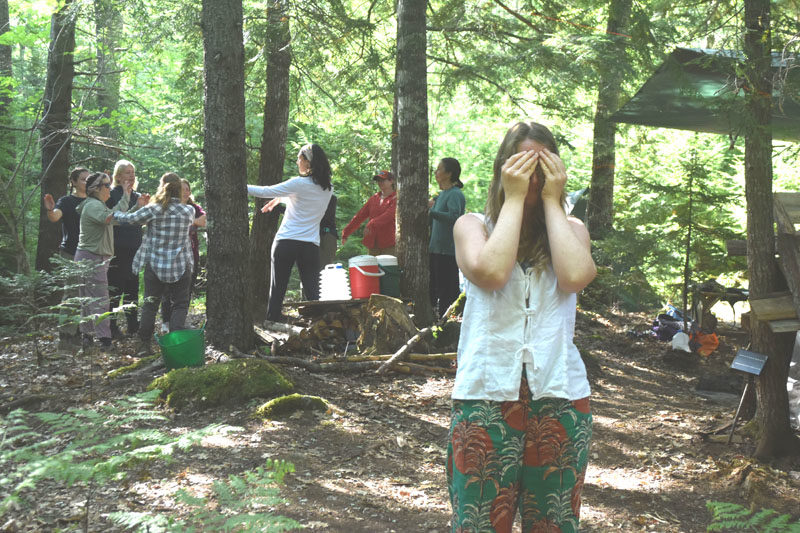
Caitlin Hill covers her eyes during a round of “Cuckoo Bee,” a nature game, among educators and instructors attending Susan Chlebowski’s forest school training session on Friday, Aug. 15. For 10 days, participants learned skills from knot tying to outdoor gameplay and ways to ensure students are safe while playing and discovering joy outdoors. (Molly Rains photo)

