


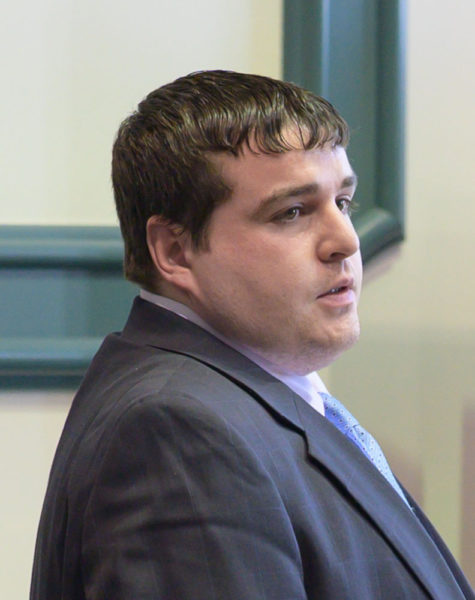
Tyler Witham-Jordan stands at the defendants table at the Sagadahoc County Superior Court in Bath on Feb. 26. Witham-Jordan was found guilty for depraved indifference murder on Tuesday, March 3 and awaits sentencing. (Bisi Cameron Yee photo)
Tyler Witham-Jordan has been found guilty of depraved indifference murder in the December 2022 death of 3-year-old Makinzlee Handrahan of Edgecomb.
The nine-day trial at the Sagadahoc County Superior Court ended Tuesday, March 3 as a jury of eight men and four women delivered their verdict after less than a day of deliberation.
They were handed the case at 12:30 p.m. on Monday, March 2 and returned the verdict at 10 a.m. the following day.
In Maine, depraved indifference murder is charged when an individual “engages in conduct that manifests a depraved indifference to the value of human life and that in fact causes the death of another human being.” It carries a minimum sentence of 25 years and a maximum sentence of life imprisonment.
As previously reported in The Lincoln County News, emergency medical services were first called to the home Makinzlee shared with her mother Faith Lewis, two half-siblings, and Witham-Jordan off Route 1 in Edgecomb after the 3-year-old was discovered unresponsive in her bed the morning of Dec. 25, 2022. After determining the child was deceased, her body was transported to MaineHealth Lincoln Hospital’s Miles Campus in Damariscotta.
An autopsy the following day identified extensive bruising on the girl’s body, abrasions on her face, and internal bleeding in her skull and abdomen. Maine Deputy Chief Medical Examiner Dr. Liam Funte determined the cause of death was “homicide caused by nonaccidental blunt force trauma.”
Witham-Jordan was arrested in connection with her death in October 2023.
A December 2024 trial at the Lincoln County Superior Court in Wiscasset was declared a mistrial following an emotional courtroom outburst by Lewis. The case was subsequently moved to Sagadahoc County and began Feb. 17.
During the first day of testimony, members of the Central Lincoln County Ambulance Service described a volatile scene at the Edgecomb apartment. Service Chief Nicholas Bryant said he observed bruises on Makinzlee’s face and torso and was concerned by the level of agitation exhibited by Witham-Jordan. Paramedic Jerrad Dinsmore said they realized very quickly that it was a potential crime scene.
Members of the Maine State Police Evidence Response Team testified about items collected from the apartment’s upstairs bathroom, the adult bedroom, and Makinzlee’s room.
In the bathroom they found evidence of blood on the floor and walls. They found tissues, a towel, and a T-shirt with red-brown staining that indicated the possible presence of blood. They found a pull-up diaper with red-brown staining in the trashcan and the broken handle of a hair brush on the bathroom floor. The head of the hairbrush was in the trashcan with a large clump of hair tangled in the bristles.
In the adult bedroom they collected a cloth with red-brown staining and a Vtech baby monitor.
From Makinzlee’s bedroom they collected clothing and bedding with red-brown staining and an adult hat and sunglasses that was found between the wall and the mattress of the bottom bunk where she died.
Forensic chemist Alison Gingras confirmed the presence of Makinzlee’s blood on the pull-up diaper and on the sheets and pillow of her bed. According to Gingras, microscopic analysis of the hair in the hairbrush indicated that it had been forcefully removed from Makinzlee’s scalp
DNA analyst Catharine MacMillan confirmed the presence of Witham-Jordan’s DNA on the diaper and on the handle of the hairbrush and said that Lewis’ DNA was excluded.
Antwan Gildersleeve, of Lewiston, testified in the early hours of Saturday, Dec. 24, Witham-Jordan texted him seeking drugs.
After a mid-morning trip to Brunswick with Lewis and the three kids to pick up the drugs, Witham-Jordan texted Gildersleeve that he was unhappy with the eight-ball of crack cocaine Gildersleeve sold him. Gildersleeve made arrangements to bring another eight-ball to the Edgecomb apartment later that day.
A neighbor, Adam Newton, testified that Witham-Jordan also purchased Adderall from him that afternoon.
Both Gildersleeve and Newton were granted immunity for their testimony.
When Lewis took the stand she confirmed the Brunswick trip. Upon returning to the Edgecomb apartment, Lewis said Witham-Jordan put Makinzlee, who wasn’t feeling well, down for a nap. Lewis had been diagnosed with the flu that Thursday and went upstairs shortly after that to lie down. She never saw her daughter alive again.
She testified that she checked in with Witham-Jordan multiple times, asking how Makinzlee was doing and he assured her that everything was fine.
“I trusted him. I thought I could believe what he said,” Lewis said.
After Lewis completed her testimony the state presented the forensic details of their case.
Funte gave the jury a detailed description of the injuries to Makinzlee’s body, which included numerous bruises, broken ribs, and lacerations to her pancreas, liver, and mesentery. He testified that she died approximately 12-24 hours prior to being found and that her injuries could not have been inflicted by a person under the age of 12.
Dawn Ego, of the Maine State Police Computer Crimes Unit, performed a forensic examination of Witham-Jordan’s iPhone and Lewis’ Google Pixel phone. She extracted numerous text and Facebook Messenger messages as well as usage information from both phones. Her examination indicated that an app for the baby monitor was launched more than 30 times between noon and 5:30 p.m. on Christmas Eve.
Detective Corporal David Powser, of the Maine State Police Major Crimes Unit, read a summary of the hundreds of calls, text messages, Facebook Messenger messages, and video calls made by Witham-Jordan and Lewis that started just after midnight on Dec. 24 and continued into Christmas Day, establishing a communication timeline of events for the jury.
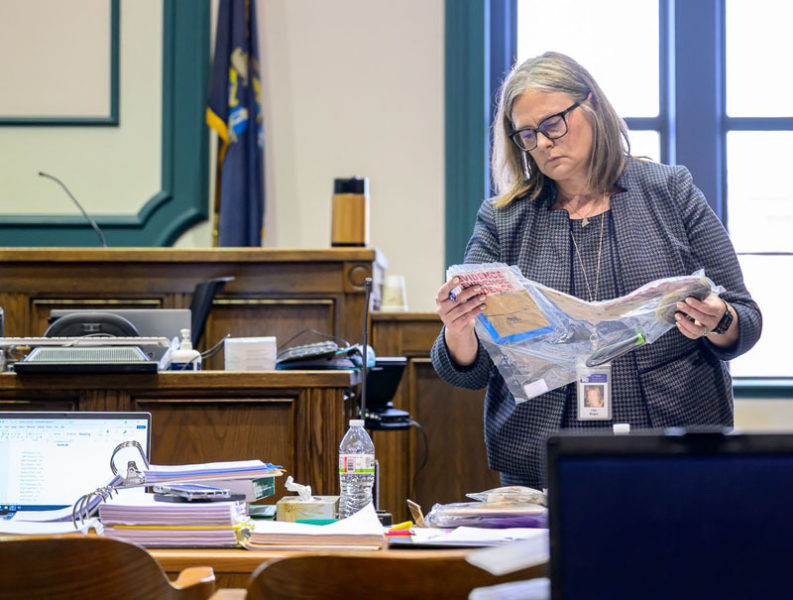
Deputy Attorney General Lisa Bogue holds an evidence bag containing a broken hairbrush at the Sagadahoc County Courthouse in Bath on Feb. 17. The hair brush was a critical component of the prosecutions case in the trial of Tyler Witham-Jordan who was found guilty for the murder of a 3-year-old Edgecomb girl. (Bisi Cameron Yee photo)
The state also presented audio and video evidence including body-cam footage, the entirety of the 911 call, and several taped interviews the police conducted with Witham-Jordan.
After the prosecution called their last witness the defense offered two additional expert witnesses to testify about the forensic and DNA evidence.
Dr. Kirk Christensen, a forensic pathologist, said he had no disagreement with Funte’s findings from the autopsy. He did note that the injuries to Makinzlee would not be expected to be immediately lethal and that she could have been injured prior to the 24-hour period estimated as the approximate time of her death.
“Sometimes death can occur days after an injury,” he said.
Rick Staub, a forensic DNA consultant, testified about the limitations of DNA analysis, noting that a lack of DNA does not necessarily exclude a person from having touched evidence.
In her closing statement, Assistant Attorney General Jennifer Ackerman described Makinzlee as a young girl with “blonde hair and bright blue eyes” who liked Cocomelon, “Peppa Pig,” and Hello Kitty and who was excited that Santa was coming.
“Sadly, as you know, she did not make it to Christmas morning,” Ackerman said.
According to Ackerman, Witham-Jordan was experiencing a number of stressors in the days and weeks leading up to the murder: the upcoming holiday; caring for all four kids while Lewis had the flu; being “flat broke” and behind on child support payments; and he was and out of the Suboxone strips he used to treat an opioid addiction.
“His short fuse was burning and 27-pound Makinzlee was at the end of that short fuse,” Ackerman said.
She led the jury through the evidence presented by detectives and forensic experts and pointed out inconsistencies in Witham-Jordan’s statements to police.
Ackerman reviewed the extensive text chains that chronicled the days around Makinzlee’s death, highlighting two in particular.
The first, from Dec. 20, depicted a man near the end of his rope.
“I’m not going to Christmas. I’m not going to work. I’m sleeping the rest of this horrible shitty week away,” he texted Lewis. “Kinz is so sick … I don’t even want to be near her. She’s so (expletive) sick. She’s literally spreading it all over that house … It’s just turned to a hellish week and I’m done with it completely.”
The second text was sent at 4:32 p.m. on Christmas Eve.
“I love you with all my heart and soul. I’m very aware that I’ve been very agitated, grouchy, short-fused the past week,” Witham Jordan texted Lewis. “I’ve never in my life wanted to die or be gone. Never. But the past few weeks I feel hopeless. I feel weak. I feel like I’m a failure. No matter how hard I work, no matter how hard I try.”
Ackerman suggested that the second text was sent after he inflicted the injuries that would end Makinzlee’s life.
“What caused him to send that text message to Faith Lewis? Seemingly out of the blue?” she asked the jury. “What happened in that apartment that was so bad, so terrible, that he reached out to Faith Lewis and he said he didn’t want to live anymore?”
Defense attorney James Howaniec accused the prosecution of “picking and choosing” evidence. He described an overly aggressive prosecutor and a police investigation that developed a narrative focused solely on the defendant that did not admit other theories of the crime.
“If they want to talk about inconsistencies, we’re going to talk about Faith,” he said.
He offered Lewis as an alternate suspect, reminding the jury that she was depressed, she had stopped taking her prescribed mood stabilizers, and she had talked about hearing voices in the weeks before the murder.
He mentioned that when the baby monitor alerted Lewis to a drop in temperature in her daughter’s room she adjusted the thermostat but did not cross the hall to see if Makinzlee was okay.
“Come on Faith! Walk 10 feet!” Howaniec said.
He also pointed out a text message from 2:30 am on Dec. 25 in which Lewis, who was laying in bed upstairs, asked Witham-Jordan, who was smoking outside the apartment, to check on Makinzlee.
“I’m worried about Kinz. She has never slept this long and every time I check the camera, she’s the same way,” Lewis texted Witham-Jordan. “Are we sure she’s good? She’s still breathing? Like what if she’s so sick that she doesn’t wake up? I’m literally going crazy.”
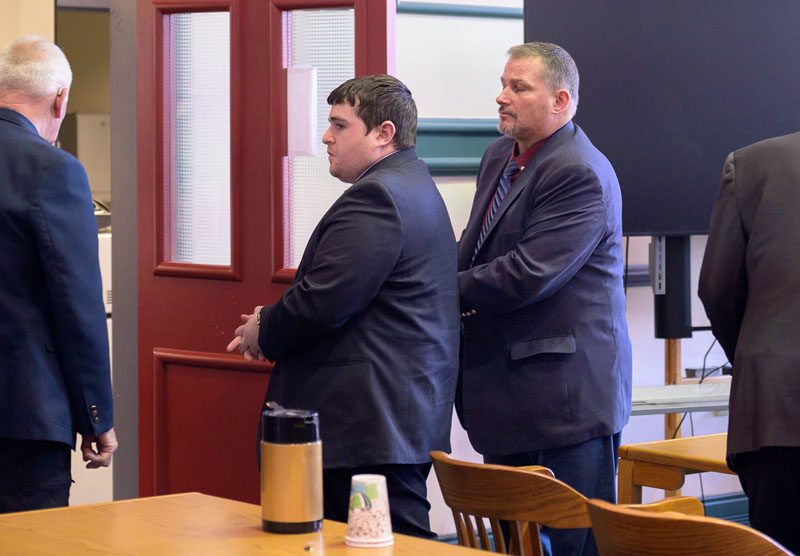
Tyler Witham-Jordan glances toward family members as he is led out of the courtroom in handcuffs after being found guilty of murder at the Sagadahoc County Courthouse in Bath on Tuesday, March 3. (Bisi Cameron Yee photo)
It had been more than 14 hours since she had seen Makinzlee. When asked why she did not check on her daughter herself, Lewis responded “I wish I had. I trusted Tyler and I was a little lazy at that minute, I can admit.”
“If you remember nothing else,” Howaniec told the jury, “remember we do not have to prove Faith harmed her daughter. The entire burden is on the state.”
Howaniec brought up potentially exculpatory evidence, including the diaper Makinzlee was wearing when she died and the fan in her bedroom that had been turned on high next to an open window on a chilly December night. Those items were not collected at the scene nor were they tested for fingerprints, blood, or DNA.
Howaniec said the prosecution presented evidence that had no bearing on the case, including a tissue with blood from one of the boy’s nosebleeds and the fact that sperm cells were found on an adult T–shirt. There was no evidence of sperm found in the sexual assault kit collected by the medical examiner’s office or on Makinzlee’s body or the pull-up diaper found at the scene.
In her rebuttal Ackerman defended the investigation by the Maine State Police, contrasting their thoroughness with the defense’s DNA expert who did not bring “one piece of paper” with him to testify.
She reminded the jury that Lewis was not accused of committing a crime.
“You might not agree with her decisions made that day,” Ackerman said. “But she is not on trial.”
Family members of Makinzlee, including Lewis, were in the gallery for the delivery of the verdict. Lewis said she was happy the truth came out.
“They got the right one,” she said.
Deputy Attorney General Lisa Bogue praised the investigation by the Maine State Police and the evidence gathered.
“We’ve worked hard to present it to this jury and we are very happy with the result,” she said. “Obviously the cases where children are hurt are the most difficult for us so we’re happy that we have justice for Makinzlee.”
A sentencing date has not yet been scheduled.
(Bisi Cameron Yee is a freelance photojournalist and reporter based in Nobleboro. To contact her, email cameronyeephotography@gmail.com.)

