


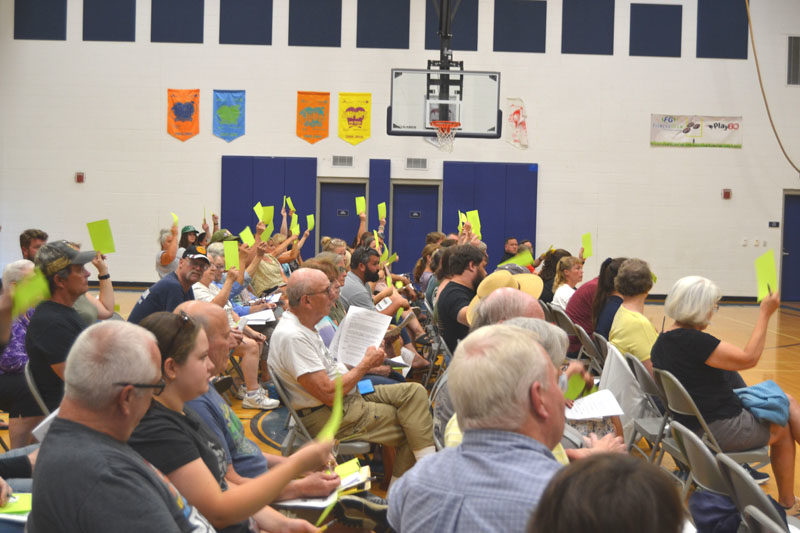
Jefferson residents vote to approve a new, higher education budget after the previous budget did not receive validation at the polls during a special town meeting on Wednesday, July 9. During the two-hour meeting, residents expressed concern about the $10 million budget while addressing the legal obligation to provide education to students. (Christina Wallace photo)
Jefferson residents approved a new, higher education budget during a Tuesday, July 9 special town meeting after rejecting a previous version of the budget at the polls in June.
The budget totals $10,044,358.24, an increase of $1,493,961.66 or 17.47% over last year’s budget. The new, approved budget is $280,552.86 or 2.9% higher than the amount voters approved at a special town meeting but failed to validate by a two-vote margin earlier this year.
According to Jefferson School Committee Chair Danielle Bernier, the increase in the budget is due to a higher percentage of incoming kindergarteners being indentified as having special needs and a staffing shortage, causing Jefferson Village School to have to outsource services for special education students that it would otherwise provide in house.
“The inability to find, hire, and retain staff not only disrupts student learning, but also undermines the stability and effectiveness of Jefferson Village School,” Bernier said at the beginning of the July 9 meeting. “As a result of not being able to hire qualified staff, we’ve been forced into a situation where we need to contract services, such as occupational therapy and speech therapy at a much higher cost, and in some situations, more than double what it would cost if we were able to have a qualified person on staff.”
The new budget will allocate $150,000 per student with special needs to help pay for these services.
According to AOS 93 Director of Special Education Dominic DePatsy, 67% of this year’s incoming kindergarten class has been identified as having special needs. The exact cause of this increase is unknown, but Executive Director of Finance and Operations Peter Nielsen said there is a “national statistical increase” in special needs following the COVID-19 pandemic.
Most of the conversation during the two-hour meeting centered on residents’ concerns on the increase in the budget and the amount taxpayers will owe.
Lisa Hodgkins, a member of the Jefferson Budget Committee, spoke in opposition to the proposed budget. At a joint meeting of the budget committee and Jefferson School Committee on June 26, Hodgkins was the only budget committee member present to vote in opposition to the total budget increase.
“I know it’s state mandated, I understand that, but I think as a town I felt compelled to stand up and say no as my own protest,” Hodgkins said, “because I do not agree with this budget. It is incredibly high.”
Alpha Williams, another member of the budget committee, brought up concerns over how the increased budget will impact students at home.
“How is that going to affect the kids in other ways?” Williams said. “When they get that increase in their tax bill, maybe their rent goes up because the landlord has to pay more in taxes. Maybe they can’t afford other things, food, fuel, oil.”
Others spoke in favor of the budget, addressing the towns need to provide adequate education to students.
“I know the special education budget has gone up considerably, but we have to remember that legally, the special education budget has to be met,” resident and educator Paula Schuster said. “If this budget is not passed, that money will be coming out of the regular education lines, which directly affects many more students.”
Schuster said that Jefferson could pursue the option of joining an education service center in the next school year. Education service centers are an organizational model permitted by the Maine Department of Education that allow member schools to share some services and employees, according to the department’s website.
Nielsen and DePatsy said at the June 26 budget committee and school committee meeting that a local education service center would be one option to help alleviate some staff and service shortages.
The Jefferson and Nobleboro school committees, as well as the Great Salt Bay School Committee previously voted against creating a seven-member education service center to share some services in fall 2024. Bristol and South Bristol tabled the discussion at the time.
“Jefferson is not the only school with these issues,” said Schuster. “This may allow schools to purchase programming for special education and others as a shared cost with other schools in the AOS… joining an ESC may allow for portions of our budget to be paid by the state, not the town.”
Bernier said the Jefferson School Committee had removed the assistant principal position, reduced one bus driver position and associated fuel costs, and decreased the maintenance and facility lines by about $57,000 to try to offset the cost of the budget during budget talks earlier this year.
Residents will have another chance to weigh in on the $10 million figure when they consider whether to validate the budget on Tuesday, Aug. 12 at Jefferson Village School. Polls will be open from 8 a.m. to 8 p.m. For more information, go to aos93.org/o/jvs or call 506-3044.
(Correction: An earlier version of this article online and on page one of the July 17, 2025 edition incorrectly identified Jefferson resident and current Nobleboro Central School third grade teacher Paula Schuster as “former educator Bella Schuster.” The Lincoln County News regrets this error.)

