


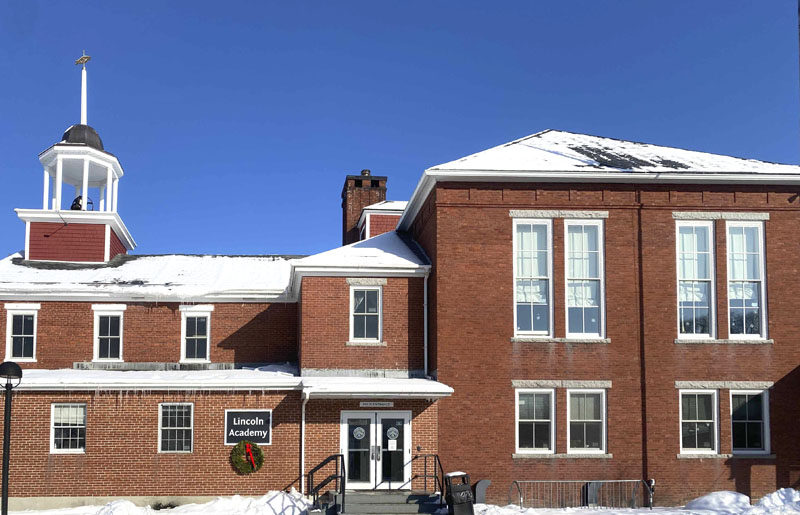
Lincoln Academy in Newcastle. The school is celebrating its 225th anniversary this year, making it the fourth oldest secondary school in the Maine. (Photo courtesy Jenny Mayher)
Lincoln Academy is celebrating its 225th anniversary this year, making it one of the oldest secondary schools in Maine.
Since Feb. 23, 1801, the Newcastle school has grown exponentially in all areas. Over two centuries, it has overcome fires, survived world conflicts, and has welcomed students from around the world. Some students who walk the halls today have parents and grandparents who also attended Lincoln Academy.
“It’s a remarkable statistic, that the school has been here this long,” said Jeffrey Burroughs, Lincoln Academy’s 44th and current head of school.
While the school is not hosting any festivities for this anniversary, LA Communications Director Jenny Mayher said there is discussion about republishing an updated history on the academy that would pick up from the 2001 publication “Lincoln Academy: A History 1801-2001.” The book recalls the history of the academy since its founding and takes a look at the people, places, and things of every decade.
In the past 25 years since the publication was released, Lincoln Academy has gone through even more changes. Some of the most notable, according to Mayher, include the building of the Alumni Dining Commons and the science wing in the early 2000s.
Mayher said the strength of the performing arts program is also something of note, the school’s one-act play winning numerous regional championships over the years. In 2024, the bell tower was refurbished.
“I think one of my favorite things that we talk about a lot in our admissions process and with our alumni, is this idea that the community has trusted Lincoln Academy for such a long time to educate young people,” Mayher said.
One of the biggest transitions Lincoln Academy has made is the introduction of its residential program in 2013, Mayher said. Kiah Bayley Hall, named after one of the 13 original trustees of the school in 1801, houses students from around the country and world.
Mayher said the introduction of international students has broadened the school’s perspective on the world and themselves.
“Having international students in the room has really impacted us in every possible way,” Mayher said.
Phil Page, often referred to as “the spirit of Lincoln Academy,” technically retired in 2025, but continues to stay involved with the school because of the tradition and history behind it. Page graduated from Lincoln Academy in 1970 and taught and coached at the school for 40 years.
To keep those traditions alive and to remember the history, Lincoln Academy often hosts trivia with questions about the school.
“When it comes to a school with so much history as ours, with our alumni banquets and other alumni activities, we get followed more closely than I would think you might find in public school settings,” Page said.
The Newcastle Historical Society houses thousands of photos of LA facilities, students, and faculty dating back to the 1800s.
Karen Paz, a volunteer with the historical society, graduated from Lincoln Academy in 1978. She started volunteering with the historical society because of her love and appreciation for history.
“I really enjoyed it. It was a nice school,” Paz said. “Now I live in Newcastle, so I really feel how much the school’s intertwined with the community here, the history of it.”
“Lincoln Academy: A History” tells the story of the school from 1800-2001. In 1800, the first petition to start Lincoln Academy was draft by Samuel Nickels, who in order to show his commitment to opening the school, made a $100 contribution, the equivalent of $2,572.40 today. In 1801, the school was officially chartered by the General Court of Massachusetts.
One hundred and seventy-eight people from Newcastle, Bristol, Wiscasset, Boothbay, Nobleboro, Alna, Thomaston, Georgetown, and Edgecomb came up with $3,123 – equivalent to $94,601.22 today – for a land endowment to start the construction of the school.
On Oct. 1, 1805, Lincoln Academy opened on River Road in Newcastle. Seventy-four students were enrolled during the first school year. Both men and women were allowed to attend.
In 1828, a fire burned down the school. After moving locations, a new building was built on what is historically known as Academy Hill. Today, the same two-story building with a bell tower remains the center of campus.
The Civil War drastically decreased student enrollment as older males were sent to fight and younger ones were left to pick up the work at home. Enrollment spiked once the war ended.
The first formal graduation ceremony was held in 1878. In previous years, students would just go on with their life after the last day of school. According to “Lincoln Academy: A History 1801-2001,” this shift in tradition marked a major milestone for the academy as it broadened its courses, extracurricular offerings, and more.
In 1894, the Lincoln Academy Alumni Association was created. George Larrabee, who served as head of school from 1895-1908, is credited with the construction of the three-story annex to the main building in June 1897. By the 18th century and Lincoln Academy’s 100th anniversary, Larrabee estimated around 4,000 students had attended the school since its founding.
“But apart from the special honors which may have been won, it is to the great mass, of average men and women who have, by the purity of their lives, by their adapting themselves to their surroundings, made themselves of value to the world and have proved the right of the Academy to exists,” Larrabee said during the centennial celebration, according to the book.
In 1903, Maine issued a mandate stating towns must pay the tuition to secondary schools, which led to the increase in enrollment.
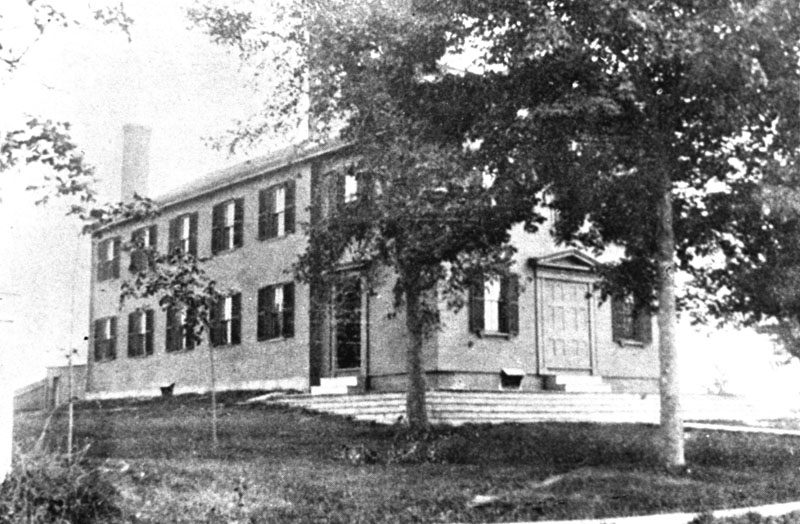
Lincoln Academy in 1890. This year, the school is celebrating its 225th anniversary, making it the fourth oldest secondary school in Maine. (Photo courtesy Newcastle Historical Societys Dinsmore-Flye Collection)
The 1921 boys basketball team won the Knox-Lincoln championship for the first time and then went on to win the state championship. With so much attention on sports, the students came up with the idea to build a gymnasium so they could move practices from a study hall in the main building. Throughout the early half of the 1920s, each class worked together to raise $20,000 for the construction of a gym, which would be completed in 1925.
Girls basketball will go on to win the state championship in 1938 and track and cross country will win in 1934-1935. A school newspaper, the Lincolnette, is started in 1930.
Lincoln Academy was also a part of the New England College Entrance Certificate Board, which was where affiliated schools would admit Lincoln Academy graduates if they had a letter signed by the head of school. In 1941, the school received charter for the National Honor Society.
Lincoln Academy celebrated its 150th anniversary in 1951 with a congratulatory messages, dedications to the original trustees and speeches by alumni. A few years later, 1955 marked the sesquintennial since classes actually started, so the school celebrated again and introduced a course on Lincoln Academy’s history.
The purchase of Hall House in 1951 continued the school’s expansion streak. A new wing was added to the main building in 1953, which was the first major renovation to the building since the annex was added in 1897.
“The new classrooms are so big and airy that some of our classes are lost in them,” a student wrote in the Lincolnian yearbook in 1953. “The sound of the new bell makes us jump.”
The first foreign exchange student arrived in 1961 from Finland and the first Lincoln Academy student studied aboard in Denmark.
The introduction of the television in classrooms sparked interest in national news, especially the Civil Rights Movement. A new wing is built in the main building in 1961 and the Col. Stanley G. Waltz athletic field was built in 1966, as was a new gym.
Lincoln Academy went from having 300 student and 20 faculty members in 1970 to 550 students and 40 faculty members in 1980.
The first color television and video tape recorder was purchased in 1980. The first computer was bought in 1982 and in 1987, class schedules and grades were digitized. In 1992, the library collection was computerized and computer literacy became a requirement to graduate. A health center was built in 1995 as the school continued to physically grow.
The 200th anniversary of the school was celebrated by the gathering of a team of faculty to research and piece together the school’s history to write “Lincoln Academy: A History,” so that students, staff, alumni, and the community had the opportunity to learn more about the school that had stood there for so long.
As the school continues to grow, Burroughs said that he hopes to see a future that is financially stable, secure, and sustainable. He said that he doesn’t see the student population growing any more, but that he does expect to see the evolution of education practices such as the shift toward an applied learning approach.
“We’re going to try to be the best stewards we can of the institution and make sure it’s here for the next generation,” Burroughs said.

