

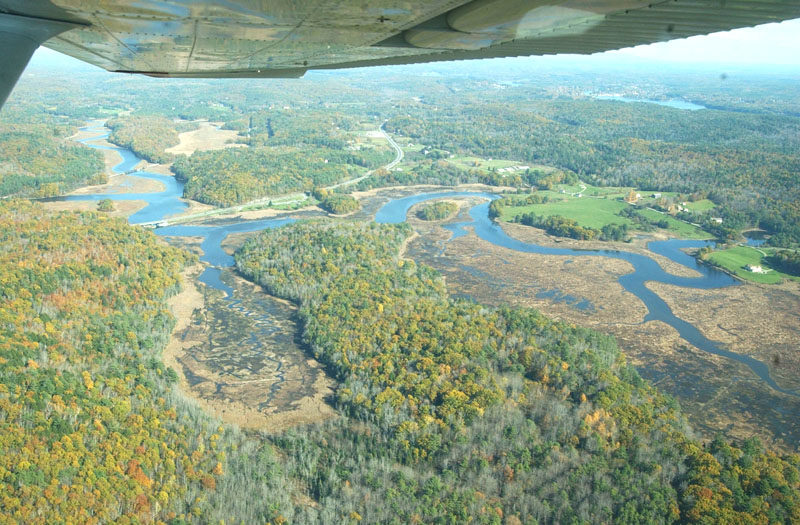
The full 200-plus acre Sherman Marsh can be seen in this aerial photo from 2008. In the weeks that followed the October 2005 storm that washed away Sherman Lake, locals debated the pros and cons of reestablishing the man-made lake. In late January 2006, the Maine Department of Transportation announced the state would not rebuild the dam, allowing the marsh to return to its natural state. (Courtesy photo) condition
Twenty years ago this week, heavy rains from a weekend storm swept away an earthen dam in Newcastle, destroying Sherman Lake and creating the conditions for Sherman Marsh to thrive.
According to The Lincoln County News archives, rainfall during the “Columbus Day Storm” over Oct. 9-10, 2005 flooded, damaged, or closed more than 150 roads across Lincoln County, inundated a pump station on Birch Point Road in Wiscasset, and caused debris to block a culvert on West Alna Road, flooding several acres of land. Newcastle-based National Weather Observer Arlene Cole reported more than seven inches of rain fell over the course of the 2005 Columbus Day weekend.
The heavy rainfall raised the level of Sherman Lake until the water breached a levee built on the top of the old roadway in 1934. Sherman Lake landowners went to bed Sunday night owning lakeside property and woke up Monday morning without a lake.
According to Richard Newkirk, of the Maine Department of Transportation Environmental Office, the washout “left a hole big enough for a truck to drive through.”
Melissa Temple, of Woolwich, was working as a dispatcher in the Lincoln County Communications Center when she first heard about the lost lake.
On his way in to work as a reserve deputy with the Lincoln County Sheriff’s Office, Temple’s brother Michael Elwell noticed the missing lake and called the communications center. Temple had traveled the same route on her way to work a little earlier.
“I had just gotten to work that morning but I guess it was too dark to see anything,” Temple said. “He said ‘What happened to Sherman Lake?’ and I’m like ‘What are you talking about?’ ‘It’s gone!’ I started thinking what about the security of the road. Did it wash out anything underneath? I said ‘This is not going to be good’ so I paged everyone.”
According to The Lincoln County News front page story Oct. 13, 2005, “Lincoln County rises to meet flood damage,” state, county, and local officials acted quickly after the washout was discovered. In the days immediately following the storm, Maine Department of Transportation engineers and workers imported stones, rip rap, and earth to backfill the area around the piles supporting the Route 1 bridge by the rest area.
DOT engineers quickly determined the Route 1 bridge was not in imminent danger and state and county officials assured the public the bridge was safe for vehicular travel.
“There is no danger at all,” said then-Lincoln County Emergency Management Agency Director Tim Pellerin. “It is 100% safe, but they don’t want to leave it the way it is.”
Citing the DOT’s report to him, Pellerin said concerns about the concrete pier caps and piles holding up the bridge were unfounded. “They go 40 feet underground to bedrock, and it is very stable,” he said.
The following week, meeting with the Lincoln County Board of Commissioners Oct. 13, Pellerin reported estimated damages from flooded and damaged roads and property amounted to $250,000.
Pellerin noted the cost estimate did not include state roads or Wiscasset’s pump station. According to Pellerin’s accounting, the Columbus Day storm flooded 96 roads, closed 33 others, and damaged 28 more.
“We received 13.1 inches of rain within nine days,” Pellerin said.
In the weeks that followed the October storm, Newcastle residents debated the pros and cons of rebuilding the dam at a series of public hearings, meetings, and letters to the editor.
After extensive study and analysis conducted by DOT’s Environmental Office, on Jan. 31, 2006, then-DOT Commissioner David Cole announced the state would not rebuild the dam that would restore the lake. Instead, the department would work with public and private agencies to restore the area as a tidal salt marsh.
Cole said environmental and budgetary considerations weighed heavily in the decision, noting the dam had ceased to serve its transportation purpose since the existing Route 1 highway and bridge were built above the dam structure in the 1960s.
“The environmental arguments are overwhelmingly in favor of not rebuilding, and instead, support marsh restoration,” Cole said. “Furthermore, from a budget perspective, dam reconstruction is significantly more expensive than other options and would likely have to come entirely from state funds.”
In his announcement, Cole acknowledged the strong attachments to the lake by area residents.
“A healthy salt marsh, while not a replacement for Sherman Lake, brings many positive benefits to the site,” he said.
Asked if the DOT’s announcement would be the final word on the subject, then-Newcastle Board of Selectmen Chair Lee Straw said concerned citizens would have to get involved to “push the issue” further.
“I don’t think that the selectmen are going to go for that and I really think if it went to a town vote, that people would say to leave it as it is,” Straw said. “Originally, I heard from so many people who were in favor of restoring the lake, and now that’s kind of shifted, and now I’m hearing that people want to just leave it as it is. They’re saying, ‘We don’t want to spend tax dollars.’”
In June 2008, addressing the quarterly meeting of the Sheepscot River Watershed Council, researchers from the University of Southern Maine Aquatic Systems Group reported the loss of the lake resulted in significant changes in vegetation and physical and hydrologic conditions.
Karen Wilson, who holds a doctorate in liminology/zoology, commented on a dramatic shift she observed between the time of her first visit to the site in June 2006, when she saw acres of mud, and the following September, when she saw evidence of “phenomenal revegetation.”
Grasses blanketed the channel edge and exposure to sun and air encouraged the mostly freshwater plants to grow, Wilson said.
“They were there waiting under the water,” Wilson said.
(This article incorporates the work of former LCN reporters Greg Foster, Kim Fletcher, Judi Finn, and Lucy Martin.)

