

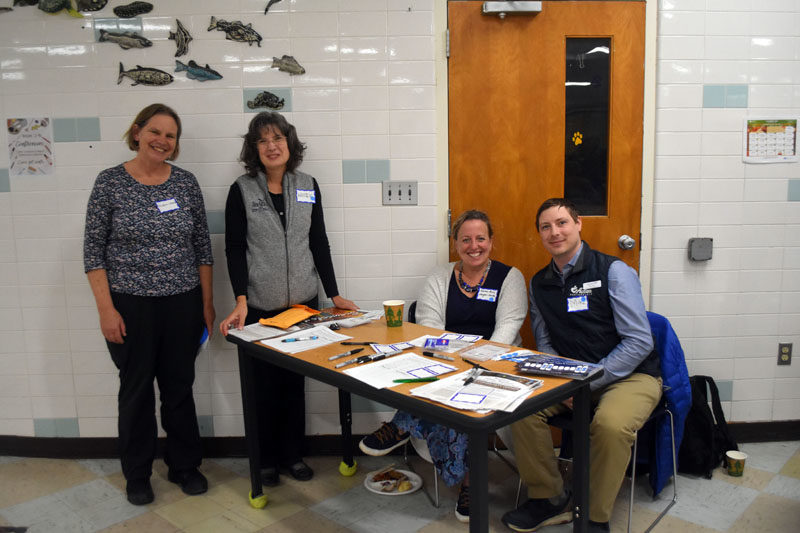
From left: Eileen Johnson, of Bowdoin College; Kristen Grant, of Maine Sea Grant; Karen-Ann Hagar-Smith, Lincoln County’s community navigator; and Michael Pepin, of Midcoast Maine Community Action, greet community members arriving for a free dinner at Medomak Valley High School in Waldoboro on Nov. 14. During the dinner, attendees and discussion facilitators recalled their experiences during last winter’s damaging storms and brainstormed ideas to make Lincoln County more resilient to severe weather events. (Molly Rains photo)
Lincoln County must fortify not only its roads and bridges but also its networks of community support in order to best prepare for future storms, according to researchers and county officials.
In an initiative deemed the Lincoln County Social Resilience Project, county and municipal leadership and emergency service providers joined researchers from Bowdoin College and the University of Maine’s Maine Sea Grant this fall to discuss the impacts of severe weather events across the county.
The talks confirmed that a spectrum of factors make storms a unique challenge for every resident – but also suggested that Lincoln County’s preexisting community networks are assets that could be better leveraged in the future to help all residents weather severe weather events more successfully, the researchers said.
“The intersectionality of different issues exacerbates the impacts of some of these storm events,” said Emily Rabbe, executive director of the Lincoln County Regional Planning Commission.
With Kristen Grant, of Maine Sea Grant; and Eileen Johnson, of Bowdoin College; Rabbe and other community leaders convened this fall to explore the different social issues that compound the effects of winter storms through an initiative deemed the Lincoln County Social Resilience Project.
The project falls under the umbrella of the Midcoast-wide Social Resilience Project, through which Grant, Johnson, community leaders, and student researchers have worked to assess the impacts of severe storms across the region. In an earlier installment of the project, the team assessed the vulnerability of the southern Midcoast – encompassing Harpswell, Georgetown, Bath, Brunswick, and surrounding communities — to severe weather, like storms and flooding.
To consider the effects of storms, Grant and Johnson assess communities through a factor they refer to as “social vulnerability:” the way that social factors – including age, socioeconomic status, minority status, and more, impact residents’ abilities to cope with disaster events differently.
Thinking about storm resilience this way, Grant said, opens discussion up to a facet of disaster response that is often overlooked.
“So much of the resilience work that has happened in the past has focused on physical vulnerability … but when you focus first and foremost on the infrastructure, then you miss that social piece,” she said. “What we’re trying to do is take that step back, and understand the needs and assets and impacts on people (from severe storms).”
When Maine Sea Grant approached the Lincoln County Regional Planning Commission about the social resilience project, which began in fall 2023, the mission aligned well with the commission’s existing efforts to prepare for severe weather events, Rabbe said.
“We’re seeing them happen more frequently, and they seem to be more intense,” she said.
As a land use planner, Rabbe welcomed the opportunity to take a broader approach to considering the effects of storms – and how the county can take steps to mitigate them.
“We were really interested. We saw (the project) as a way to take what we’ve heard anecdotally and what we’ve been doing … and take it a step further by focusing on infrastructure – not just physical, but social – and make sure we’re helping our community members prepare for, and weather, storms,” she said.
On Nov. 14, the project advisory committee invited residents to a community dinner at Medomak Valley High School to gather insight on the effects of severe storms. Also present were representative service providers, like Lincoln County Emergency Management Agency, who took the opportunity to get to know residents and hear concerns.
Attendees discussed effects from the back-to-back storms that hit Maine in January, causing severe damage countywide from storm surge, flooding, and power outages that, for many, stretched for days. They also talked about the impacts of other storms, from the lower-grade but more frequent effects of less severe winter storms to autumn wind storms that can down trees and challenge farmers during a crucial time of year, said Rabbe.
The community dinner yielded insight into the diversity of residents’ storm experiences and the potential impacts of severe weather, said Johnson.
“The depth of the conversations was beyond anything I had imagined,” Grant said.
Much of the discussion from the community dinner fit with the team’s understanding of how social factors impact storm response. For some residents, advanced age made cleaning up and recovering from storm damage extremely daunting; for others, the loss of a freezer-full of food during a power outage was a significant financial blow. Many experienced social isolation, compounded by trees downed in roadways and lack of power, phone, and internet.
After the dinner, facilitators compiled a list of the major themes that emerged through the discussion. Ranging from the challenge of power outages to food insecurity, economic and educational disruptions, and difficulty accessing medical care, the themes encompass how severe storms are felt throughout the community in ways far beyond simple damage to infrastructure.
Another theme that emerged, however, was more positive: many stories emphasized the importance of community amidst disaster, said Johnson. Neighbors and community members, she said, played essential roles in helping one another cope, whether they were helping share information and resources or helping with tasks some residents couldn’t undertake on their own.
“In Maine, we’re really lucky. People really do want to help. It’s a culture of volunteerism in a way that some places are not. It’s an amazing asset,” Grant said.
The team brought the major themes from the community dinner to a workshop on Dec. 10 with 40 municipal leaders from throughout the county, including select board members and county officials. The group considered nine major themes from the dinner, working collaboratively to prioritize them and discuss possible measures for socially informed mitigation.
Attendees, working in small groups, identified power outages as a major priority to tackle when coping with storms, said Grant. However, others, argued that those on the ground can do very little to remedy power outages but wait on utilities. Instead, these groups chose to prioritize tasks they could take on themselves: communication, cross-sector collaboration, and social network building.
Grant said this reprioritization emphasized how community network-building can immediately improve local ability to respond to severe weather emergencies and other dire events.
“Communication and network-building – those are actions that people at the table could actually take. If you build those, that communication and those networks, then when the power goes out, those impacts could be lessened,” Grant said.
Later, the leaders discussed next steps for community preparedness in light of those priorities. One of the key themes that emerged, Grant said, was the importance of fortifying Lincoln County’s network of volunteers.
“The volunteer capacity is under-utilized,” she said.
In the wake of the workshop, community leaders will continue to mull over the findings. Now that the research phase is complete, next steps lie with community leaders, said Grant.
Rabbe said the Lincoln County Regional Planning Commission hopes to translate the outcome of the social resilience project into improved storm preparedness.
“For me, I look at this exercise as almost a comprehensive plan,” she said. “What I am excited about is to take what comes out of this, these proposed actions and priorities, and say, how do we start implementing this?”
Rabbe pointed to the county’s hazard mitigation plan, which the county will begin the process of updating in 2025, as one place where the takeaways from the Lincoln County Social Resilience Project will be implemented.
“There is so much information to take from the work that’s been done,” she said, “through the Social Resilience Project, and embed it in the hazard mitigation plan, and keep that framework in mind as we’re working with communities.”
As a first step, elevating the stories of community members and bringing residents forward to share their experiences was rewarding and has proven valuable to understanding the scope of winter storms, Grant said.
The Social Resilience Project Advisory Committee also hopes the project will help inform discussions in other regions of Maine, where similar factors – like long peninsulas with single access roads, rural communities, and aging populations – make storms particularly threatening for the same reasons they are in Lincoln County.
“Our hope is that there are lessons learned for other areas of Maine, other areas that are grappling with the same things,” Johnson said.
To learn more about the Social Resilience Project, go to bit.ly/LCSocialResilience

