

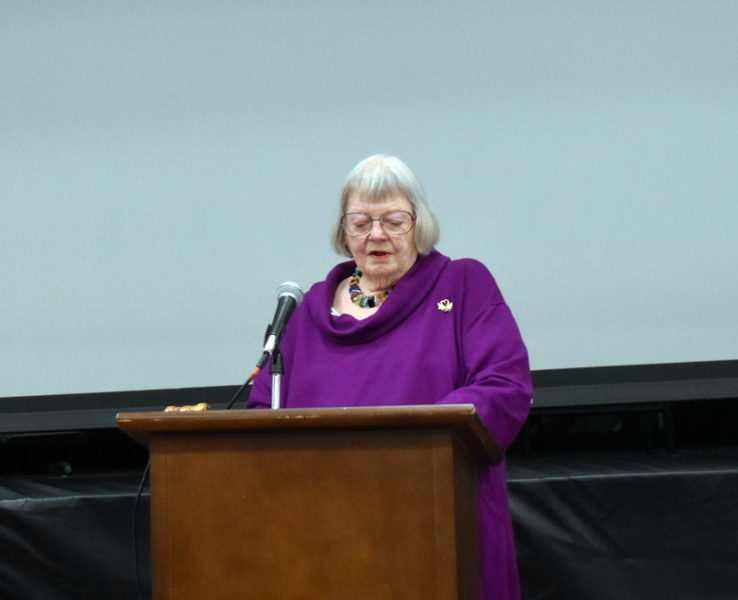
Moderator Susan Blagdon addresses Wiscasset residents during a special town meeting to consider the town’s education budget on Tuesday, April 29. Voters ultimately passed the budget as recommended by the school committee at a total of $10,896,270. (Molly Rains photo)
Wiscasset residents debated and ultimately passed a $10,896,270.38 education budget over the course of three hours on Tuesday, April 29.
The budget represents an increase of $323,267.81 or 3.06% over last year. As proposed and approved, the budget was recommended by a 3-2 vote of the Wiscasset School Committee in March, with members Victoria Hugo-Vidal, Jodi Hardwick, and Chair Jason Putnam voting in favor and when committee members Jonathan Barnes and Tracey Whitney against.
About 100 residents gathered at Wiscasset Middle High School to consider the budget April 29.
The budget as a whole accounts for an expansion in early childhood education, including by beginning to offer special education services for 3- and 4-year-old students through public schools next year. This is in line with a mandate from the governor for schools to assume care of such students in the coming years, Wiscasset School Department Superintendent Kim Andersson said.
Much of the cost for that development is offset by state funding, according to Andersson, who added that investing in early childhood education is shown to decrease special education costs down the line.
“We are emphasizing growth in the early childhood education area because we understand that early intervention will reduce costs for special education as soon as by second or third grade,” she said.
Wiscasset resident and former state Rep. Edward Polewarczyk said he questioned whether the town had enough skilled professionals to staff an expanded early childhood program. Andersson responded that the school already had staff in house qualified to do so.
The first budget category discussed, regular instruction, totaled $3,679,773, an increase of $181,656 or 5.19% over last year.
This includes a rise in staff salaries due to a collective bargaining agreement and insurance costs, according to Andersson.
Polewarczyk proposed reducing this line item to $3,600,000, saying that total was how much he believed the town was on track to spend this year. However, the amendment failed after a counted vote of 61-29.
Another resident, Richard Lutes, proposed another amendment to decrease the budget further, to a total of $3,279,772, to remove what he said were line items that were not accounted for. This amendment also failed.
Wiscasset Select Board member Terry Heller called the question, and a vote proceeded; the regular instruction budget line passed as written at a total of $3,679,773.
The next budget category considered was special education, totaling $2,548,057, a decrease of $10,231 or 0.40% from last year.
Andrea Lovell, Wiscasset School Department’s director of special education, said the number of students forecasted to need services next year was an estimate based on current levels and a standard of about 25-29% of Wiscasset students requiring special education services.
The special education budget passed as proposed.
Voters also passed Article 4, approving the expenditure of $0 for career and technical education. The state directly funds career and technical education and vocational programming at Bath Regional Career and Technical Center for Wiscasset students.
Article 5, the budget for other instruction – which includes extracurricular activities, alternative education, and education for students for whom English is not a first language – totaled $395,622, an increase of $17,041 or 4.50%.
Lutes proposed decreasing the amount to $200,000, suggesting that parents could be required to bear the cost of sports participation for their children. The motion did not receive a second, and the other instruction budget line passed as recommended.
The budget line for student and staff support, totaling $799,381, a $29,035 or 3.77% increase, passed as recommended with no discussion.
When discussing the system administration budget, which encompasses salaries and benefits for administrators as well as insurance, legal fees, dues, human resources, and audit expenses, Polewarczyk made a motion to remove the superintendent’s salary from the total. He said he wanted the committee to reevaluate this total.
Andersson is currently in her first year of a five-year contract. In response to a question from Wiscasset resident and Lincoln County Commissioner Evan Goodkowsky, school committee members confirmed that the district could face civil liability for violating that contract. Maine statutes describe the role of a superintendent and stipulate that it is among a school board’s mandated duties to select and appoint that role.
“I’m a reasonable person, and I love this town. You have to have a superintendent by law,” Andersson said.
This amendment failed and the budget line for system administration, totaling $514,879, passed.
Other line items passed by voters included $647,885 for school administration, an increase of $105,479 or 19.45% reflecting the addition of an administrator.
The transportation and buses line of $710,012, a decrease of $22,591 or 3.08%, also passed, as did the budget for facilities and maintenance, which totals $1,532,662, a decrease of $16,683 or 1.07% due to a retirement.
The funds to be raised by taxpayers total $7,111,823, an increase of $309,098 or 4.54% from last year.
The meeting adjourned at about 9 p.m.
Voters will be asked to validate the budget at Wiscasset’s annual town meeting by referendum, which is set for Tuesday, June 10.

