


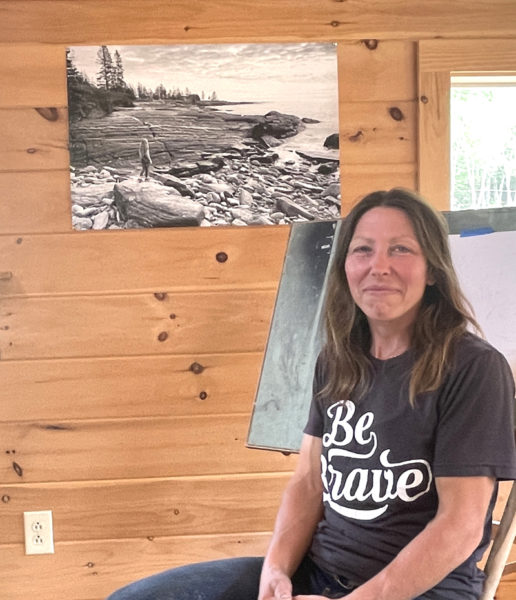
Jen Casad sits in a small artist studio on her property behind her home in Pemaquid. Casad shares her home with her husband and daughter, two horses, two cats, one bunny, and 20 chickens. In the winter when shellfish harvesting slows down, she focuses on her art and homeschooling her daughter, Elizabeth. (Sherwood Olin photo)
Jennifer Casad is a slender pillar of muscle and bone. Veins bulge from her rippling forearms, which meld into impressive biceps that pop and flex as she excitedly punctuates her conversation with calloused hands.
“They are not very feminine,” she said with a laugh.
A mother, noted artist, and fulltime shellfish harvester, Casad has made a living on Lincoln County’s mudflats ever since she was a teenager. Digging for clams is hard work, and Casad remains one of the few women to work in the overwhelmingly male-dominated industry.
Casad said she more or less fell into shellfish harvesting as a teenager when her boyfriend at the time introduced her to the profession. Born in Damariscotta, she moved to South Bristol in 1994 while still in high school and needed a means of supporting herself. She started out picking snails and discovered she could make more money working for herself than she could with the retail job she had at the time.
“I moved out when I was relatively young, because my mother and I didn’t get along that well,” Casad said. “I got emancipated at 16. My dad that raised me didn’t have legal rights, so I went to court. They were having a custody battle … So things are pretty rugged between my mother and I.”
Casad’s parents came to Maine from California and Washington state to buy a boat, an 80-footer that was one of the remnants of the sardine fleet once owned by R.J. Peacock Canning Co. The couple sailed the boat up and down the Maine coast, eventually tying up at Junior Farrin’s dock in South Bristol when Casad’s mother was expecting.
“My biological father had an art studio on the boat, and so fishing and art have always been a combination,” she said. “My grandmother in Seattle went on her honeymoon fishing in Alaska for salmon with her husband. So it just seems like it’s part of our family, or just passed down; something you turn to that works together well.”
At her then-boyfriend’s suggestion she obtained a clamming license at the Damariscotta town office. Back then, available licenses were sold on a first-come, first-served basis, requiring Casad to line up at 4 a.m. in order to obtain one, she said.
After graduating from Lincoln Academy in 1996, she ended up making enough to support herself through college. She received a Bachelor of Arts in art from the University of Maine Augusta in 2003. Different from a Bachelor of Fine Arts, the degree still required Casad to take every available course in the art department.
“It gave you a great rounding,” she said. “Like, you did the sculpture. You did the photography. You did drawing. You did painting. You did printmaking, clay, and I found that the drawing and the photography were so wonderfully combined.”
In 2002, the summer before her senior year of college, Casad spent the summer working on a fishing boat in Alaska. That trip was a turning point for her as it prompted her to reexamine her perception of the world.
“After going to Alaska, I thought of people more in relationship to the working class and in nature,” she said. “Like how do we, as fishermen, respect and try to take care of what we have? How can we give back?”
Following this epiphany, her art evolved as she started incorporating more people into her images and began focusing on hand-drawing historical photos. Casad described her art style as photo realism. It is a very time-consuming process, she said, comparing it to an office job.
“I am not very good at sitting,” she said. “I like to be outdoors.”
After she injured her shoulder in a car accident in 2003, Casad took a break from shellfish harvesting to take a job as a “sternlady,” working for South Bristol lobsterman David Rice. She figured lobster fishing would be easier on her shoulder, which it was, but after a while she started digging when she could. She completed her apprenticeship in 2006 and applied for a commercial lobster fishing license.
In 2007, Casad moved to Boothbay, buying a house on her own but sharing it with the man who would become her daughter’s father in 2012. Casad embraced sobriety as an expectant mother and, within a year of welcoming baby Elizabeth into the world, she realized her child needed sober parents.
“You can be a functioning alcoholic, right?” Casad said. “You can work very well; make ends meet and do what you’re supposed to do and function as an alcoholic … You can do fine, but I didn’t want her to grow up in kind of like a hippie situation. My parents were hippies and that was a long party and I wanted to be sober.”
Casad and Elizabeth’s father differed in their views of sobriety and parenthood. Very quickly Casad was raising her daughter as a single mother.
Although the Boothbay mudflats were very productive, Casad didn’t particularly care for living in Boothbay and the end of her relationship was as a good reason as any to leave. She sold her home and returned to the Bristol peninsula to spend a few years finding places to stay and supporting herself and Elizabeth as best she could.
One of the few bright spots to living in Boothbay for Casad was meeting documentary filmmaker Sharon Lockhart in 2009. Lockhart, who was in Boothbay to work on her movie “Lunch Break,” kept hearing about Casad from locals, but nobody could tell Lockhart where Casad lived.
“She was actually staying across the street from where I was, and she saw me get out of my truck with my hip boots on,” Casad said. “’Excuse me. Are you Jennifer?’ … She kind of had me do, like a little skit for her ‘Lunch Break’ thing and I’m like, ‘Sharon, I don’t eat lunch. I go clamming.’ She’s like, ‘Can’t you eat some cookies or a cracker or something?’”
The result of that meeting was the 2009 Lockhart film “Double Tide.” A double tide refers to conditions that allow for two low tides during daylight hours, allowing two opportunities to dig. The 99–minute, dialogue-free film shows Casad hard at work on the flats during a double tide day.
“That was basically me working at Seal Cove,” Casad said “We did like a week of filming, and it came out in a 99-minute real-time movie, half shot in the morning with this beautiful gray, black-and-white light and half in the evening with the sunset and the house.”
Lockhart took the film and some of Casad’s art along with it around the world. Casad made appearances at showings at the Museum of Modern Art in New York City, the Hammer Museum in Los Angeles, Harvard University, and Internationale Filmfestspiele Berlin in Germany.
At a showing at Colby College in Waterville, Casad’s art hung in a gallery next to works by Louise Nevelson, Alex Katz, James Whistler, and Andrew Wyeth, an experience she described as “unreal.”
Through the showing at Colby College, Casad met a New York art dealer who set her up for her own show in New York City.
“Two weeks before I had Elizabeth, I had a show in New York City,” Casad said. “It was awesome. Then I had a baby (and) I was off the radar.”
In 2014, Casad received her lobster fishing license, having been on the waiting list for seven years. Before long Casad had bought a skiff and was hauling 60 traps, taking her toddler with her. After one stressful, financially unsuccessful season, Casad went back to clamming full time.
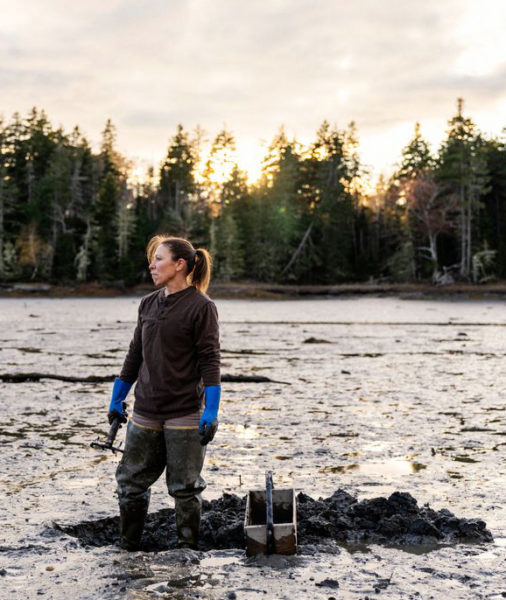
Jen Casad pauses to catch her breath while working in School House Cove in Bristol in 2024. Casad has worked for herself digging for clams on Lincoln Countys mudflats since she was a teenager. (Photo courtesy Tara Rice)
She eventually sold the skiff to fund a successful legal effort to secure sole parental rights. She loved lobster fishing and hoped to get back to it someday, she said. As it turned out, someday arrived in 2024 with the man who became her husband, Troy Lasselle.
“The skiff was sold and I had no idea how I was ever going to reinvest,” Casad said. “I thought maybe when she’s 12 or 13, we’ll buy another boat and go lobstering together. I still wasn’t sure how to do it. And then, you know, it’s almost like God put this silver fisherman on my doorstep.”
Lasselle had stopped by Casad’s home in Pemaquid to ask about the local markets. Besides the looks and charm, one of the things caught Casad’s attention was LaSalle’s mention of his own sobriety. In her experience, eligible, sober commercial fishermen are rare. That meeting turned into a series of early morning coffee dates before Lasselle popped the real question.
“We had coffee at like 5 in the morning forever, and then he said, ‘Do you want to go fishing?’ and I did, yes!” she said, giggling.
The two quickly invested in a boat together, a wooden 34-footer named Y-Knot and began fishing out of New Harbor and later South Bristol. They married in a small ceremony at Pemaquid Point on May 8.
Buying the boat, Casad said, was a surefire sign of commitment.
“Once you bought the boat, it was kind of like the ring before the ring,” she said.
Today, Casad’s home in Pemaquid is located about five minutes from nearby clam flats where she digs regularly. She homeschools her daughter, who has grown into a precocious 12-year-old exhibiting her mother’s artistic talents. In 2024, mother and daughter collaborated on an exhibition of their work at Badhus Co., a gallery in Rockland.
Casad’s work is currently on display at the Blue Raven Gallery, at 374 Main St. in Rockland, and available on the gallery’s website, blueravengallery.com.
Between lobster fishing, clamdigging, homeschooling, and motherhood, there is always something to do, Casad said. In good weather, she works nonstop seven days a week to satisfy her wholesale and retail shellfish clients. Summer is the time of plenty, she said, but there plenty of winter days when there is no money to be made. Winter is a good time to focus on her artwork, she said.
She hasn’t gotten around to adopting her husband’s name only because they have been too busy fishing, she said.
“If I am not out clamming, then we’re lobstering, then we’re clamming, so there really isn’t a day off,” she said. “It’s just you’re making two or three times what you make in the winter, so you have to do it now. There are definitely days off, but I never want to leave fishing.”
(Do you have a suggestion for a “Characters of the County” subject? Email info@lcnme.com with the subject line “Characters of the County” with the name and contact information of your nominee.)

