

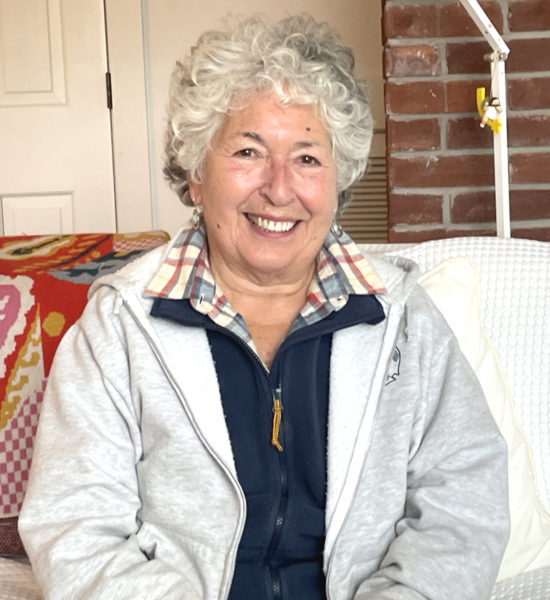
After to Bremen in 2010, avid birdwatcher Juanita Roushdy went on to found the Friends of Hog Island and took an active role volunteering at the Audubon camp for more than nine years. Roushdy said she has learned a great deal in life through her volunteer efforts. “Anytime you learn a skill it’s a good thing,” she said. “You never know.” (Sherwood Olin photo)
If she had done nothing else since moving to Maine, Bremen resident Juanita Roushdy reserved a small place in the state’s history for herself as the founder of The Friends of Hog Island.
As the person who spearheaded the creation of the nonprofit dedicated to supporting the legacy and conservation programs of the Audubon Camp at Hog Island, Roushdy navigated the legal legwork and drew up a business plan for Hog Island Audubon Camp.
Before she became involved, Roushdy was merely a Hog Island camper; an avid birdwatcher with a specific mission in mind.
“Bicknell’s thrush,” she said. “That’s the reason I came up to Maine originally. I still haven’t seen it. They are very rare. They are one of those disappearing species.”
She enjoyed two separate stints as a camper of Hog Island in 2007 and 2008 but when she wanted to sign up for a second week on Hog Island in the fall of 2008, she was told the camp was going to close as the operation was hemorrhaging money.
Invited to a planning meeting at the end of 2010, Roushdy suggested forming a nonprofit to raise money for island operations. When the idea appeared to flummox others at the meeting Roushdy stepped up, having previously founded a nonprofit in North Carolina.
“I said, ‘OK, I’ll do it for you,’” she said. “‘I’ll get it started. You’ll need a board and everything, and then, of course, you know who’s going to be the board.’ I always said RoushdyI usually don’t step forward. People step backwards.”
As a direct result of forming the nonprofit, Roushdy was invited to meet with leaders of National Audubon Society in New York City in late November 2011. Ultimately the national organization agreed to assume responsibility for paying professional staff members and resuming programming on the island while the Friends of Hog Island committed to raising money to offset the costs of running the camp.
“In the business plan, or when I spoke to (National Audubon Society CEO) David Yarnold, I said ‘We would plan to give you $50,000 a year until you didn’t need it anymore, as long as we can’ and we have,” Roushdy said. “Then we give them $50,000 a year to run their programs and then we pay for other things. Like when I was there, because we were still building, we were paying for all the activists, all the linens, all the stoves, kitchens, showers, toilets, all the sundry items that are not big ticket items.”
In 2020, prompted by a heart attack related to her substantial workload and significant demands on her time, Roushdy decided to cut back, beginning what she calls a “third retirement.”
“I was also on a number of other things at the same time like the Bremen Conservation Commission,” she said. “I was doing Maine Audubon, the Lincoln Theater board, and then I was also taking care of my 93-year-old neighbor who was losing her eyesight and couldn’t drive anymore. I had to stop some of this stuff and I have to say that when I did tell all of these people, it was like a buoy popped up. I had never experienced that.”
Born in the war ravaged London in the dying days of World War II, Roushdy endured a troubled childhood, divided between England and Canada. In her 20s she traveled around Europe for a while before returning to the United States where she took a job with the Egyptian Embassy in Washington, D.C.
In 1974, at the age of 30, she went to work for the International Monetary Fund. An international financial institution operating under the auspices of the United Nations, the International Monetary Fund consists of 191 member countries and acts as a lender of last resort to members in dire financial straits.
Starting out as entry level office assistant, Roushdy capitalized on every opportunity to learn something new. Over the course of her 28-year tenure with the International Monetary Fund, she rose to become a senior editor and director of community relations.
“Even when I was at the lowest, in the basement … in the graphics department, I’d go to the composition unit,” she said. “At the time, they were still doing it in lead and something. ‘What are you doing? Oh, can I help you? Because nothing is happening in my section.’ And I’d help them, or I go to the photography unit … then the print shop, and the same thing.
“I was not being paid for any of those tasks,” she said. “I was only being paid to answer the phone and type for the boss but because I did all of that, then further up above ground, when an editorial position came up, then I could say, well, I had composition. I understood the graphics. I understood the art. I understood the photography. I understood the printing. I understood the color separation, and I also have an English degree.”
As a senior editor Roushdy was responsible for reviewing the International Monetary Fund’s vast array of materials published in 12 languages. With the fund being an international organization, oftentimes English may not be the author’s first language, she said.
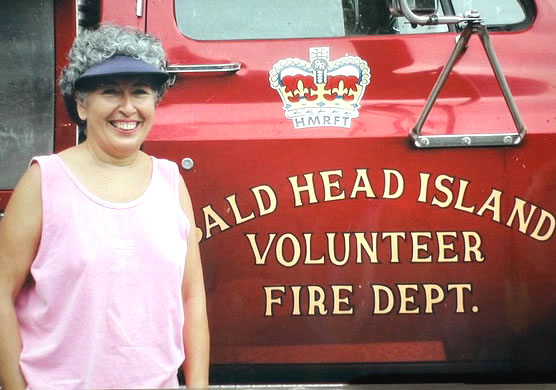
Juanita Roushdy stands next to a Bald Head Island Volunteer Fire Department fire truck. Having moved to Bald Head Island, N.C. for her first retirement in 2001, Roushdy served on the department for nine years. Department members had a special decal made for her truck, HMFRT. When I asked them what it meant, they laughed and said Her Majestys Royal Fire Truck! Roushdy said. So much for humor! (Courtesy photo)
“You always want to be careful that words do matter,” Roushdy said. “Words do have meaning, and how they’re put together has meaning, and the pace of them has meaning: so all of those things. That’s what I would do and then also check the facts as much as I can from the materials they gave me.”
Roushdy’s other title, director of community of relations, was a position she created for herself in response to being accosted by people who wanted to discuss one International Monetary Fund fiscal policy or another. She and many of her coworkers had nothing to do with policy, Roushdy said and she wanted to put a human face on the bureaucracy.
Her solution was to develop a community outreach effort to humanize International Monetary Fund employees. Programs started during Roushdy’s tenure included supporting homeless street kids in Peru, setting up hospitals in disaster areas, sending city kids to summer camp, and mentoring interns who needed professional development.
“I would go and ask different departments if they would allow this kind of person to come in for over six weeks,” Roushdy said. “Then we would give them a certificate that they had learned the basic tools of working in an office; computers, photocopy machines, and just basically how to act. So they would get that. Then we had program where we would also dress them, so they’d have clothes for when they went for a professional interview.”
By the time she retired for the first time in 2001, there were 33 different community outreach programs going under her office.
Looking for a significant change, Roushdy discovered Bald Head Island, a barrier island on North Carolina’s coast. After an exploratory trip, she purchased a small lot in the island’s interior and had a small house built.
She enjoyed her first year in Bald Head in blissful silence, telling her neighbors she was retreating from a hectic life and didn’t want to be sociable. After the first year, she joined the island’s volunteer fire department and first responders, which kept her busy for most of the next nine years.
It was in North Carolina that Roushdy’s interest in birding developed. She had unknowingly moved into the East Coast Flyway, a globally important route for migrating birds.
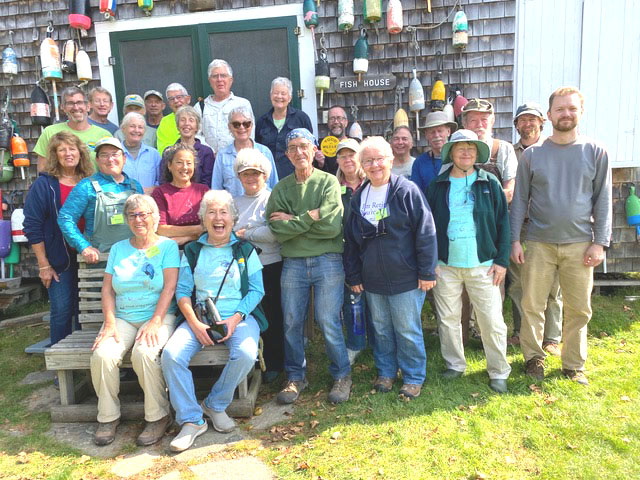
A group of Hog Island volunteers, including Juanita Roushdy, take a break in front of the Fish House. The National Audubon Society pays professional staff members to work on the island. The Friends of Hog Island raises money to support camp operations and coordinates volunteer labor during the season. (Courtesy photo)
“I became interested in birds and started birding because there was such a great birding area down there,” she said.
Once she became involved in birdwatching she dove all the way in, eventually being appointed to the board for Audubon North Carolina and founding a local Audubon chapter. Then one day in 2007 she heard the man who talked her into joining the North Carolina board talking about Hog Island. Roushdy had never heard of the place.
Still she heard enough to be intrigued and made arrangements to come for a week in 2007.
“I really liked it,” she said. “I liked the egalitarian nature of it, and I loved the historical quality of the buildings at the time, because it was what I imagined as a real, woodsy, Maine kind of thing. So then I signed up for another one the next year.”
By 2008, Roushdy was already thinking of leaving North Carolina where the weather was regularly too hot and too dry for her liking. She was mulling a move to Washington state when, almost on a whim, she pulled off to visit a home for sale, on the road leaving Hog Island.
“I stopped here at 7:30 a.m.” she said. “I said, ‘I’ll only be a few minutes, because I have to get to Portland to catch a plane. Could I just walk in?’ The lady was not happy, but the husband said, ‘Oh, OK.’”
Roushdy said she needed about three minutes to know she loved the property but it took another year and a half to close on the property. She moved to Bremen in 2010, arriving Pumpkinfest weekend.
Within weeks she attended the planning meeting that resulted in the founding of the Friends of Hog Island.
For more information, go to fohi.org or hogisland.audubon.org.
(Do you have a suggestion for a “Characters of the County” subject? Email info@lcnme.com with the subject line “Characters of the County” with the name and contact information of your nominee.)

