


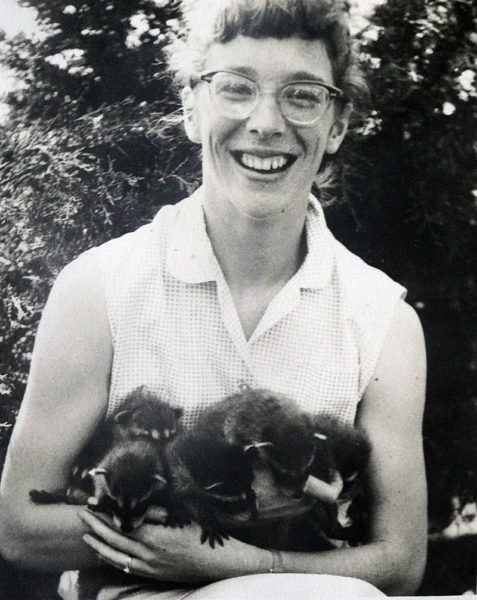
A young Nancy Holmes with an armful of orphaned raccoons. (Photo courtesy Peter Holmes)
This is the time that young animals (birds are animals, too) are coming out of nest and burrow in all their baby charm and innocence. Two people I know were studied by curious fox kits. When they were bored with the big, two-legged human animals, they scampered back into the woods. Aside from a brief fear of rabies, the humans were amazed and charmed.
A baby robin on the lawn is a different story. Get the cats and dogs indoors quickly. We are inclined to try to catch the babies and get them up out of our pets’ reach. Actually, it would be better to go indoors with the predatory pets and watch out the window. The parents are probably trying frantically to get the baby to fly up to safety.
I think a lot of us (me, too) have tried helpfully to catch a little one and get it to a higher roost. I actually taught a bird to fly by persistently trying to catch it. Every time it fluttered away from me, it flew better, until it flew up into a tree. Poor bird and frantic parents! I learned to be less helpful.
Sometimes a bird gets out of the nest somehow before it can fly. Those helpless babies are protected by law.
For lists of people doing wildlife rehabilitation in Maine, go to wildlife.rescueshelter.com/maine or call a game warden in Augusta at 1-800-452-4664.
Young mammals are sometimes found without parents in evidence. Fawns are left by their mothers between feedings. A fawn curled up in a clump of ferns is almost irresistibly adorable. Unless you know that the parent has been killed, leave the little one alone, and call the pros. Two people I know found fawns, newborn and still wet, on a road. Hoping that the doe was nearby, the finders carried the fawns away from the road for her to find. “If you care, leave it there.”
The photo with this article shows a young me holds six or seven little raccoons. They were the young of coons at the University of Illinois where I worked. They were taken from their mothers as part of a raccoon reproduction study. Very young ones are hard to raise because they inhale milk and get pneumonia.
I fed them frequently, day and night, and they all survived – for what futures, I don’t know. Research is not always kind. Some of the adult animals in the study group were donated by people whose adorable pets turned into biters. One of them must have been in a bad mood one day, because he locked his teeth on my hand when I gave him his food dish.
Of course I can’t blame him – a wild animal living in a cage. But wildlife research helps humans to protect wild animals as best we can.
(Nancy Holmes prowled Linekin Neck in Boothbay as a child, then an Illinois bottomland while earning a master’s degree in wildlife management. Once back in Maine, she raised children and kept assorted animals, wild and domestic. She and her Carolina dog roam their woods in Newcastle. Write to Holmes at castlerock@tidewater.net.)

