


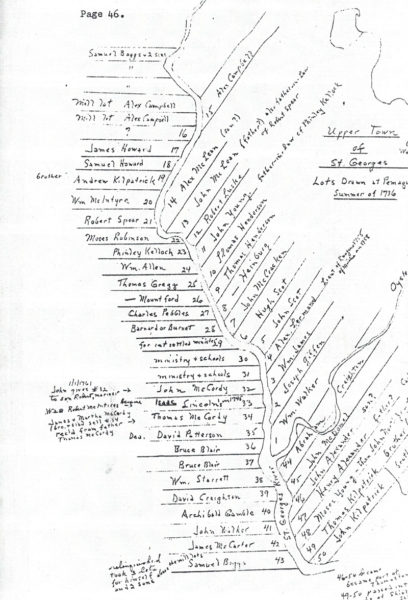
Records show the lots assigned to early settlers of Pemaquid in this recreation of a 1736 map, which includes one of the earliest mentions of the McCurdy family name in Lincoln County. John “McCardy” is listed as the owner of lot number 32, and James “McCardy” is recorded owning lot 34. (Courtesy photo)
This will be my last tale. I have been writing Newcastle History for more than 25 years and it is time I retired. This will be a personal story.
Donald Bradford Macurda writes in his “Early McCurdys in Maine” about my McCurda family. In the last sentence I have spelled my maiden name three ways. It is also spelled McCordy and McKirdy.
The most romantic and perhaps rather fanciful story of the origin of the McCurdy clan is contained in the opening chapter of Mr. H. Perry Blanchard’s “The Ancestral McCurdys: Their Origin and Remote History.” It begins in the Eastern Mediterranean area, gallops through early Irish history, moves into Scotland, back to Ireland, and sails across the Atlantic to the Unites States and Canada. I will not try to follow it here, but I will start my story after my ancestors were settled in Scotland.
It seems the McCurdy group obtained possession of the island of Bute between 800-1000 A.D. A clue as to the origin of the McCurdy name and clan might be derived from their habitat. People of the islands of Bute and Arran obtained much of their living from the sea. This was supplemented by cattle raising and by farming.
The sea distances between the islands off the mouth of the River Clyde and in the North Channel served as convenient havens for surprise raids. This bred a race of hardy men, seafarers, and warriors; constantly watchful for raiders.
Christianity came to the area, but it did not stop the fighting. This caused some of the smaller clans to disappear or, as in the McCurdy case, to be listed as a sect of the Stewards of Bute.
The Presbyterian form of worship became common. This caused a clash between the English Church and the Scottish states. They were invaded often. Donald Macurda writes, “They were undisciplined, friends fell away, and their opposition was soon broken.”
This brings us to the point of how the McCurdys got to Ireland. To the tradition, during the reign of Charles II the McCurdys were being pursued by Royalist troops under the command of Sir James Turner. Pursued by the soldiers, at the water’s edge, five McCurdy brothers (or was it six), seized a boat and without further pause, pushed away from Scotland.
It was the latter part of November 1666, and it was bitterly cold. They had no chance to prepare for food or comfort, but they were desperate. For two days and nights they sailed on an Easterly wind across about 50 miles of sea.
They made it to the Island of Rathlin and the next day crossed the 4 or 5 miles to Ireland, landing near Ballintoy.
The McCurdy “boys” were Daniel, Patrick, David, William, and John. Daniel had a son, James born around 1676-1678, and a son Thomas, born in 1706. Thomas is the ancestor who appeared at Pemaquid with David Dunbar. His wife’s maiden name was Kirkpatrick.
It was about 1730 that the name McCurdy first appeared in Lincoln County. It is believed these settlers, known as Scotch-Irish, had been but a short time in this country and were quick to accept the apparently generous land acquisition terms of Col. David Dunbar and removed to Pemaquid in 1730-31.
Dunbar, however well intentioned, in effect perpetrated a fraud on the would-be settlers. In 1732, the Crown revoked the authority given to Nova Scotia Governor Richard Phillips. Thus the deeds could not be delivered as promised and the land was returned to the Province of Massachusetts and the previous patent holders.
The McCurdys and other settlers were left sitting at Pemaquid and vicinity with, at best, only what might be described as squatters rights. Many of the settlers settled in the county especially in the Boothbay, Southport area.
Samuel Waldo, who was chief claimant of the Lincoln or Muscongus (later Waldo) Patent, decided to open his land to settlement. He extended his claim and on March 27, 1733 purchased a one undivided half on an 8-mile square tract from James Stilson.
Being in possession of land on the St. George River, Waldo began plans to settle it. His ad stated that he intended to settle two towns of 40 families each on a tract of land on the Western side of the St. George River. People who were “desireous” to take up lots and settle there were to meet him at his house in Boston from March 17-24.
Waldo determined to locate those of the same origin together. Thus he clustered together the natives of Ireland, or their immediate descendents. These were Protestants from the north of Ireland, originally descended from families who had immigrated to Ireland from Scotland. They were called Scotch-Irish.
There were 27 individuals who entered into formal agreement with Waldo. They agreed to settle on the St. George River, to build a convenient dwelling house within eight months and dwell therein for three years and to clear and subdue four acres of land within two years.
On his part, Waldo agreed to give the settlers a tract of land on the Western branch of the river; 100 acres to each settler, 40 rods wide on the river and to extend back to meet the amount.
Among the 27 who signed the contract were Thomas McCurdy and Thomas Kirkpatrick (believed to be Thomas’ brother-in-law). They also signed for others who were not present or under age including John McCurdy, John and Andrew Kirkpatrick, and Andrew Fosset.
Thomas (b. 1706) became number 34 on Waldo’s plan. He and his wife moved in with their family. He is said to have left for Massachusetts about 1740 after the beginning of the King George’s War.
Thomas’ son John (b. 1736) married Anna Hilton (b. 1741) and moved to Breman. It is believed it was at this time that McCurdy became the accepted surname. Anna had an inheritance of 100 acres, from her father, William (b. 1714) who had been killed by Indians. John, also, owned various amounts of land bordering on Cranberry Meadow, Pemaquid Great Pond, and Pemaquid Lower Pond (presumably the one, which is now described as McCurdy Pond).
There are indications John may have been involved as a member of General Washington’s bodyguard, also that he was a guide to Benedict Arnold. However, these are stories and should be viewed as such. John and Anna moved, with their family to the area east of the Kennebec River where they died.
John and Anna’s son, John Jr. (b. 1760) married Mary Reeves, daughter of James Reeves, in whose house in Ballstown, the decision was made to separate Ballstown into the towns of Jefferson and Whitefield. John Jr. served in the Revolutionary War in Capt. Benjamin Plummer’s company. He enlisted in the War of 1812, was a private in the 21st United States Infantry under company commander Captain Vose. He was sent to the Great Lakes area where he was wounded and died in Sackett’s Harbor, N.Y. on June 11, 1813. Mary moved back to Jefferson.
Luther (b. 1799) was the second son of John and Mary. He married Ophelia Erskine (b. 1800). They are listed as having nine children. Of them eight were boys. They are the generation that populated the little settlement.
When my father, Elton, was young there were five families of McCurda living in a row. They were, now, spelling their name McCurda, the last letter was an “a.” The road leading to Jefferson village was known as McCurda Road and the McCurda schoolhouse sat beside it. When I was growing up McCurda’s were three in a row. My great-grandfather had died and one of his brothers had moved away.
Luther and Ophelia’s son, another John (b. 1824) married Sara Lane. It is a family story that he went to sea early and fought in the Mexican War. Thus, when he joined the Civil War his past experience gave him the rank of second lieutenant. He was already married and they had two boys.
He served in Company I, Eighth Maine Infantry. He left the state on Sept. 10, 1861 and in the following month sailed from Annapolis with General T.W. Sherman’s expedition to Port Royal, S.C., which landing at Hilton Head in November. John McCurda remained on duty for over two years. He took part in the reduction of Fort Pulaski, the occupation of Jacksonville, Fla. and was present at the bombardment of Fort Sumter. Most of the time he was on garrison duty at Hilton Head and Beaufort, S.C. He sent a gold dollar home to his older son, Henry. I have that gold dollar now.
When John returned home, he bought 50 acres of land between what is now Route 215 and Dyer Pond. He opened a small store across the road from his house. He was listed as a grocer in 1908.
John’s older son, Henry (b. 1852) grew up in the area, working as a chopper in the woods. He was restless. He had heard about the vast wooded areas opening in the West. Henry and two of his friends headed to Oregon by train in 1878. The problem was, it meant he left his friend, Lucy Manuel (b. 1859) at home. Their romance developed and he returned home in 1883 and they were married.
They built a house on the spot where a former house had burned, but Henry was still interested in the West. He went back for a time, even logging in Washington and lower Canada, but in 1887 he returned to Jefferson and he and Lucy settled in. He added about 30 more acres to his farm.
Henry’s son, Elton (b. 1888) grew up on their farm and lived there all his life. He had a chance to add to the farm acreage when his next door neighbor moved away.
Henry had died in 1908 and Elton ran the farm in the old style, using oxen, horses, wood for fire, and ice from the lake for cooling. He was interested in town affairs and served as selectman, and then was elected tax collector and treasurer with the office in his living room.
He held the job from 1925 until he died in 1956. He also was a deputy sheriff for Lincoln County for a number of years.
In 1920 his life changed. A fellow, Ora Turner (b. 1866) retired from Massachusetts and brought his wife, Henrietta (b. 1870) and family to South Jefferson. One of the family was his divorced daughter, Bertha (b. 1892). Elton and Bertha were married in 1923. Her claim on family history was she was a direct descendant of Thomas Rogers, John Alden, and Priscilla Mullins of the Mayflower.
They had a little girl, Margaret, (b. 1928). They were not a young couple but Elton wanted a son. They would try again, but it was not to be. On July 10, 1930, I was born at the old Lincoln Community Hospital on Elm Street in Damariscotta.
Bertha wrote home to Elton, “Well, you poor boy, I did not get you a son. I was so disappointed. She is an awful little baby, but she will grow. I know you are haying, but come down as soon as possible. The doctor wants the baby’s name and I could not tell him.”
They came up with Arlene Ina and I did grow in both size and understanding. I have had a very wonderful life, but the McCurda surname has disappeared from this area.

