


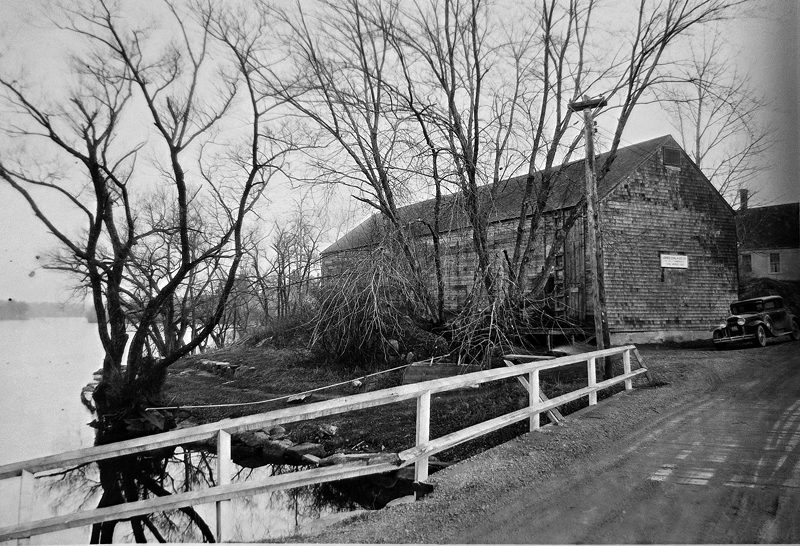
The former ice house at Damariscotta Mills overlooks Damariscotta Lake. The sign on the front of the house says, “Jones Coal & Ice Co., G.H. Melville.” This was the previous location of the Gorham House. The land now belongs to the town of Nobleboro and is known as “the ice house lot.” (Photo courtesy Nobleboro Historical Society)
Originally published March 13, 1980
The ice business was developed by Alice and George Harry Melville in 1927 to supplement their coal sales. They purchased the old David Gorham lot in February 1926 (Deed 375-229), and erected ice house walls for the first year’s harvest, using sawdust only for a covering.
Subsequently a roof was added for a permanent building, and in 1936 an extension was made to increase ice house capacity. The ice business was continued until 1959, at which time electric refrigeration had largely replaced the home use of ice.
The Melvilles operated under the name of Jones Coal and Ice Co. This name ties in with Mrs. Melville’s father, who was Charles M. Jones, the owner-operator of a grocery store in Damariscotta until his death in 1922. The Melville coal yard was in Newcastle, near the railroad station.
Ice harvest had been a busy time at the Mills on Damariscotta Lake. Otis Witham, father of Harold Witham, was for many years in charge of harvesting and storing the ice. Harvesting started as soon as the ice was 12 inches thick and continued at full speed for eight to 10 days until the building was full. This comprised a total of at least 1,500 tons of ice. By the time the ice had been cut, it was often 18 to 20 inches thick.
Otis Witham hired a crew of at least 13 men who worked a nine-hour day and were paid in these earlier years at the rate of $2 to $2.25 per day. Initially the ice was cut by using two one-horse teams to groove the ice. Subsequently Otis and his son Arthur constructed a mechanical circular saw for more efficient cutting of the strips of ice. The field was cut to a depth of about four inches from the bottom of the ice and then broken off with a two-pronged busting bar or iron.
Several men worked in the field, completing by hand-sawing the strips of ice which were then poled along the channel to the ice house. There the strips of ice were “busted” into the separate ice cakes. Harold Witham was responsible for hoisting the ice cakes up the conveyor, into the house. In the earlier years a horse and rope provided the motive power; but subsequently a Chevrolet gasoline engine was used. In later years an electric hoist served to lift the ice.
Within the ice house, the crew consisted of a chiseler who smoothed off the edges of the cakes so they would fit together closely, and then two or more men did the stacking. Other members of the overall crew included those who initially marked out the field of ice prior to grooving or sawing. Mr. Melville also worked regularly with the crew.
After Otis Witham died in 1940, he was succeeded by Donald Weston as superintendent of ice harvesting.
The harvesting was highly seasonal work, and a cold job. It was also a mean job if the weather was stormy. The men, however, appreciated the opportunity of earning winter money at a time when jobs were scarce. These were the years before there was unemployment insurance or food stamps.
Ice was retailed during the summer months in Damariscotta, Newcastle, and Nobleboro with truck delivery at least twice a week. The truck drivers dug out their own ice and loaded their trucks at the ice house.
By 1959 the demand for ice had dropped severely, and all retail routes had been discontinued several years earlier. Sales were then limited to wholesale customers, one of whom was Edward A. Myers, who used considerable quantities of ice for his nearby lobster business. In May 1959 the Melvilles sold the ice house and lot to Mr. Myers (Deed 545-350).
Myers, however, did not use enough ice to justify continued operation of the ice house for much longer. Consequently he employed Henry “Pat” Sidelinger to tear down the building. Since then, the land has been appropriately known as “the ice house lot.”
Finally in June 1972, Mr. Myers sold this lot to the town of Nobleboro for $3,600, payable over a 10-year period. This deed provides for continued access across this property as desired by the University of Maine for “conducting limnological and other scientific study of Damariscotta Lake.” The university also has the right to construct a small building on the premises for use in storing its scientific equipment (Deed 73311).
The eastern boundary for this ice house lot is specifically described in the deed for the adjoining MacLean property. The line starts at the old county road “at the easterly wall (ledge) of the Gorham lot, thence Northeasterly by said wall nine rods to a bolt in the rock; thence northwesterly 45 feet to a bolt in the ledge at the shore of the Lake” (Deed 735-192).
Mr. Melville was born in 1883 and came to Damariscotta from Boston when he was about 18 years of age. One of his ancestors was a leader in the Boston Tea Party. Prior to entering the coal and ice business, he was railroad freight agent at the Newcastle station. He was active in town affairs, and served several terms as president of the local chamber of commerce, and as a trustee of the Skidompha Library.
One who well remembers the old ice house and coal business is Neil Sprague. His father, Ralph Sprague, had a house adjoining the coal yard in Newcastle, and he served as caretaker of the yard and was one of the delivery men. It is reported that Neil and his five small brothers who frequently played in the nearby yard sometimes had a darker complexion than at present!
Another knowledgeable person is Grevis Melville, the son of Alice and G. Harry Melville who operated the ice business. He is an accomplished landscape painter, having his studio and living quarters in Damariscotta on the third floor over the Pine Tree Variety Store. This building was known as the Jones Block, owned by Charles M. Jones, with his grocery store on the first floor.
The four-story block was originally built by Borland and Metcalf, shipbuilders, after the great fire of May 3-4 in 1845. The builders had a mould design loft upstairs for shipyard purposes. The local militia had their meetings on the fourth floor. The Skidompha Library occupied the second floor until acquiring its present facility. A post office also was on the first floor, adjoining Jones’ grocery.
A marvelous view of the river can be seen from Mr. Melville’s third floor rooms. Also the overhead timbers in all these rooms are the most magnificent of hand-hewn lumber! The giant beams are 38 feet long and 13 inches wide.
The Jones Block was inherited by Alice Jones Melville and her sister, Daisy Jones Curtis. Alice and her husband had two children, Grevis Melville and the late Barbara Melville Fossett. These two became the subsequent owners.
Grevis Melville has been active in promoting our local area, past and present. He was the originator and the continuing manager of the two Damariscotta Area Information Bureaus. He was also a leader in organizing the Chapman-Hall House Preservation Society. Other activities include serving as president of the Damariscotta River Association.
But for coal and ice, how times have changed! They both became obsolete in our area. Coal, however, is now making a comeback. What of ice? Your writer still enjoys using that for his old-fashioned, hand-cranked ice cream maker and our young people continue to keep cool in summer at the ol’ swimming hole at the town’s Ice House Lot at the Mills.
(As Nobleboro’s town historian George Dow contributed more than 760 articles to The Lincoln County News. These articles, as adapted by Laurie McBurnie, are being reprinted under the auspices of the Nobleboro Historical Society. Comments or requests about repeating a particular topic may be directed to lmcb293@gmail.com.)

