

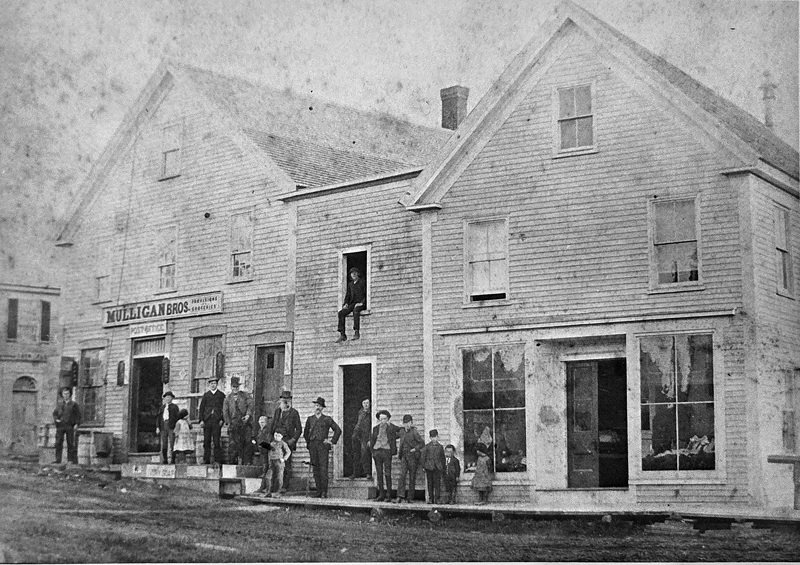
Mulligan Brothers Store and Post Office in 1886, with adjoining building that previously was David Gorham’s Saddler’s Shop. (Photo courtesy Nobleboro Historical Society)
Originally published Mar. 20, 1980
You have to see this historic picture to believe it! In the 1880s these two buildings were located at Damariscotta Mills between the bridge and the Rice house, more recently the home of Nelson A. “Buddy” Hancock, and now of Terrence and Jo Coyne. At the rear and to the west were Little Pond (or Mill Pond). It doesn’t seem possible that these two buildings were crowded into such a small space, but they were!
This picture was taken in 1886, shortly after the store had been purchased on Dec. 1, 1885 by James Edward Mulligan from the Josiah Myrick heirs. These deeds specified that the sale included the store and “all counters and drawers connected therewith … and all store fixtures” (Deeds 280-401, 281-216, 217).
James Edward operated the store in cooperation with his brother, John F. Mulligan, who also served as postmaster, starting in February 1886. The sign on the front of the store states “Mulligan Bros., Provisions and Groceries,” and below that the “Post Office” sign.
The Mulligans operated this store and post office until the place burned in October 1889. They then acquired the building just across the bridge in Newcastle that now serves as Hollis Nelson’s welding shop. The history of that building, including its use as the Red Men’s Hall, was given in our article of Nov. 25, 1977.
In the picture, the smaller building at the right, (near the bridge) was the old saddler’s shop of David Gorham, who lived across the road on what is now the Ice House Lot. We also surmise that Gorham, and maybe others, used the building as the Mills post office.
He was postmaster from September 1834 to September 1844. He was followed by postmasters Joseph Haines (1844-55) and Mrs. Clara J. Huse (1855-60).
The Gorham building appears to be pretty well out of business when this picture was taken in 1886. This is confirmed in another picture of the Mulligan Bros. store taken in July 1886 or 1887, with only the store then standing on this site.
This later picture was taken on the Fourth of July, with a large crowd in front of the store, including two one-horse buggies. The American flag was proudly displayed, which was fondly called the “Democratic Flag” by the Mulligans, who rejoiced in having Grover Cleveland elected as Democratic president during 1885-89.
The Mulligans had wonderful bargains available at their store! Just imagine having a whole barrel of flour priced at only $4.80, and muscatel raisins at 10 cents per pound, or three pounds for 25 cents!
The original store located here was operated by Jeremiah Russell as a “Hatter’s Shop.” In a mortgage deed by Russell to Benjamin Lincoln in July 1819, for a loan of $202.77, it was stated that this place included house, barn, and hatter’s shop (Deed 107-56).
This deed stated that the eastern boundary extended from the county road southerly “until it strikes the edge of the water in Kavanagh’s Mill Pond, later called Little Pond.”
A subsequent owner was Albert Smith, who lived here and served as the first postmaster at the Mills. He had the post office from Sept. 6, 1825 to Sept. 2, 1834, when David Gorham became the second postmaster. Soon thereafter the building served as the Myrick & Haines Store, as reported in Deed 164-159, when the adjoining saddler’s shop was sold in September 1835.
These two men, Josiah Myrick and Joseph Haines, were listed in several deeds as “Copartners in Trade.”
Somewhat later, in July 1844, title to this property was acquired solely by Josiah Myrick, upon payment of $1,500 to Albert Smith. The deed stated that this was the “same property as purchased by Albert Smith of Jeremiah Russell, and the same formerly occupied by me” (Deed 181-260).
Evidently Albert Smith was a father and son combination because this later deed was by Albert Smith of Portland and the earlier Albert Smith, who had purchased this place, was by now “late of Hanover, Mass., deceased.”
James Edward Mulligan was the next owner, buying the store in December 1885 as reported previously. He had also bought from Edward K. Clark in February 1889 the adjoining lot of land where Gorham’s shop had stood (Deed 279-527).
After the store and post office had burned in late 1889, Mr. Mulligan sold the two combined vacant lots to his sister, Delia Mulligan (later Mrs. Hale), in February 1891. The deed stated that the eastern boundary line was south, 3 degrees east for a distance of only 33 feet from the county road to the southeast corner of the lot. The southern boundary line was south 63 degrees west for a distance of 40 feet to the shore of the Mill Pond. The boundaries for the other two sides were the Mill Pond and the county road.
The store faced almost directly on the road. The 33 feet for depth of the lot included not only the store but a right of way in back. This right of way was in common with the adjoining property owner (Rice, later Hancock, now Coyne) and extended from the road, on the easterly side of the property, and “passed round the back side of my store” to the pond for watering purposes (Deed 286-265 and 186-363).
Obviously with available land only 33 feet in depth from the road, it was impossible for the two stores to have much depth. Another view of the Mulligan store, from the east, indicates that it was only about 25 feet in depth. This is confirmed in the 1889 deed for the adjoining Gorham lot, which stated that its eastern boundary extended southerly from the county road for a distance of “about 25 feet to a point which was once the southwest corner of a hatter’s shop” (later the Mulligan store – Deed 279-527).
This is further evidence of how closely buildings were crowded together to make use of available land at Damariscotta Mills during those early years of more than 100 years ago when ship building flourished at the Mills.
In closing this article, it will be interesting to list the names and locations of the four surviving Myrick heirs who sold the store property in 1885. Josiah Myrick had moved to Portland, Ore., where he was a steamboat man and gold miner. He was captain of the Jennie Clark and other boats until 1870.
James H. Myrick had moved to Boston. His sister, Arlitta Myrick Ford, was in Washington, D.C. Another sister was Hannah Elizabeth “Lizzie” Myrick Webb of Newcastle. Their scattered homes illustrate the beginning out-migration that started at the Mills about this time, as ship building was on the decline.
The population of our town was near its all-time peak in 1880 at 1,142; then was down in 1890 to 947; and by 1900 was at 810.
The picture of the two buildings in 1886 is in the possession of Marion Harris Mulligan. Her husband, John Joseph Mulligan, who died in 1979, was a son of James Edward Mulligan, who owned the store.
(As Nobleboro’s town historian George Dow contributed more than 760 articles to The Lincoln County News. These articles, as adapted by Laurie McBurnie, are being reprinted under the auspices of the Nobleboro Historical Society. Comments or requests about repeating a particular topic may be directed to lmcb293@gmail.com.)

