


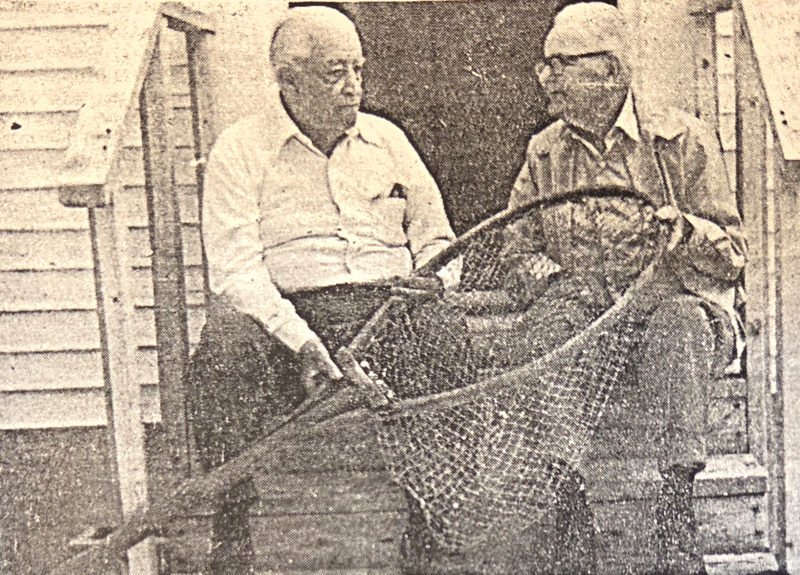
Nelson C. Hancock (left) and Harold Coombs share their alewife experiences during an open house at the Nobleboro Historical Center on Thursday afternoon, May 22, 1980. Hancock was a longtime operator of the alewife fisheries on behalf of the towns of Nobleboro and Newcastle. He developed and installed the mechanical hoists to replace the old method of hand dipping. Coombs was noted for his alewife smokehouse and the high quality of his smoked fish, which were sold throughout the coastal area. They are holding one of the old-time dip nets, used with much hand labor prior to 1955. (Photo courtesy Laurie McBurnie)
Originally published April 3, 1980
The old Hawthorne Schoolhouse looks pretty special with the new lawn and driveway all graded and seeded down by Chester Wright and son Dale. The large granite blocks that serve as curbing in the parking area in front of the historical center were given to the society by Jennie Trask Hall and son, Fred Willis Hall. These blocks had been part of the foundation for the Halls’ barn. The stones show the holes that had been hand drilled in order to insert the small wedges used to split the granite blocks.
On display at the open house on May 22 was one of the old wooden alewife hods that held one bushel of fish, or 100 alewives. This hod was used when selling fish to the smokers or other buyers or when dispensing the two-bushel quota allowed widows or other needy persons approved by the selectmen. This carrying hod, transported by two men, was marked “N & N Fish Co.,” indicating it to have been the joint property of the towns of Nobleboro and Newcastle.
Also on display was one of the hefty old-time dip nets, now owned by George F. Jones, which was used in dipping alewives from the stream. There was also an excellent collection of historic pictures and write-ups concerning the harvesting and sale of the alewives at Damariscotta Mills. To provide the proper alewife atmosphere, there was a string of currently smoked alewives from the smokehouse of Sally Ann Mulligan and Mary Jane Mulligan Buchan. They are great-great-granddaughters of James Mulligan Sr., an early settler and prominent citizen at the Mills.
A special feature of the open house was the showing, in both afternoon and evening, of the beautiful colored movie of the alewife run and the alewife festival held at the Mills in 1955. This movie was made by Charles Farnsworth and given to the historical society by his son Earl. Two of those actively participating in the recorded harvest were Nelson C. Hancock and Lee Cousins, both of whom were in attendance at the open house.
Following the movie, Hancock spoke of his experiences in operating the fisheries, including his development of the mechanical hoists that eliminated the laborious method of hand dipping. Harold Coombs also related how he had cured and smoked nearly 30,000 alewives annually and peddled them to stores all the way to Farmington and Searsport. The price then was five cents a fish, versus the current retail price of 30 cents.
Two special guests at the open house were Chester and Eunice Baker, of Waterville, who are charter members of the Nobleboro Historical Society. Mr. Baker served for years as executive secretary of the state YMCA of Maine. Mrs. Baker’s grandparents were Chapin Judson Genthner and his wife, Lucy Ann Winslow, both of Nobleboro in the Glendon area.
Genthner, when 19 years of age, made the attractive secretary the Bakers have donated to the society along with a set of handmade dominoes and other historic material.
Tom and Ada Wriggins presented the society with an old-time hand flail used in threshing beans or grain. The Wriggins live on the old Enoch Merrill homestead. We can visualize the Merrill menfolk flailing away at their bean crop, spread on the big barn floor, to remove the beans from the dry pods. Enoch Merrill, with his brother John Merrill, operated the nearby Merrill shipyard on Great Salt Bay.
Another recent gift to the society has been an excellent steelyard that had been used by William B. Hall, grandfather of Fred Willis Hall, who lived on East Neck Road where Mrs. Beston now resides.
(As Nobleboro’s town historian George Dow contributed more than 760 articles to The Lincoln County News. These articles, as adapted by Laurie McBurnie, are being reprinted under the auspices of the Nobleboro Historical Society. Comments or requests about repeating a particular topic may be directed to lmcb293@gmail.com.)

