

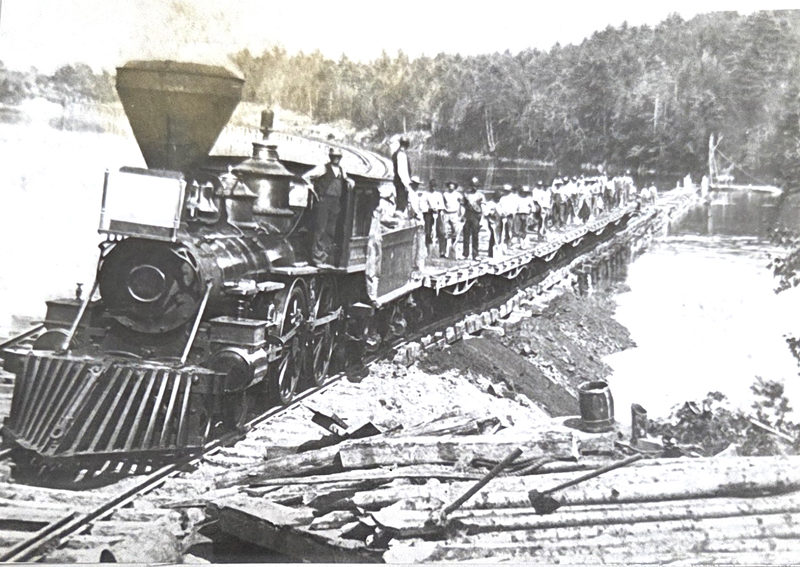
A gravel train at Muscongus Bay during construction of the Knox & Lincoln Railroad. The large crew of men on the flatbed cars were employed in hand-loading fill for the roadbed. This train was crossing a temporary spur track built on cobbled timbers across the waters of Muscongus Bay. Note the wood burning steam engine. (Courtesy photo)
Originally published July 17, 1980
When the railroad was constructed, the landholders along the line received cash payments for the railroad right of way. These land sales were four rods in width, and the land prices varied from about $35 to $60 per acre for the farmland taken in the vicinity of East Neck Road, Vannah Road, and Route 1.
Prices presumably varied according to whether it was good or poor crop land, or woodland. One of the most specific deeds was for the sale of nearly six acres of land by William and Helen Vannah, dated Dec. 9, 1872, for a total of $200.
This deed was as follows: “The right of way for said railroad company to build and construct their said railroad beginning at the line of land of John H. Bryant where said roadbed leaves his land, then easterly by and on said roadbed as now built about 230 rods to land of Cyrus N. Winslow, the former Jonn Genthner farm, said way to be four rods wide, two rods on each side of the center of said roadbed as now built. And also discharging and releasing all claim on said company for materials taken or damage done in the building and construction of said road.”
Several deeds also referred to the land sales as including payment for “borrow pits on field and pasture” (as for Wilson F. Chapman’s land on East Neck Road) or “damage for all borrow pits for earth taken to date” (for Umberhind’s land on East Pond Road). This term “borrow pit” is defined in our dictionary as “an excavated area where material has been borrowed for use as fill at another location.”
A great many of these deeds for railroad right of way are recorded in Book 310 at the Registry of Deeds in Wiscasset.
William Vannah not only sold farmland to the railroad, but also contracted to build 7 miles of roadbed. He was paid on the basis of the yards of fill required. This was fortunate because one section, over very swampy land, covered with a heavy fill, sank overnight and had to be rebuilt. His job also included building at least one culvert, using granite stones. It is reported that one of the workman cut his initials into a stone, with the last letter a “G,” which we surmise was for “Genthner.”
This William Vannah was the grandfather of Hudson Vannah who now lives on the original Vannah homestead. William lived from 1829 to 1921, and thus was about 43 years of age when he helped build the railroad. He was a very competent man, having had experience on sailing vessels, in farming, and as master of the “Queen of the Lake” in conveying passengers, their baggage, and freight from the Muscongus Bay railroad station to the summer hotels and other places in Jefferson at the head of Damariscotta Lake.
Many other men worked on the gravel train or in laying the rails, including Chapmans and Palmers of East Neck Road. The gravel train had to be loaded and unloaded by hand shoveling. One of the gravel pits was near Muscongus Bay, and the train and crew are shown in the picture. George Nelson Glidden, born in 1860, was a husky young lad working on the gravel train, along with his brother Anson. George subsequently became a brakeman, and then a conductor on the passenger trains.
Henry K. Palmer, a next door neighbor who married Mary Glidden (sister to George and Anson), was born in 1853, and helped to lay the rails. He later became a section foreman. Also helping to lay the rails was his brother, Joab E. Palmer, who became a member of Palmer’s section crew. Another Glidden, Joseph W., later became a brakeman on the freight train. A fourth Glidden brother was Edwin Wilbur who worked with Palmer on railway maintenance.
As will be noted in the picture, the engine on the gravel train (and for all trains in these early years) was a wood burner. Steam was generated by burning large cordwood sticks, obtained at nearby wood yards. One such yard, owned by the railroad, was a little ways north of the Damariscotta Mills station; and another large yard was near the crossing at Muscongus Bay.
The huge smokestack above the engine boiler was to control the sparks from the burning wood, hopefully preventing forest fires along the right of way.
Cutting and hauling cordwood provided fall and winter work for a number of men at a time when jobs were scarce. A review of old weekly newspapers found in the county court record’s vault in Wiscasset revealed the following accounts from the Village Herald and Lincoln Record, or The Lincoln County News:
Sept. 27, 1877, “The wood train stops here nights at Damariscotta Mills, and quite a number of men from this place are at work on it.”
Nov. 22, 1877, “Quite a large amount of wood will be landed at the depot (Damariscotta Mills) here this winter if all the contracts taken are filled.”
Feb. 20, 1879, “Last year at this time 1,200 cords of wood had been hauled down the Damariscotta Pond to Muscongus landing, but this year none has as yet been hauled on account of the bad sledding, and last year the railroad contract was $3.75 a cord; but for this year is only $3.”
There have been other reports (by Harold Castner) that at times the price was down to $2.50 per cord.
On Nov. 19, 1880, it was reported that “A tract of land has been purchased by the Knox & Lincoln Railroad of Mr. Bryant to be used as a place for landing wood.”
This would have been Ozro Bryant’s land, across the road from where Dorothy and Samuel W. Chapman now live on East Neck Road, down by the Great Heath where there was a double track railroad siding.
These various reports show that the railroad was the source of considerable cash payments to our local residents, received from the sale of their adjoining land, from jobs during railroad construction, and from supplying cordwood for the wood burning engines. These benefits were a plus factor that helped to compensate for the risk involved in the great amount of credit extended by the town to help finance the railroad. More next article!
(As Nobleboro’s town historian George Dow contributed more than 760 articles to The Lincoln County News. These articles, as adapted by Laurie McBurnie, are being reprinted under the auspices of the Nobleboro Historical Society. Comments or requests about repeating a particular topic may be directed to lmcb293@gmail.com.)

