


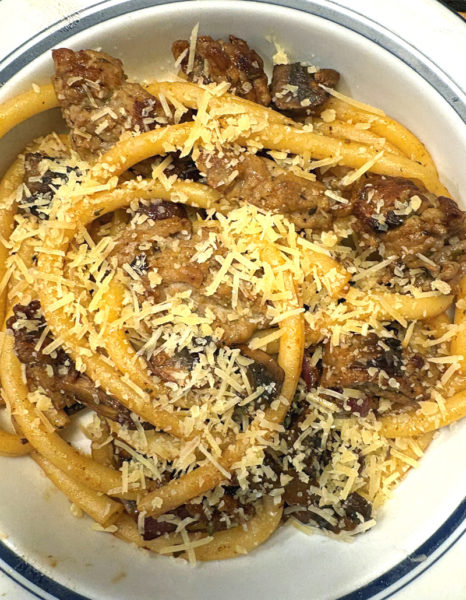
Balsamic matriacini mushrooms (Photo courtesy I. Winicov Harrington)
Pasta is one of those comfort foods that is equally at home on our cold winter days and easily transforms itself into a refreshing light meal in the summer. Its origins go back 3,500 years in China and the ancient Etruscan civilization, current Italy. Marco Polo did not bring pasta to Italy from China; it originated in both locations probably because it tasted so good, was easy to cook and was amenable to many added flavors.
Romans feasted on precursors of lasagna with sheets of stuffed dough and in 1154 an Arab geographer described “food of flour in form of threads” in Sicily, presumably sheets of dough cut in thin strips. Modern chefs are known for their signature dishes, such as fettuccine Alfredo, which now depicts pasta in a rich cream sauce. I still have a treasured old photograph from dinner at Alfredo, a small restaurant in Rome, where the original Alfredo was the chef.
Today’s landscape for pasta dishes has expanded to embrace a large variety of shapes and flavors in every cook’s repertoire.
Balsamic matriacini with mushrooms and sausage
Cook matriacini (thick round noodles or wide pasta) for 10 minutes in boiling salted water and drain reserving 1/2 cup pasta water.
Heat 1 tbsp olive oil and 1 tbsp butter in a large pan and saute 8 oz sliced mushroom and 1/2 red onion chopped for 8 minutes and set aside. In the same pan crumble 6 oz mild Italian sausage and brown for 5 minutes. Stir in 2 sliced garlic cloves, 1 tbsp double concentrated tomato paste, 1/8 tsp crushed red pepper, 1/4 tsp oregano, 1/2 tsp thyme, and 3 tbsp balsamic vinegar. Cook with stirring 2 minutes on medium low heat.
Toss with the mushrooms, pasta, and 1/2 cup of the reserved pasta liquid. Cook for 2 minutes to mix thoroughly and heat. Serve hot with freshly grated Parmigiano-Reggiano and a green salad on the side.
Recent proliferation of recipes of pasta sauced with peanut butter piqued my curiosity. While most of us grew up with peanut butter and jelly sandwiches, peanut butter did not appear in the U.S. until WWI, when it became a desirable source of easily digestible protein instead of meat.
I was familiar with satay sauce for meat made of ground peanuts and spices, a historical mainstay in Chinese and Southeast Asian cuisine, but in pasta? Well, blending oriental noodles with a combination of spices and peanut butter was an interesting experiment with delicious results.
Peanut butter-ginger-spiced udon
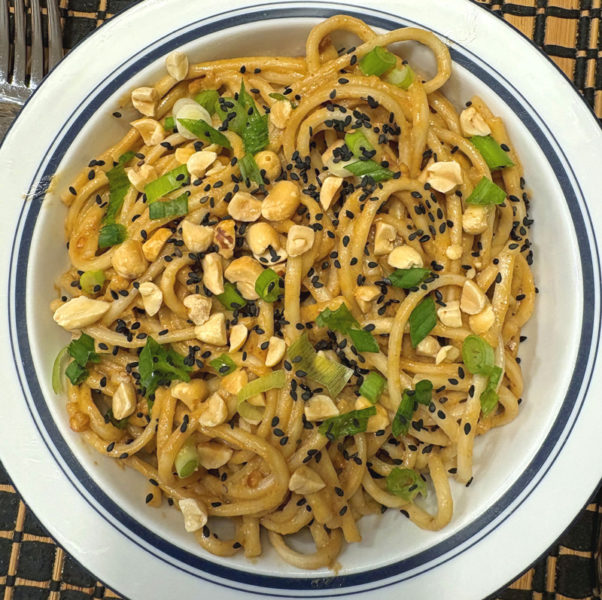
Peanut-ginger spiced udon (Photo courtesy I. Winicov Harrington)
Most recipes call for smooth peanut butter, but chunky works fine and gives a little extra crunch. To prepare the sauce, heat 1 tbsp olive oil in a small saucepan and saute 2 finely chopped garlic cloves and 2 tbsp finely chopped fresh ginger for 2 minutes. Remove from heat and stir in 1/2 cup chunky or smooth peanut butter and 1/4 cup very hot water to make a thick paste. Stir in 2 tbsp light soy sauce, 2 tbsp lime juice, 1 tsp toasted sesame oil, 1 tsp gochujang or hot chili garlic sauce, and 1/4 cup sour cream onion dip.
Cook 14 oz udon noodles according to package directions, drain, rinse with hot water, and return to the pot. Add in the sauce and heat on low heat with stirring for 2-3 minutes. Serve in shallow bowls garnished with chopped scallions, chopped roasted peanuts, and black sesame seeds.
Some frozen rhubarb and cranberries from the freezer provided a simple tart dessert to go with either pasta dish.
Rhubarb-cranberry-raisin compote
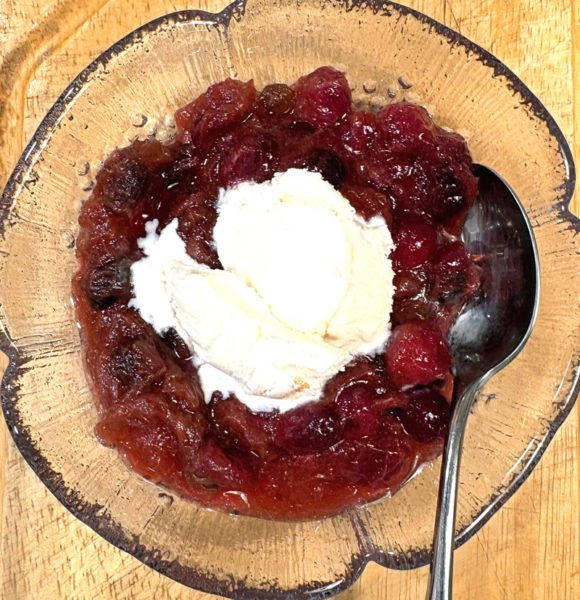
Rhubarb cranberry raisin compote (Photo courtesy I. Winicov Harrington)
Combine 2 cups frozen 1- to 2-inch pieces of rhubarb, l cup cranberries, 1/2 cup raisins, 5 cloves, and 1/2 cup water in a 3 qt pot. Bring to boil and cook for 10 minutes, stir in 1 cup sugar and cook for additional 5 minutes. Serve cold with a dab of ice cream.
One of the joys of cooking is the wonderful continuing education of taste for both old and new ingredients found in compatible and tasty combinations.
(I. Winicov Harrington, of Waldoboro, is the author of “How to Eat Healthy and Well for Less Than $5.00 a Day: The Smart-Frugal Food Plan” and “Uncharted Journey from Riga.” For more information, go to winicov-harrington.com.)

