

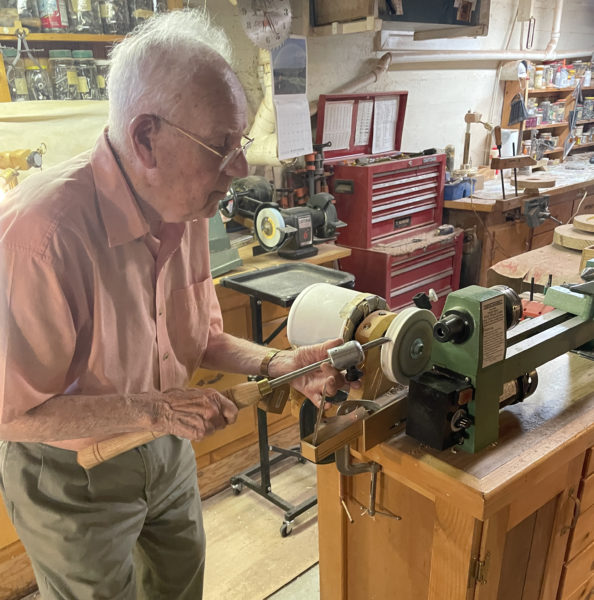
Tom Raymond sharpens a bowl gouge in his basement workshop in Damariscotta. The bowl gouge is the most important chisel in his toolbox, Raymond said. He will frequently begin working with three sharpened gouges so he can work uninterrupted when one chisel dulls. (Sherwood Olin photo)
Tom Raymond is 92 years old and producing some of the best work of his wood turning career. Almost every day, the retired engineer descends into his basement workshop in Damariscotta where he spends hours turning blocks of wood into bowls, wine stoppers, and anything else that strikes his fancy.
Today, Raymond is a highly regarded artist and craftsman, but even after working at his art for more than a quarter century, Raymond said he still thinks like an engineer.
“I don’t think like an artist,” he said. “They’re the furthest thing from my life. Most of the artists I’ve seen and dealt with don’t have much common sense.”
Raymond and his late wife Shirley moved to Damariscotta from Connecticut after his retirement in 1995. Tongue planted firmly in cheek, Raymond said his plans for retirement included buying a sailboat and taking up golfing.
“Never happened,” he said. “I got interested in wood turning again, and that was more fun than anything.”
For the first couple of years after the couple moved to Damariscotta, most of Raymond’s energies were spent repairing the house and making furniture for it. They had bought the house eight years earlier, but years as rental property left the building in rough shape.
While the house was rounding into form, Raymond took a wood turning class that really motivated him.
Although he had a home workshop for his entire life, Raymond didn’t get serious about wood turning until he retired.
“I always had a shop at home and I built a lot of my own stuff,” he said. “All the furniture in this house I built after I moved here.
The first seven years I was building all this stuff. I got rid of stuff that we brought here. I paid to move it and then I got rid of it.”
Inspired, Raymond connected with the Maine Woodturners Association, a group of like-minded souls who provided a wealth of knowledge and support. He would go on to serve as the group’s treasurer for more than 20 years and remains a member in good standing today.
Through the association, Raymond met Ken Keoughan, a fellow club member who founded the private Woodturning School in Damariscotta, which operated from 2004-2011. Keoughan added Raymond to the school’s faculty.
“We’d teach six people at a time, and I did that for seven years,” Raymond said. “We used to get students from the high school, students from different places, and we ran courses in the evening and afternoon.”
By then Raymond was already selling his work in local art galleries like the Saltwater Artists Gallery in New Harbor and Archipelago in Rockland. He said he spent three years refining his technique before he started exhibiting in art galleries in 2000.
Maine art galleries carrying Raymond’s bowls include Saltwater Artists Gallery; Archipelago, and Beyond the Moon Gift Shop in the Knox County Regional Airport in Owls Head. He also sells in galleries in New York and Connecticut and his daughter Paula Raymond posts them for him in her Etsy shop, Paulas Bazaar.
To keep his clients supplied, Tom Raymond works steadily, contributing five or more hours every day. He usually has several bowls in various stages of completion so he can work from one to another as the mood or work flow dictates.
“I generally come down around 9 in the morning and I quit at noon,” he said. “I come back in the afternoon. What happens is you’ve got stuff drying and you’re turning stuff. I only run, like, three bowls at a time in different stages. Right now, I’ve got two. When I do bottle stoppers I do five at a time. It’s like a production shop.”
All of Raymond’s pieces come to him as a 3-foot to 5-foot section of a tree. He used to go find his own trees to harvest, but in recent years he has deferred to younger friends and fans who bring him lengths of various desirable hardwoods. Raymond cuts the logs into sections in his garage using an electric chainsaw. Each section is slightly bigger than the diameter of the log.
Each section is then rough cut into form on a band saw and dried using a microwave technique Raymond developed after hearing about it from an instructor during a course he once took in Virginia.
Once the section is thoroughly dried, Raymond roughs out the piece and leaves it on the woodstove in his kitchen for five days or more before he starts working with it in earnest.
“You start with 36% moisture, and you want to work your way down to about 6%,” he said. “Then what the microwave does, it pushes the water from the inside of the wood to the outside. If you let it air dry up there for five days, it’s ready for the final turn.”
Once he has shaped the item to its final form, he applies five coats of finish, polishing each to a near flawless sheen between each coat with Scotch-Brite pads.
The entire process is tracked in a meticulously kept handwritten log that records the transformation from block of wood into a finished piece. In addition to carefully tracking every penny for tax purposes, Raymond notes where each piece is during production and records how many of the five coats of finish he has already applied. For marketing purposes he records the materials used in each one of the bowls he has turned for sale – to date, 1,802 – since his first one in 2000.
“When I put them in the gallery, I have to tell them what the wood is,” Raymond said. “So like for here, I track the wood for 1,801. It’s cherry and sycamore, and that would be the seven pieces that makes up that bowl. This is the diameter and the height. When Paula puts them on the website, she has to describe it of course … so I write all that down. She copies that and puts it on, so there’s a lot of little things you have to do.”
Although the Raymonds lived in Connecticut for more than 30 years before moving to Damariscotta, both were native Mainers, growing up in the Winslow area. After attending Winslow High School, Tom Raymond went on to study marine engineering at the Maine Maritime Academy in Castine. Graduating in 1954, he went to sea, spending four years in the Merchant Marine and then two years in the U.S. Navy, mustering out in 1960.
“It was like two worlds,” he said. “The Merchant Marine, you get well paid, yes, but you’re working with a lot of bums. The Navy has class, but there’s no money.”
Settling in Connecticut, Raymond returned home long enough to marry a hometown girl, Shirley Ayotte, in 1961. After a period of declining health, Shirley Raymond passed away in February 2023. The Raymonds were married for 62 years.
The two went to Winslow High School together, but according to Tom Raymond, things didn’t get serious until his sister’s wedding.
“I was the best man,” he said. “She was the maid of honor. I think that’s where we made the decision.”
The couple settled in Windsor, Conn., where they built a house for themselves and raised two daughters, Paula and Lisa. Tom Raymond took a job as the chief testing engineer with the Terry Steam Turbine Co. As the chief test engineer, Raymond was responsible for making sure the turbines were tested properly before delivery.
“Every product we made, we tested of course, with steam, and my job was to make sure everything was properly running before we shipped it out the door,” he said. “It’s too expensive to fix it in the field.”
Late in Raymond’s tenure, Terry Steam Turbine was sold to Ingersoll Rand, an international conglomerate that ultimately shuttered the business, leaving Raymond unemployed for the first time in 27 years. He wasn’t out of work long, as he quickly found a position as a chief instrumentation engineer with the Hartford Steam Boiler Co., a machinery insurance company. He worked there for eight years, retiring in 1995.
During her professional career, Shirley Raymond worked in the travel industry. The couple traveled extensively during their marriage, taking trips internationally and buying a pop up camper and traversing around the country.
Shirley Raymond even found a way to combine her love of travel with her husband’s love of fly fishing.
“My wife knew I was hooked on fly fishing, and she loved to travel,” Tom Raymond said. “She’d say, ‘You know, there’s a fly fishing class in Montana.’ I said, ‘That would be fun.’ Well, we’d take off. She’d get on the phone, make a reservation, and we were gone.”
Raymond grew up fishing on China Lake, where his parents owned a camp. His true calling, however, came years later when he discovered fly fishing while living in Connecticut, attracted by the complexity and the discipline the sport required. As he would do years later in Maine, Raymond joined a local organization to learn the ropes, in this case the Connecticut Fly Fisherman’s Association, and set about learning everything he could.
“I took it all; how to build fly rods, how to fish, and how to tie flies,” he said. “They had good educational program. You paid a few bucks and you could learn how to do it. You can’t rush it and you need instruction how to throw the fly line. How to throw a wet line, how to throw a dry fly line, you know, floating line, and this is what belonging to a club helped with.”
Before retiring to Maine, Raymond regularly vacationed in Maine, organizing outing trips with his co-workers or fishing and camping with friends and family. In fact it was during one local camping trip, the Raymonds found their future home in 1987, Tom Raymond said. They were camping in Wiscasset when Shirley Raymond suggested a tour of the area.
“She said, ‘Could you live here?’” Tom Raymond said, “I said, ‘Oh, yeah, I like this.’ Before we left that trip, we bought this house.”
(Do you have a suggestion for a “Characters of the County” subject? Email info@lcnme.com with the subject line “Characters of the County” with the name and contact information of your nominee.)

