


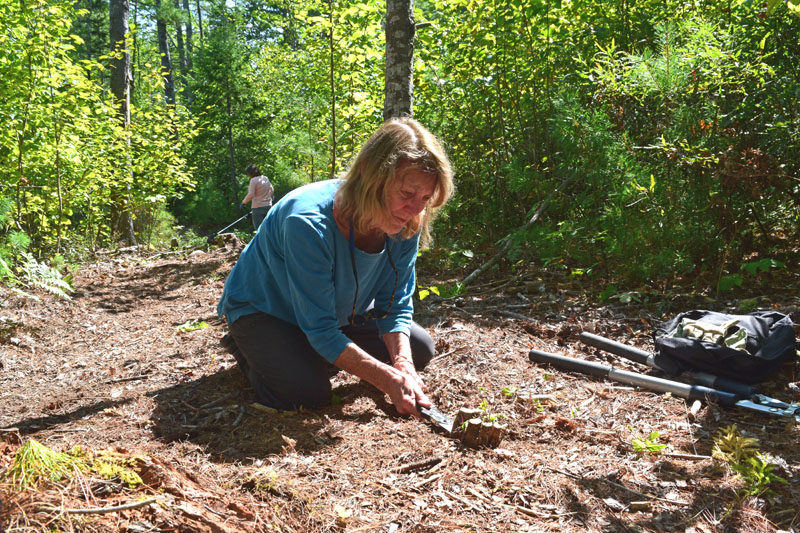
Volunteer Joy Vaughan saws a tree stump on part of a Pemaquid Pond trail on Thursday, Sept. 11. Vaughan started volunteering at the Damariscotta River Association, now Coastal Rivers Conservation Trust, 30 years ago. (Ali Juell photo)
On a sunny Thursday afternoon, a group gathers at the Pemaquid Pond hiking trail with saws, weedwackers, garden cutters, and other tools.
The gaggle of Coastal Rivers Conservation Trust volunteers and organizers begin their descent down the beaten path before turning off onto a less groomed walkway. Instead of enjoying a leisurely hike, everyone gets to work.
Budding weeds get snipped, branches are pulled away, tree stumps are sawed off; all in an effort to create a new trail loop at Pemaquid Pond.
“We want to be like fairies,” Coastal Rivers Volunteer Coordinator Bell Moroney said as she pulled a fallen tree off the trail. It’s part of maintaining the magic of the trails, she said.
This outing is one of many Coastal Rivers-led efforts championed by volunteers. The land trust came together in 2019, but its original organizations that merged to form it have much longer histories. The Damariscotta River Association was incorporated in 1973 and the Pemaquid Watershed Association was created in 1966. From both of their inceptions, the organizations maintained and monitored Lincoln County’s natural areas.
The unified land trust’s main goals are to protect water quality, conserve wild places, maintain trails, provide nature education, and build climate resilience. Volunteers play a role in every sector.
‘Making a mark on nature in a sustainable way’
Moroney, as well as volunteers Betsy Evans, Joy Vaughan, and Honora Perkins, all participated in the Trail Tamers event, monthly gatherings to build new trails.
Over the course of two hours, the group’s spirits stay as high as the many trees surrounding the path. They swap stories, listening and learning about one another as they work their way through the loop.
One of Coastal Rivers’ more ubiquitous roles is as the keepers of 32 public trail areas. Behind each of those pathways is a team of volunteers and organizers who go out to clear brush and create walkways.
The work doesn’t end once the trail is created. To keep those areas accessible and safe for walkers, volunteers return periodically cut back invasive plants and trim back any growth on a monthly basis.
This was Perkins’ first time volunteering as a trail tamer. She hadn’t been able to come out for the event previously because of her work schedule, she said, but making it out on that Thursday, Sept. 11 was a dream realized.
“Literally I wanted to do this for so long,” Perkins said. “You got to jump on the opportunity.”
Vaughan has been a volunteer at Damariscotta River Association and now Coastal Rivers for the past 30 years. After leaving behind her “very stable job” and moving back to Maine, she said she would walk the Plummer Point trail in South Bristol every day.
She said she eventually came to wonder who created the walkways she frequented.
“I thought, ‘When I have time, I want to be somebody who makes trails,’” Vaughan said. “Building a trail, everybody loves that … I’ve never tired of it. Never.”
All of the trail tamers agreed that there’s something special about creating the walkways that countless people will eventually use.
“It’s like you’re making a mark on nature in a sustainable way,” Moroney said.
Beyond recreation, responsibility
On Thursday, Sept. 18, Coastal Rivers Community Science Director Sarah Gladu paddles out to Muddy Pond’s deepest point to measure multiple water quality markers. By bottling some of the pond’s waters, measuring temperatures, and determining oxygen levels, she’s adding to a treasure trove of data that will later be processed and analyzed.
By collecting and analyzing water data, Coastal Rivers helps the Maine Department of Marine Resources identify water contamination and even searches for the sources of such problems.
“We monitor seven ponds, mostly in the summer,” Gladu said. “It’s our intern and the volunteers doing all of it.”
As water temperatures rise, Gladu said this type of water testing is becoming more essential than ever before.
“With the increase in temperatures and the phosphorus that exists, we could suddenly have massive algae pollutants,” Gladu said.
There’s more than one way volunteers act as community scientists. Volunteers count phytoplankton, tiny organisms at the foundation of the Earth’s food web, to ensure the safety of Maine’s shellfish for consumers. They go out to count horseshoe crabs to aid scientific research.
All of it helps further scientific research as well as ensuring the safety of the county’s waters and sea life.
Gladu said volunteers many times bring fresh eyes to the scientific work at Coastal Rivers. Even if they can’t put a name to it, she said they can often tell when something is off with the waterways.
“They’re kind of ambassadors or sentinels for us on our waters,” she said.
Someone doesn’t have to have a scientific background to do these opportunities. Gladu said Coastal Rivers offers training to prepare people beforehand, and she makes sure volunteers feel supported at their first sessions.
Something for everyone
It may seem intimidating to saw down a tree or to help conduct scientific data collection, but there are many more ways to give back at Coastal Rivers.
People can help with carpentry or painting, be a counselor at an educational camp for kids, or staff the front desk at the organization’s headquarters. There are 22 different opportunities listed on the Coastal Rivers volunteer interest form.
In an effort to honor every type of volunteer at Coastal Rivers, the organization held a celebration on Thursday, Sept. 18 complete with a spread of food and a raffle. Deputy Director Katie Beaver said it’s important to let volunteers know their efforts are deeply appreciated.
“We just really try to practice gratitude,” she said. “I think making that a core part of the work we do helps people keep coming back.”
Even if people can only help out once a year, Executive Director Steven Hufnagel said they shouldn’t feel like that isn’t enough. Volunteers’ collective efforts, big and small, are all necessary to keep Coastal Rivers running, he said.
“People feel like, ‘If I’m not doing a ton, should I even be here?’” Hufnagel said. “You totally should just do it.”
The volunteering opportunities slow down a bit during the winter time, but people are still welcome to do things like volunteer at the front desk or help monitor Coastal River’s land easements. Moroney said she will still hold some trail maintenance events during the colder season.
And if a specific activity is out of season, Beaver said people are still welcome to complete the volunteer interest form. Someone from Coastal Rivers will reach out once things like water monitoring start up again in the warmer months.
Beaver said the organization is working on coming up with more volunteering opportunities for people who have full-time jobs or other time-consuming responsibilities.
At the end of the day, she said she just hopes more people can tap into the Coastal Rivers community.
“The work that we get done is critical, but it’s also the value of having a community of people you want to spend time with,” Beaver said. “It’s invaluable.”
To learn more about volunteering at Coastal Rivers, go to coastalrivers.org, email info@coastalrivers.org or call 563-1393.
(“Voluntary View” is a monthly series highlighting community volunteer efforts across Lincoln County. Have a volunteer organization you would like to see featured? Email info@lcnme.com with the subject line “Voluntary View” and include the group’s name, description, and contact information.)

