

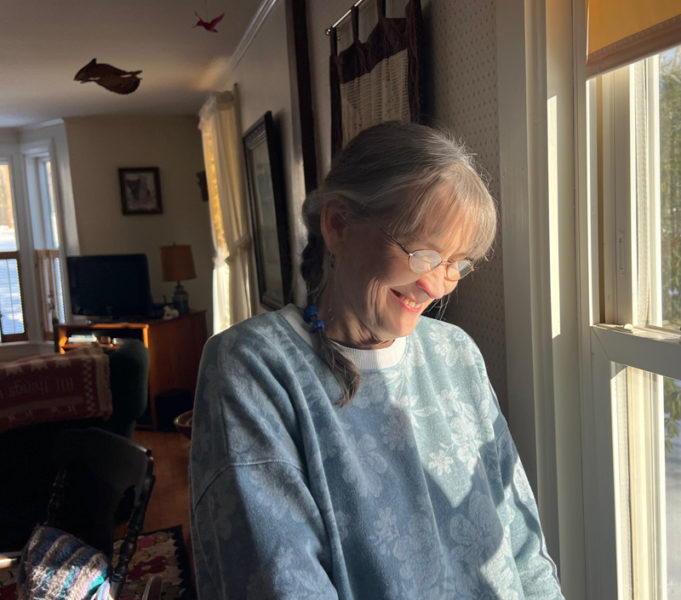
Pam Trahan at home, surrounded by photos, furniture, and mementos from her family and her husband David.
Read Jasper Stahl and you’ll see how in Waldoboro, people created deep fractures between each other over politics, religion, education, and commerce.
But talk to Pam Trahan, and you’ll see how connected we are – by blood, geography, history, interests, and love.
“Until I was 5, we lived in South Waldoboro, just past Finntown Road, in a small house near my father’s family farm. My dad was Ronald Nash, and he owned and ran his own gas station, Nash Shell Station, but I think he had the yen for more.
“One day he came back from work and said, ‘Let’s take a ride. I found some land.’ My mother, my sister, and I all piled into the car. My sister was 9, and I was 5.
“He took us to a dead-end, dirt road in North Waldoboro. There was no house; just the remains of a burned-down house; just a great, big chicken farm and a chicken house, and a lot of mess.
“‘Well, where are we going to live?’ my mother asked. Dad just said, ‘Well, we’ll figure that out.’ The land we were looking at was 340 acres with woods and fields.
“We moved up. My dad sold the garage, taught himself to cut wood, and became a substitute postal worker. With the money they got from selling our house, we got a small mobile home where we lived.
“I remember getting stuck in the mud that first year when we were clearing all the trash and how my dad came and lifted me up from my little red boots, which stayed behind in the mud. It was a wonderful place to grow up. We could ride our bikes and never have to worry about traffic. It was freedom.
“We had animals. I started out with a pony, and by grade school I had chickens and sold the eggs to my teachers. We had dogs and cats, too. When I was older, I got a horse.
“One day, my sister’s friend was getting a lamb. We asked, ‘Why can’t we get one?’ and off we went in the station wagon to bring back one of the little lambs. We named it Cuddles. He turned out to be a big, mean ram, but I could never have gotten rid of him. That’s how it was with all our animals. We kept them until they left us.
“Back then, 4-H was a big part of our lives. We got to meet people and even had a little group that met at the Orff’s Corner Community Club. We learned about birds and cooking and horse care. My sister and I even did two 4-H calves, which were supposed to be beef critters, but after we named them Wrinkles and Stardust, they turned into pets. Then they got bigger, and we sent them to live at my grandparents’ farm until it was their time to go.
“My father loved animals as much as we did. He and I did a lot together with them; we’d get the hay and we’d buy the grain at the Agway. I think he loved it as much as I did because he grew up having draft horses and cows and chickens, and that made us really close.
“For my mother, who was used to just cats, it was a lot. She was a Simmons who became Donna Nash when she married my father. She’d grown up down in Muscongus, near Bremen, and in her house, there were, more or less, 12 cats. When you opened the door, one would be coming in and another would be going out.
“She wasn’t used to my big animals, and my horse, and she was afraid of them. She put up with it because that was what we loved as kids and she could see that saw that it taught us responsibility. My sister and I would get up at 5:30 to care for all the animals before school and we loved it.
“When I turned 6, my mother went to work at the Friendship Street School. She started as a teacher’s aide, and then she became the school secretary. She did that for 20 years. Everyone knew Donna Nash.
“By my senior year in high school, I was a vegetarian. I’d gotten really interested in nutrition. I ended up with an associate’s degree in that. While I was doing my internship at Togus, I met David (Trahan – he was working in construction there), and we got married and I found work as a diet tech at Miles.
“I always stayed close to my parents. Family is everything! That’s been true for David, too. Every weekend, my mom would call and say, ‘Sunday dinner! Make sure you come!’ She always cooked these big Sunday dinners, and anybody was welcome. She covered the bar with baked goods. She loved it.
“My dad would do anything for anybody that needed help. When a neighbor’s house burned down, my dad and David went and cut wood for the neighbor to build a new house. My parents had a compass inside of them pointing to the right thing to do, and they never veered from it. Sometimes, when Dave was working in the State House, he’d come back and ask for my thoughts. I’d just point him in the direction where my father would have gone.
“Dave and I never had children of our own. It wasn’t meant to be, but I switched to working in the Title 1 program at Miller School, working with first and second graders and helping in reading, writing, and math. I think that helped settle things.
“I worked there for 16 years until my health grew so poor I had to leave. That was when I went back to school to be a certified nursing assistant and I started caring for older people. I stopped caretaking for others when my mother got ill. After she died, it felt too crushing to go back to that, so I started helping out in Dave’s office.
“It was Elizabeth Sproul who recruited me for the Waldoborough Historical Society. She had been my first grade teacher and lived up the road a bit. It must have been about 10 or 15 years ago. She just called me up and said, ‘How would you like to come with me to a meeting at the historical society?’
“She was probably in her 80s then. Well, she picked me up. I sat in on the meeting and at the end, they asked me if I’d like to be an associate. After that, we would go together, and she would pick me up or vice versa. When I got on the board, my mother was so proud of me.
“One of the things you do as an associate is sit at the main desk in the hours the museum is open for visitors, but you’re also supposed to look at the collections so you can learn about them. One time I was leafing through the World War II book and came across my great uncles, Herbert and Herman Hatch, twins on my father’s side.
“Herman had been in the Battle of the Bulge, and Herbert, in the Pacific. They both made it back, but the war took its toll on Herman, and he died before I got to know him. He lived the rest of his life in a small shack on Old Route 1. To see them in that book made me so proud.
“Inside the Boggs Schoolhouse I found their sister, my grandmother Hazel, in a high school photo from 1929. Her family was from Bath before there was a bridge – you had to take the ferry across the river to get to Waldoboro. Well, sometime in her senior year, she switched high schools from Bath (where she was going to be the valedictorian) to Waldoboro. Waldoboro High School let her share the award with the Waldoboro valedictorian.
“She married my grandfather, Maynard Nash, who I also found in a photo of a sixth grade class. That picture also hangs inside the schoolhouse. My grandfather never went further in school. His father died around then, and they needed him on the farm.
“I was lucky to know both of my grandparents. Hazel was on my father’s side, but she was like my mother: she liked to feed people. She had an old cookstove, and if you came by, she’d crank it up and whip up biscuits. If her cupboards were empty, she’d find something else to bake. She had a huge garden where she’d stand and wait for a potato bug, and when it landed, she’d drop it into her little can.
“It’s been a huge void since my parents’ deaths. They were my rock, and now that anchor is gone. Some days I still cry a lot.
“My dad came to me once in a dream. We were in the driveway together, and he was walking around checking everyone’s registrations and inspections, just like he always used to do when we visited him. It was so nice to see him.”

