


Lissa Jennings (left) and her daughter Erica Jennings, of Bucksport, choose their Salad Days plates at Watershed Center for the Ceramic Arts on Saturday, July 12 in Newcastle. This year marked Erica Jennings third and Lissa Jennings first visit to Salad Days. (Sarah Masters photo)
The picnic party in the woods in Newcastle gets bigger every year, as ceramic artists and their supporters from all over the world descend on the usually quiet campus of the Watershed Center for the Ceramic Arts for the annual Salad Days fundraiser.
This year’s Salad Days marked the 30th anniversary of the event. The celebration began with a VIP Garden Party on Friday, July 11 and continued Saturday, July 12 with a lunch buffet, invitational pottery sale, stein sale, artist demonstrations, and tours of the campus.
Watershed’s first Salad Days in August 1995 was free to attend and featured a public picnic, open house, and pottery sale. Programming included clay-working demonstrations and a children’s activity table. For a $10 donation, visitors could choose one of 250 one-of-a-kind handmade plates to eat from and keep as a souvenir. Proceeds supported Watershed’s community classes.
The event was so notable it quickly caught national attention. Delta Airlines’ in-flight magazine included Salad Days on their list of the country’s must-attend summer events of 1997.
Thirty years later, prices have risen, Watershed has transformed, but Salad Days remains largely the same.
Each year an artist in residence spends the winter months creating the hundreds of plates offered at Salad Days. This year, Portland artist Emily Armstrong made 520 plates over six months. The 2025 ticket price for a plate was $70 and needed to be purchased online prior to the event.
Armstrong said she had a great experience at Watershed. For her six months in residence, Armstrong focused on nothing, but making ceramics.
“It was awesome,” Armstrong said. “The plates speak to how much fun I was having.”
Attendees began lining up an hour early to get first crack at choosing one of Armstrong’s plates. The catered lunch offered five types of salads and freshly baked rolls and cookies.
Armstrong was among the artists demonstrating various ceramic skills throughout the day, showing other artists and the simply curious how she forms clay into a planter.
Didem Mert demonstrated how to apply a design to a piece of unglazed pottery. Asta Bubliene made a sample of the pillowy ceramic embellishments which adorn her vases.
The reverse raffle was the most exhilarating hour of Salad Days. Each of the 110 tickets sold wins a prize. As numbers are called, ticket holders choose their item from a table of donated ceramic pieces. Cheers, screams, and laughs rang out as eager watchers counted down the winner’s seconds to pick their piece.
Watershed Executive Director David East said there is something important about milestone markers. They are reminders of the history of the place, and that is particularly poignant when there has been so much change on the physical level with the new buildings, he said.
A lot of Salad Day attendees have seen Watershed’s changes over the years and they keep coming back, East said.
“There’s something really wonderful about that,” he said.
This year the founders were honored with the dedication of a new hillside garden.
Watershed Center for the Ceramic Arts launched in 1986 in the remnants of a former brick making factory. The studio was a converted chicken barn and there were twin beehive wood-fired kilns. Those kilns have since been decommissioned and one was dissembled so its materials could be reused around the property.
A recently completed capital campaign brought a new studio, common space, and updated artists residences to Watershed, among other improvements.
Two of Watershed’s founding artists, Lynn Duryea and Chris Gustin, led tours of the Windgate Studio.
According to Gustin, the dream behind Watershed was to offer a serious space for artists, for their ideas, and the work they want to make. The studio has an open concept because when people are put together to work, the less walls, the better, he said.
“It’s about giving accommodation to possibility,” Gustin said.
Elise Grams was excited to see the new studio during the tour. Grams attended a residency at Watershed years ago, before the new studio. She hopes to save enough money and then find the time to attend again someday, she said.
Watershed is a central and powerful part of ceramic community in the Northeast, said Joe Upham, who traveled from Boston, Mass. Upham’s wife, Janna Longacre, is on Watershed’s board of directors. Together they have been coming to Salad Days for nearly 20 years.
“It has been thrilling to watch it grow, and get more established and refined,” Upham said, adding he is always pleased to see how the property is developing during his every-other-year visits.
Armstrong’s sister Mallory Armstrong traveled to Salad Days from her home in Maryland.
“It’s so amazing how artists can start from the same materials and come up with such different things,” she said.
Funds raised from Salad Days will help to create the next generation of artists by funding classes, workshops, and Watershed’s community programming efforts.
For more information about Watershed Center for the Ceramic Arts, go to watershed.org.
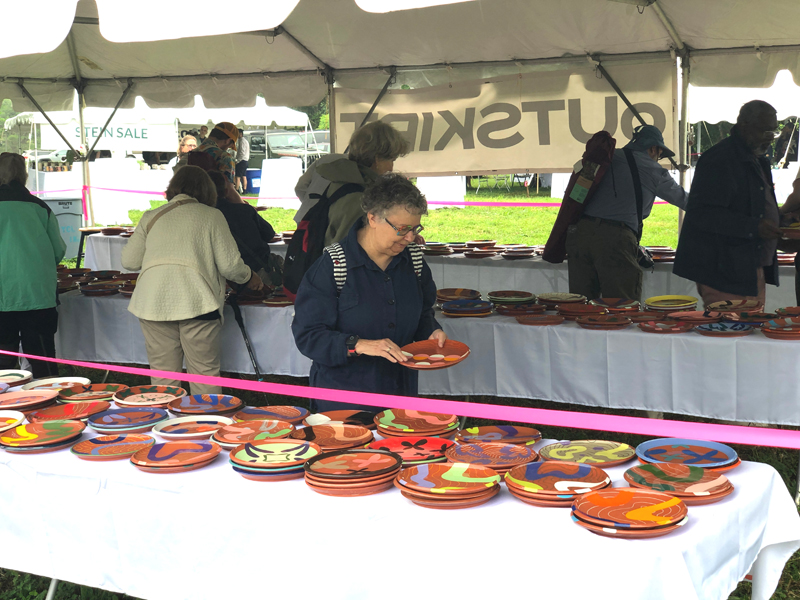
San D. Hasselman chooses one of 520 plates designed for Watershed Center for Ceramic Arts annual Salad Days event on Saturday, June 12 in Newcastle. Each year a selected artist spends six to eight months in residence at the center creating the hundreds of plates that are sold to support Watersheds community education initiatives. (Sarah Masters photo)

