

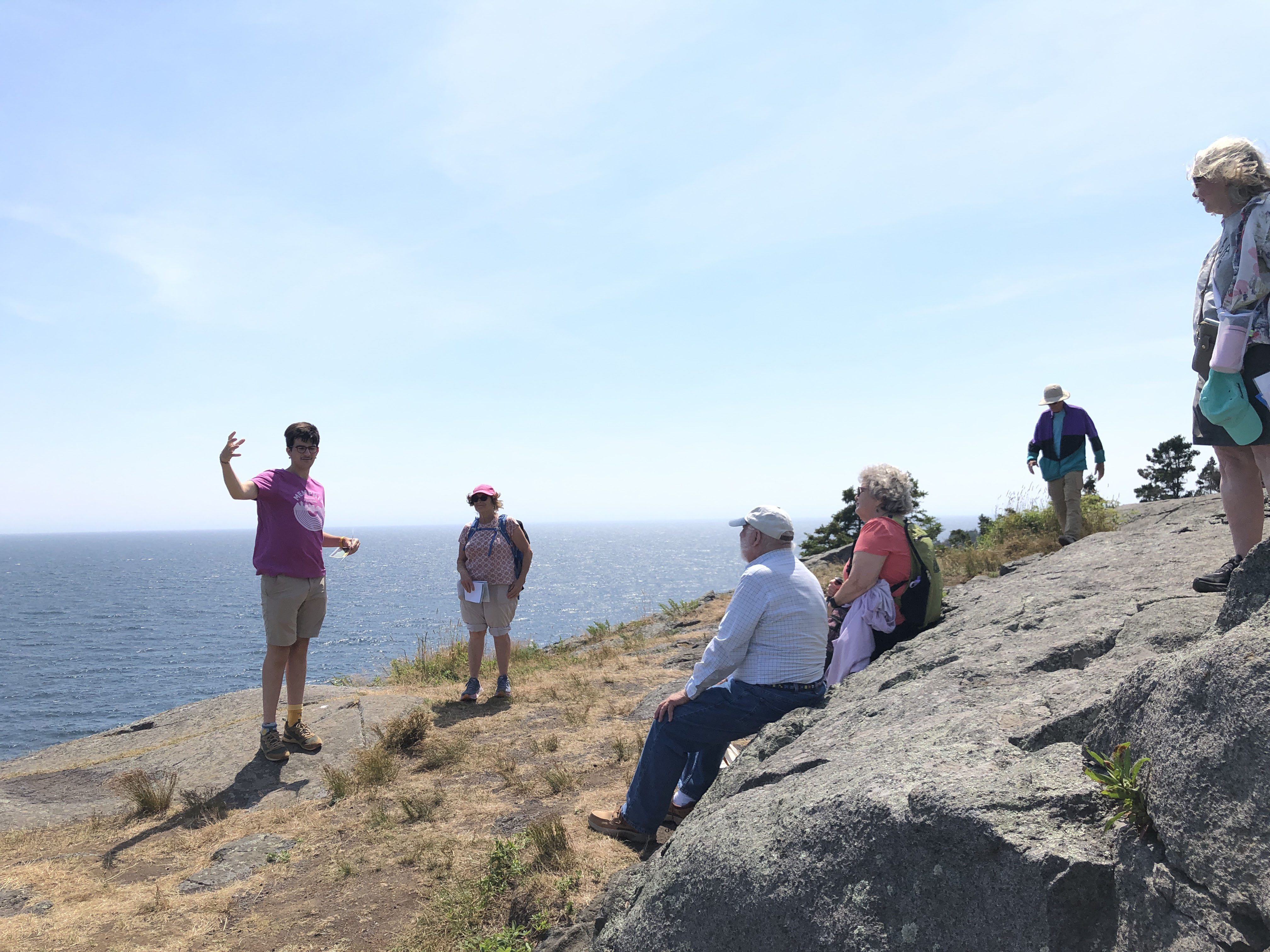
Bowdoin College biology student and Monhegan Museum of Art and History summer intern Tolly Kaiser (left) leads a group on a Wildlands Walk to Whitehead Cliff on Monhegan Island on Thursday, July 24 as part of the current exhibition Art, Ecology, and the Resilience of a Maine Island. Kaiser said he was happy to spend the summer on Monhegan bridging the museums exhibit of art and artifacts with the wildlife of the island. (Sarah Masters photo)
Artistic expression and scientific research collide in an exhibition thousands of years in the making and now at the Monhegan Museum of Art and History on Monhegan Island. “Art, Ecology, and the Resilience of a Maine Island: The Monhegan Wildlands” is more than an art show; it is also a biology lesson, a history class, and a community effort.
“Art, Ecology, and the Resilience of a Maine Island features” paintings, artifacts, photographs, maps, and scientific tools documenting Monhegan Island’s evolution since the ice retreated 17,000 years ago and particularly focuses on the eras of human influence on the island from Indigenous people to modern conservationists.
Each chapter of the island’s history brought changes to the ecology that affected Monhegan Island’s appearance and utility.
Where 25-feet-tall trees now stand, grazing sheep and deer once kept vegetation to a minimum. As the white spruce trees have grown, many have been killed by a parasitic infection called dwarf mistletoe Professor Barry Logan, of Bowdoin College, holds a doctorate in biology. He has spent more than two dozen years studying the dwarf mistletoe on white spruce trees on Monhegan Island, he said. About a dozen years ago, he became aware of the artistic traditions on the island.
“Although I was a little bit slow on the uptake, along the way I began to realize that the artists have a lot to say about the historical ecology of the island in ways that can help to inform my work,” Logan said.
Monhegan Museum Director Jennifer Pye said she was similarly unaware of the work scientists conduct on Monhegan.
“The biologists kind of keep to themselves out here,” Pye said. She did not know about Logan’s work until he came to her office several years ago with a picture of a Rockwell Kent painting from the mid-20th century.
“The story he saw told in that painting was something that I never would have conceived of, the way he saw the residue of the sheep and the growth of the forest, all of these things depicted in this one painting,” Pye said.
The work was eye opening and added a whole new layer to the way she looks at the art of the island and how it represents its ecology and what can be learned from that, she said.
“I didn’t look at the Edward Hopper painting and see the dwarf mistletoe infected spruce tree right in the center,” Pye said. “I didn’t recognize that for what it was, but now I’m seeing those elements, rather than just the place and the style of painting.”
That first meeting eventually led to the current exhibition. Logan began talking with Pye and Bowdoin College Museum co-Director Frank Goodyear to conceptualize the multifaceted show, which first ran at the Bowdoin College Museum this winter and spring.
“‘Could this be a thing?’ manifested into this project,” Logan said. Along with the first known renderings and maps of the island by English explorers and paintings from the late 1800s are new wide format panoramic photographs by Accra Shepp, of New York, commissioned for the exhibition and an audio/visual presentation captured by Bowdoin College students.
Pye said that while she never would have dreamed of an exhibition like “Art, Ecology and the Resilience of a Maine Island,” it feels very natural.
“It’s a way of fully embracing this unusual situation that we have. Where do you get to go and look at art in the place where it was made? Where you can look at the art and then walk out and stand where the artist stood,” she said.
The Monhegan Museum offers several programs that expound upon the displays in the exhibition. Bowdoin College biology student and Monhegan Museum summer intern Tolly Kaiser leads daily Wildlands Walks from Monhegan Museum. On Thursday, July 24, Kaiser provided a laminated flipbook with pictures of selected works from the exhibition and led a group of a half dozen island visitors onto the Whitehead Trail.
Monhegan Island’s untouched ancient forest has never been cultivated or cut down, which is rare to see in Maine, Kaiser said. Even today, while much of Maine is heavily forested, it is also heavily used.
Logging, herbicides, and pesticides used to control certain parts of the mainland’s environment are absent on Monhegan Island, he said.
“That’s a really special thing to have on an island like this,” Kaiser said.
Kaiser stopped several times to point out natural and human influenced elements of the island, dense ancient conifer groves juxtaposed against a barren patch now serving as the town dump.
Samuel Peter Rolt Triscott’s 1985 photograph “Sheep on Monhegan” depicts a small flock browsing a near desolate landscape of short grass patches among exposed rock.
Kaiser pointed out a mountain ash tree and said scientists were unaware that species grew on Mohegan as no ecological datasets included them. “But when looking at artwork in the museum, we saw (a Charles Ebert painting), which depicts Blackhead and has a mountain ash right in the front,” Kaiser said. “Artists can serve as documentarians for an ecological landscape.”
The ancient forest of Monhegan Island remains untouched and can look as they have for eons. Emil Holzhauer’s circa 1930 painting “Cathedral Woods” appears to portray the Cathedral Woods as they were nearly a century later on July 24.
The last page of the flipbook is a cardboard viewfinder. Patrons get a little help to see the sights the way artists have since Aaron Draper Shattuck first visited Monhegan Island in 1858.
At Whitehead Cliff, Kaiser pointed out three spruce trees afflicted with parasitic dwarf mistletoe. A painting that happened to include the infection was the spark that launched “Art, Ecology, and the Resilience of a Maine Island.”
“Artists paint what they see,” Kaiser said, “It’s important we’re respecting artists as documentarians and also as scientists that are collecting data for ecologists to use.”
Monhegan Museum President and Director Emeritus Edward Deci, who saw the show more that once at Bowdoin College, said it is wonderful to have a project that brings together Bowdoin College and the people of Monhegan Island.
“To put on an exhibit that’s just amazing,” Deci said. Pye said Deci spends more time in the exhibit on Mohegan than any of the staff. To complement all that time inside the gallery, Deci attended the Wildlands Walk on July 24. He was looking forward to getting on the trail.
“Out there, where all those artists were painting, out there,” he said. “Art, Ecology, and the Resilience of a Maine Island: The Monhegan Wildlands” is on view at the Monhegan Museum of Art and History, at 1 Lighthouse Hill, until Tuesday, Sept. 30. The museum is open daily. The Wildlands Walks are offered at 1 p.m. Monday through Friday at 1 p.m. from the museum.
For more information, including a 3D tour of the exhibition and information about the exhibition’s companion book, go to monheganmuseum.org.
(Correction: An earlier version of this article online and on Page 1 of the July 31 edition inaccurately described the ancient forest as pine groves when in fact the forest contains multiple species of conifer trees. The Lincoln County News regrets this error.)

