

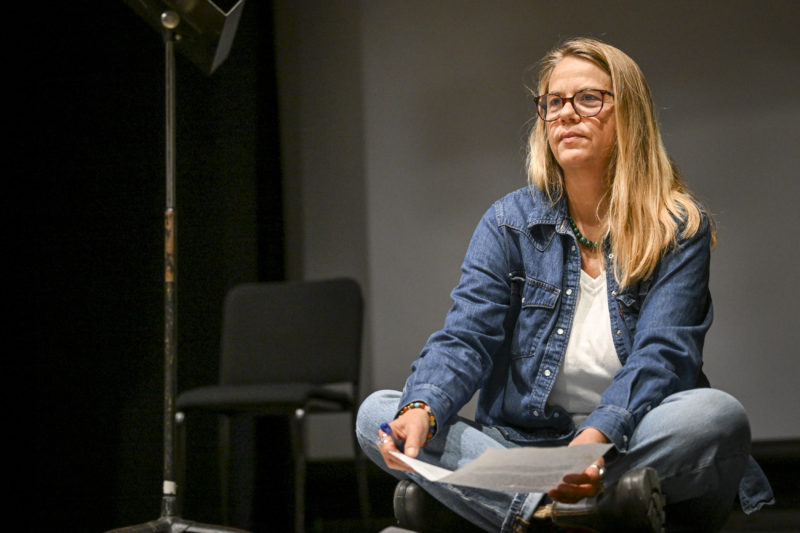
Hannah Johnson receives feedback during the third meeting of The Waldo Theatres storytelling workshop in Waldoboro on June 6. The opportunity to tell their story from the stage and comments on content and presentation from other workshop participants helped shape each story for the final performance. (Bisi Cameron Yee photo)
Backstage at The Waldo Theatre, Susan Morris sits in the green room sifting through a thick sheaf of papers. Laetitia Brundage stands in the hallway outside, arms braced against the wall as she studies a small stack of notecards.
Hanji Chang shifts side to side as she stands holding a slim white envelope. Karen Swanson breathes deeply as she admires an array of flowers on the quilt-covered piano, each bouquet accompanied by a small slip of paper folded like a fortune.
And mentor Heather Leslie moves gently between each person, her voice soothing, her experience a reassurance. She has been where they are now. She knows the jangle of nerves, the creeping doubt, the rising adrenaline as they each prepare to take the stage to share stories of love and hope and fear and loss and the mystery and mysticism of being human.
The culmination of the Waldo Theatre’s storytelling workshop took place in the historic venue on June 12. After two months of plumbing the depths of memory, finding the heart of a story, writing and rewriting, polishing practicing, and perfecting, five people took the stage and shared a small slice of their life with the audience that filled the sage green seats.
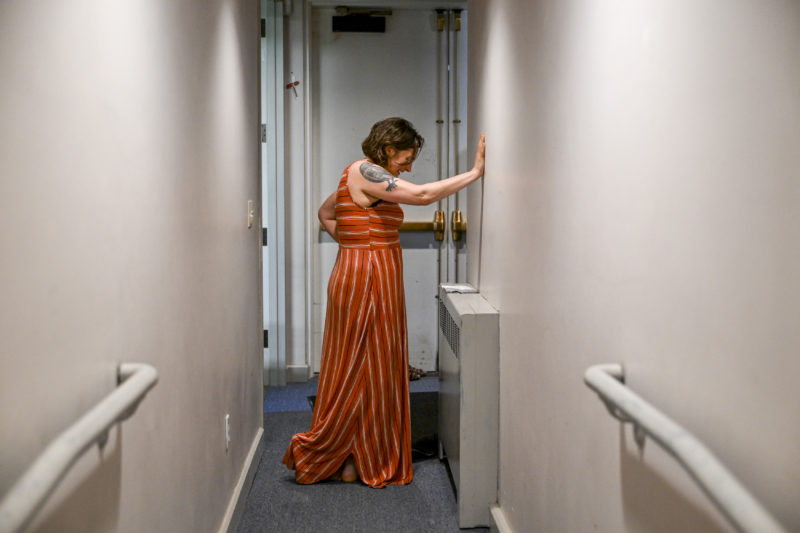
Laetitia Brundage reviews her notes just before her live storytelling performance at The Waldo Theatre in Waldoboro on June 12. Brundage used song to access emotions that arose after her mothers dementia diagnosis. (Bisi Cameron Yee photo)
The backstory
The storytelling workshop, now in its fourth year, is a free spring offering from the education arm of the Waldo Theatre. According to Education Program Director, Mia Branco, its aim is to foster collaborative creation “in reflection of or in conversation with the world around you.”
Led by Branco with assistance from Michael Amico, the workshop series got its start in 2023 with four storytellers.
Loosely based on “The Moth,” a weekly podcast, “it was a bit of an experiment,” Branco said. “But for the four of us who stuck with it, it was really impactful and we got a really good response from those who came. So we decided to do it again the next year.”
In 2024, inspired by a theme of “Dreams,” 10 storytellers performed. In 2025 nine storytellers spoke about “Second Chances.”
That year, Branco and Amico also started The Drafting Room, a creative community of workshop participants that meets monthly at the Open House of History in Waldoboro.
“I think that’s one of the things that I love most about it,” Branco said of the initiative. “That we can’t shake our storytellers off of us.”
This year The Waldo received a grant from the Maine Humanities Council that enabled the theater to provide the workshop series free of charge to participants and audiences alike.
Over the years stories have been shown in different formats. One participant recited their story in couplets. Others use music.
All the stories must be brief, 10 minutes or less. And they must be personal. And they must be true.
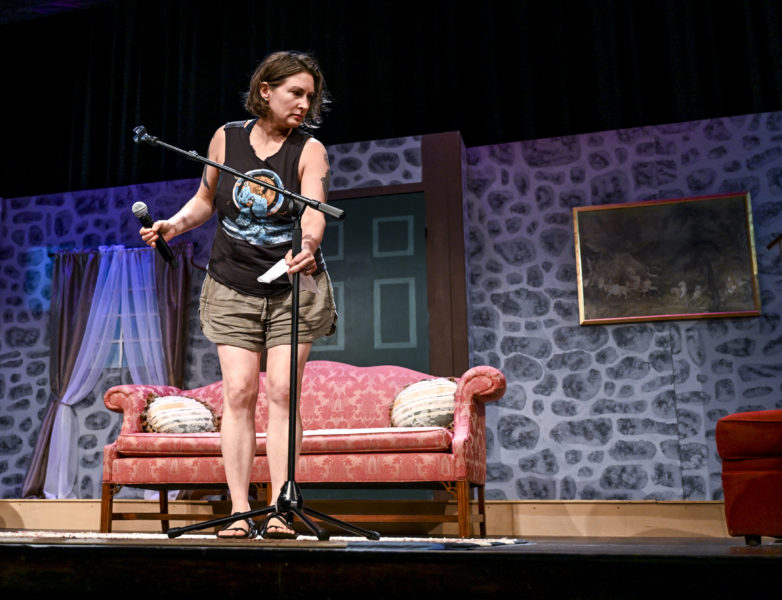
Laetitia Brundage takes advantage of an opportunity to practice using the microphone at The Waldo Theatre in Waldoboro on June 11. All of this years storytellers were experiencing reading their work from a stage to an audience for the first time. (Bisi Cameron Yee photo)
The seed
“There’s a lot of learning curve, there always is,” said Branco as she welcomed 16 participants to the first workshop of the year on April 11. “We learn from each other.”
That learning began with the elements of a story: the seed, the stakes, the challenge, and the arc – where the story starts, where it ends, and the journey in between.
Participants were then given six prompts on the theme of “Shared Paths” to explore journeys taken and people met along the way. After a brief time to write, the freshly germinating stories were presented to the group.
Initial pitches ranged from humorous digressions to romantic entanglements to family estrangements to adventurous exploits.
“Our stories do not have to be trauma,” Branco said. “Intensity can mean a lot of different things.”
Swanson, more used to the rhythms of the written word, found it challenging to make the oral story linear and logical and complete.
“This is like speaking backwards,” she said.
Chang, more attuned to visual art than verbal, used her story to explore a lifetime of adapting to different cultures without fully understanding her own.
“Looking outside the window, I forgot to look inside the room,” she said.
Branco and Amico encouraged participants to punctuate action with reflection.
“Be open to changing and adjusting the story, taking in feedback,” Amico said.
Branco agreed.
“At this point, the stories should be different every time you tell them,” she said. “If the story goes off on a tangent, follow the tangent. See if it’s important. See what gets unearthed.”
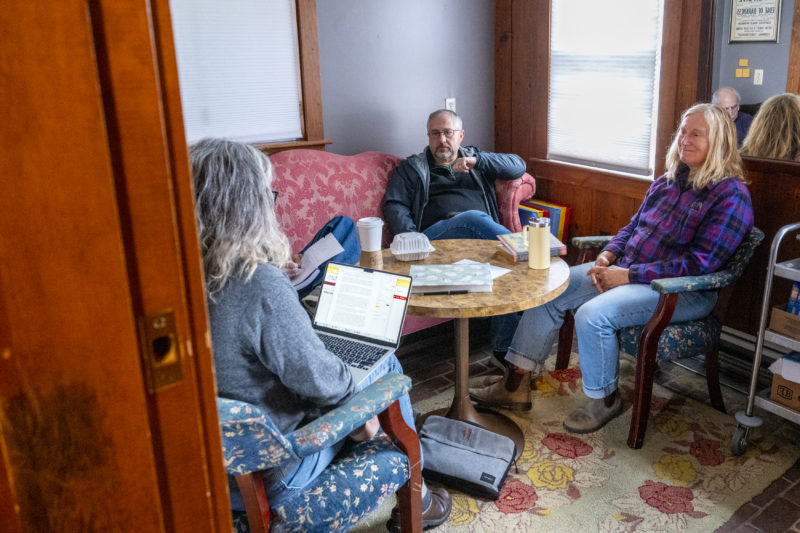
Karen Swanson (left), Jeff Mullin (center), and Jana Brownlee discuss the status of their stories during a storytelling workshop at The Waldo Theatre in Waldoboro on May 2. The 16 storytellers broke into smaller groups to share their most current drafts. (Bisi Cameron Yee photo)
The stakes
“The magic moments for me are always when you see the story click for the storyteller and for others and it’s always the same moment. Like, you can feel it,” Branco said.
On May 2 breakout groups dispersed through the theater, to the balcony, the green room, or the lobby in search of those moments. Feedback was shared and storytellers were encouraged to find it where their story begins and to cut extraneous details.
“Where there is humor, let the humor land. Save space for silence,” they were advised.
There were debates. Should Chang stick with her letter format or abandon it in favor of memorization? Would the letter provide the security and comfort necessary to face her fear and tell her truth?
In a final group read of the day, Jeff Mullin shared how he wrote and memorized his story, editing as he read it aloud.
“I’ve got the beats in my head.” he said.
Swanson said she learned from recording her story and listening back. That process prompted breakthroughs in her understanding of her own experiences.
“Something has shifted in me that feels powerful,” she said.
Morris found a new tangent, shifting from a humorous telling to something deeper, a dream world of memory.
“I’ve never cried over this before,” she said as tears welled up.
“This is why it’s a process. You discover right now what needs to be told,” Amico said.
The reading was emotional for multiple people as they expressed aloud for what may have been the first time stories that were troubling, painful, even heartbreaking.
Chang admitted she considered not returning.
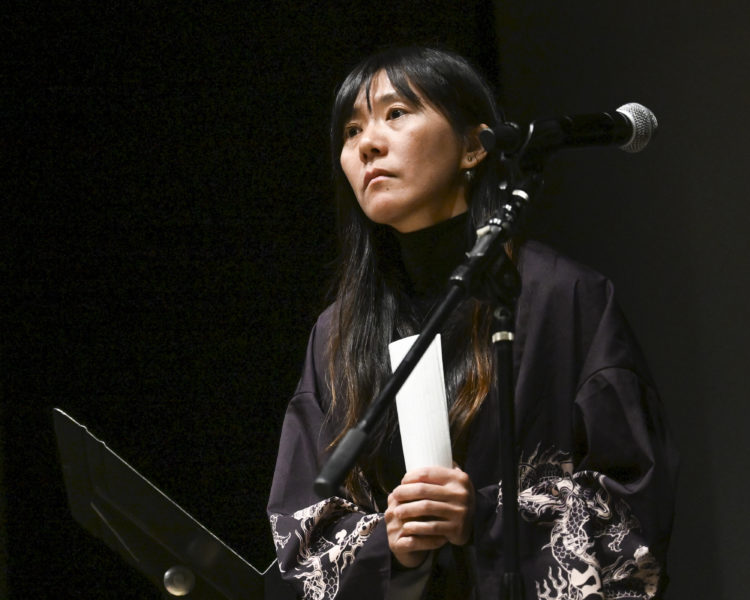
Hanji Chang holds the letter she is about to read to her fellow storytellers At the Waldo Theatre in Waldoboro on June 6. Chang formatted her performance around a confessional letter to Puerto Rican singer Bad Bunny. (Bisi Cameron Yee photo)
The challenge
On May 22 the more experienced storytellers shared the fruits of their labor at the Open House of History during the monthly Artwalk Waldoboro.
For the eight new storytellers, the first run-through on The Waldo stage was scheduled for June 6. Branco, who gave birth to twins just days before the final performance, was on bed rest by this time.
Amico gave feedback and coached storytellers on the basics: turning on the microphone, staying in the spotlight. And pacing the stories to be under 10 minutes – every story was running long.
Jana Brownlee told a story of loss and guilt and the death of her Air Force pilot father. Standing in front of the microphone recounting a fateful day in December 1968, she froze, rocked by the unexpected upwelling of emotion.
“Something deep within me just shook loose,” she said later. “And there was a moment as I was standing there that I could feel I was making a decision – do I go on? And then I put my hand on my stomach and I collected (myself) and I continued. And at the end of it, I felt this incredible completeness.”
Her partner Hannah Johnson faced a different struggle.
“I have a real issue with focusing on myself,” she said. “I’m a therapist so I focus on others and their stories and their feelings. So for me to take the limelight in that way? That’s a real challenge.”
It was Johnson’s first time standing on a stage, using a microphone, facing an audience of any size.
“I was nervous as hell,” she said. “‘I’m so perfectionistic about myself … I forgot this one line that was so important to me, but at the same time I was proud of myself. It was transforming just in those 10 minutes up there.”
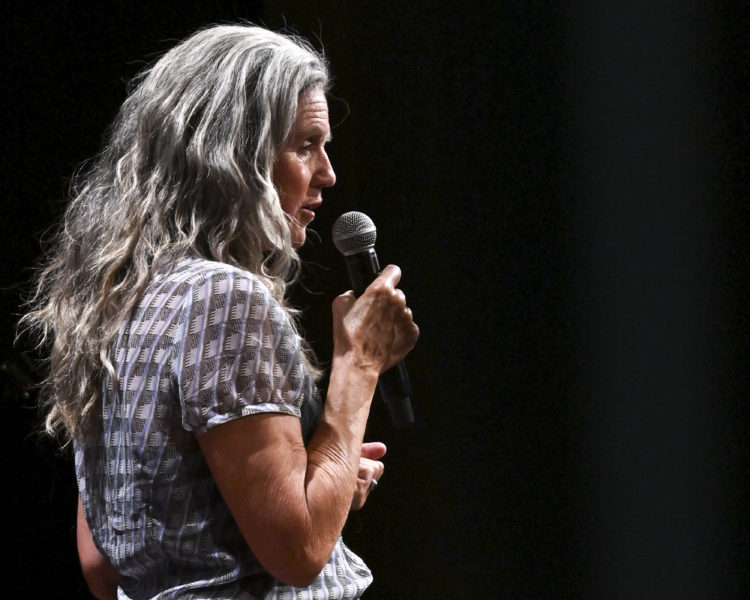
Karen Swanson recites the story she polished over two months of workshopping at The Waldo Theatre in Waldoboro on June 12. Part of storytellings essential charm is that things dont always go as expected: when the microphones batteries died midstory, Swanson gracefully recovered and continued her train of thought. (Bisi Cameron Yee photo)
The arc
The dress rehearsal was a week later. Amico reminded the storytellers to think about the arc of the performance as a whole.
“There’s an energy to each story and an energy to the show,” Amico said. “How is that energy carried from one to the next?”
All stories were still running long, but three performers, including Brownlee and Johnson, had shared that they were unable to make the show.
Amico gave last notes to the remaining five, suggesting that they avoid pacing the stage unless it made sense for the story.
“It’s so much more powerful the stiller you are,” he said. “And then when you do move, there’s tremendous weight.”
Morris would be the final performer and he suggested she pause after the first part of her story and “claim her power over the audience” reminding them that she had so much more to say.
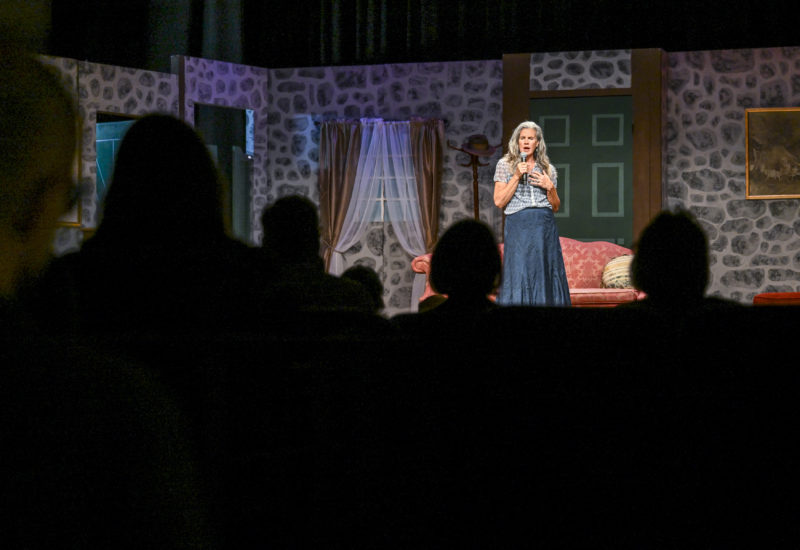
Karen Swanson speaks of love and loss to a rapt audience at The Waldo Theatre in Waldoboro on June 12. Storytelling themes ran the gamut from the humorous to the philosophical to the emotional to the mystical. (Bisi Cameron Yee photo)
The storytellers
Mullin was one of the mentors for this year’s series. He started telling stories with Community Plate, a Maine-based nonprofit that fosters connection through shared meals and stories in spring of 2025. He found the Waldo workshop shortly thereafter. And has continued to perform in a variety of venues, including the Maine Storytelling Muster last September.
Despite living 90 minutes away in Gorham, Mullin is committed to the storytelling community the Waldo is fostering.
“I think it’s the group, the camaraderie, the workshopping of stuff,” he said. “We’re in it together … We’re there for each other.”
Leslie also savored her role as a mentor. She appreciated the chance to slow down, to connect her stories even more with her scientific background.
“I love the way I get absorbed in writing protocols, and the editing process when there’s time to percolate,” she said.
But she still remembers her first performance.
“I hadn’t been so excited about something in a long time.”
Brownlee and Johnson are self-proclaimed introverts who have found themselves stuck, isolated and creatively blocked. The workshop addressed both issues.
“Maybe this will open up a creative flow,” Johnson recalled thinking. “And it did. It opened that door.”
But that door encompassed even more. Participation in the workshop also brought self-reflection and “so much healing … I wasn’t really expecting that, you know?” Johnson said.
Brundage, who used music to access her emotions around an all-too-familiar situation – the decline of her aging parents and her mother’s dementia – highly recommends the workshop.
“I think it helps to share your stories,” she said. “It helps me feel not alone in the process. You never know who’s going to connect with your story … I found something that I connected with in every story shared.”
Chang, who exorcised her fear and doubt in a letter to Puerto Rican rapper Bad Bunny, found the experience therapeutic.
“This is very new to me,” she said of finding catharsis in writing and performing.
For Swanson, who at 70 revisited the variety of love throughout her life from brief shining moments to the subtle ache of remembered loss, the waiting to go on stage was the hardest part.
“Too much space to second guess yourself,” she said.
Yet she had her story down, even recovering from technical difficulties when the batteries in the microphone died.
“What a rush!” she said as she exited the stage to appreciative applause.
Morris read her story directly from the page. The humorous dilemma she described about her attempts to rid her barn of rats contained echoes of magical realism, further emphasized by a dreamlike exploration of shamanism that led her and the audience and the workshop to a transcendent conclusion.
The curtain call
As for myself, I was the first storyteller on stage that night. I shared what I thought would be a charming meet-cute story, but as I processed that period of my life over the course of the workshop, I realized that the story went much deeper than I thought. It was about being lost in the most fundamental way at a critical time in my life. And being found.
For the last 30 years I have shared a path with the person who made everything possible. His support enabled me to do what I never dared dream – to tell stories like that one and to write stories like this one.
(Bisi Cameron Yee is a freelance photojournalist and reporter based in Nobleboro. To contact her, email cameronyeephotography@gmail.com.)

