

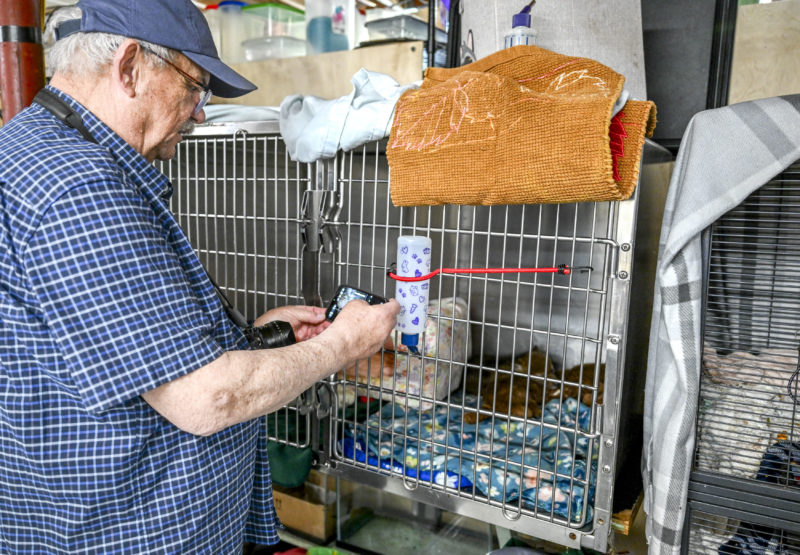
Peter Williams snaps a photograph of coyote pup Manitou at Wilderness Miracles in Bowdoin on Saturday, May 16. Williams was one of several people who stopped to help the at-risk animal as it tried to cross Route 1 in Damariscotta. (Bisi Cameron Yee photo)
“I love animals.”
That is the oft-repeated reason why people get involved in wilderness rescue. But for other people it’s a particular circumstance – like May 7, the day when multiple cars stopped to rescue a very young, very lost coyote pup attempting to cross Route 1 as a pair of eagles circled in the sky above.
Wiscasset resident Peter Williams and wife Leslie were on their way to Moody’s Diner in Waldoboro when they came across stopped traffic just past the Damariscotta turn-off. As they pulled to the right they saw a small animal run across the road right in front of their car.
Others at the scene identified the creature as a coyote pup and Williams left his car to follow it down the embankment. He found it burrowing into a small pile of leaves.
Leslie Williams said the coyote was very weak and easily captured.
“He was in danger,” she said of the coyote’s chances of survival on the heavily trafficked road. “Those big tractor trailers aren’t going to stop in time.”
Peter Williams said he hesitated to pick the small coyote up, knowing that rabies is a real risk when handling wild animals. But one woman who had stopped had a banker’s box in her car and he was able to safely make the capture. He said later that he believed the woman was the one who originally saw the coyote running along the side of the road and stopped.
“She’s the real hero,” he said.
After he and the woman placed several calls to various agencies, Peter Williams was contacted by Kathi McCue, of Wilderness Miracles in Bowdoin.
McCue started her animal rescue in 2019 and takes in approximately 1,200 animals a year. At any given time, there are squirrels, raccoons, possums, skunks, and foxes in the licensed basement facility she operates on her property. She doesn’t get coyotes often. McCue named the pup one Manitou, a First Nations word, which she said meant “wilderness.” “Individual animals need more help than litters do, so they get a little more personalized attention,” she said. While she often recommends waiting to see if a lost baby animal will make its way back to its mother, McCue said Manitou’s dehydrated condition combined with the dangerous road and the circling eagles meant catching the animal was an appropriate response.
Manitou wasn’t eating when he was first brought in to the facility. McCue and her team of volunteers treated him with IV fluids to replenish his electrolytes.
Still, she wasn’t sure he would survive. He was quiet the first couple of days and she checked on him often.
“But now he’s howling all night long,” she said when Williams came for a visit a week later. Williams wants to stay in the loop and see the rescue through to the coyote’s eventual release.
Manitou is regaining his strength thanks to puppy chow and Pedialyte. He will soon graduate to a diet designed to mimic the food he would have been eating in the wild.
Once he’s deemed stable, he’ll be moved to a larger cage and staff will be less hands-on to ensure that he won’t become too familiar with humans and will retain his wild nature.
“It’s about what’s best for the animal,” McCue said. “As much as we want to keep and love them forever.”
McCue plans to transfer Manitou to the Saco River Wildlife Center to join another rescued coyote. She said the two will probably be released together in July.
For those who may find themselves in a situation like the one Williams experienced, McCue urges attention to basic safety protocols.
“The first and most important thing is gloves when handling any animal,” she said. “If you’re bit, then the battle is lost.”
She also recommends calling the Maine Department of Inland Fisheries and Wildlife.
“They might put you in contact with a wildlife rehabber or they might advise you to leave the situation as you found it,” she said.
For help with lost or injured animals she also recommends a national nonprofit organization called Animal Help Now. Its easy-to-use website uses location data to find the closest humane resources for consultation or animal rescue.
Not all animals can be saved. Adult deer, for example, cannot be rehabilitated, as the stress of capture alone is likely to cause death.
“It’s just not possible,” McCue said.
In such cases game wardens may be able to come out to humanely dispatch a suffering animal.
“Sometimes that’s the call,” she said.
But for rescues like Manitou, there’s a chance. At places like Wilderness Miracles they are fed, medicated, and cared for by dedicated volunteers who love animals, and then they are released back into nature.
For more information about Wilderness Miracles, go to wildernessmiracles.org.
(Bisi Cameron Yee is a freelance photojournalist and reporter based in Nobleboro. To contact her, email cameronyeephotography@gmail.com.)

