


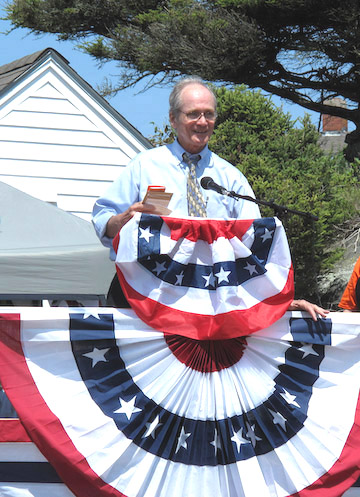
Former Monhegan Museum of Art and History President and Director Edward L. Deci died on Feb. 14 in his Rochester, New York home. Decis dedication to Monhegan Island and preserving its history and art culture helped build a collection from under 20 pieces in 1978 to over 33,000 pieces today. (LCN file)
More than 50 years ago, American art aficionado Edward L. Deci became enraptured with Monhegan Island during his first visit. After that, he quickly became a valued member of the island community, which he helped transform through decades of preserving and share the island’s cultural heritage and history.
Deci, of Rochester, N.Y. and Monhegan Island, died on Feb. 14.
Monhegan Museum of Art & History Director Jennifer Pye cannot remember not knowing Deci. She first visited Monhegan as summer staff in the early 2000s.
“He was everywhere. He was very outgoing and social; he had a real presence,” Pye said.
Everybody on Monhegan Island knew Deci, and every one in Deci’s life, family, friends, and colleagues, knew Deci loved Monhegan Island, according to Monhegan Museum Association President Adam Blumenthal. Blumenthal was one of more than 100 people from around the world who attended Deci’s memorial in Rochester, N.Y. on Saturday, March 14. Deci’s commitment to the museum, Monhegan, and Maine was noted by everyone in attendance.
“They all knew about us,” Blumenthal said.
Being on Monhegan Island, one could not help but know of Deci, but Blumenthal did not really get to know Deci until about six years ago when Blumenthal was invited to join the Monhegan Museum Board of Trustees.
Deci deeply respected the land and the artists who have visited or lived in the Monhegan art colony since the 1870s.
“The amazing thing about the Monhegan art colony is that all of the art movements in America had representatives on Monhegan,” Deci said in an interview with The Lincoln County News in July 2018 to commemorate the museum’s 50th anniversary.
Deci first visited Monhegan Island in 1973. He bought a home on the island in 1978, by which time his summer arrivals and departures were noted with the rest of the regulars in the Monhegan column of The Lincoln County News.
A turning point came in 1983 when Deci became a trustee of the island preservation group Monhegan Associates, which owned the Monhegan Museum. The collection consisted of a few pieces in rooms within the Monhegan Light Station. The museum’s annual budget was $200.
It was clear that preserving the Monhegan wildlands was a separate body of work from preserving the art of the island. When Deci suggested splitting the entities, in true Maine style, the association said it was a great idea for Deci to accomplish.
Deci became president of the newly formed Monhegan Cultural and Historic Association and director of the Monhegan Museum. An art enthusiast, Deci led lectures and talks at the Monhegan Schoolhouse relaying stories of the art and artists Monhegan inspired.
Deci advocated for the new museum all year, every year. In October 1984 Rockland’s Farnsworth Art Museum exhibited James Fitzgerald’s works, including many completed about and on Monhegan. Deci flew in for the show from Dallas, Texas, where he was teaching university courses.
Deci traveled the country to collect pieces for exhibition. In 1988 he transported 20 Jay Connaway oil paintings from the artist’s daughter’s home in Pawlet, Vt. to the island. That same summer Deci secured a $16,000 U.S. Park Service grant to repair museum buildings, reestablish a sewage system, and complete several other preservation projects. The grant required a local match, which Deci went about raising from islanders that year.
The museum’s future began to take shape with plans to rebuild the assistant keeper’s house to host the museum, a project completed in 1998. Deci oversaw the acquisition of the Monhegan Light Tower from the Coast Guard also in 1998.
Deci was an incredible person driven by passion for the art of Monhegan Island, Pye said. It was Deci’s tremendous vision which drove the museum from three rooms in the lighthouse with about 12 works of art to a collection of buildings including a climate-controlled gallery and a vault holding over 3,000 artworks and 30,000 pieces of archival material such as letters, photographs, and articles about Monhegan Island.
Each and every item was donated to the museum. Pye said Deci’s ongoing dedication created an environment which made people want to donate.
“The art and culture of Monhegan Island has been made by thousands of people over a century and a half,” said Blumenthal. “Deci defined, collected, personalized, and preserved it in a way that made it much more real and accessible to the residence and visitors.”
Deci was excellent at explaining why the art should be preserved and studied in a very relatable way the reason Deci was successful, said Blumenthal. He understood the heritage.
Monhegan Museum Vice President Susan Bateson and her husband have been friends with Deci for more than a decade.
“We were blessed to know him,” Bateson said.
Visiting Deci in his Rochester and Monhegan homes was always a treat, she said, as Deci regaled Bateson and her husband with stories of Deci’s art collection journey. Art hung floor to ceiling on every wall, including the bathrooms, said Bateson.
“We enjoyed many a dinner together talking art, artists, Monhegan stories, and, of course, his, and our, beloved museum atop Lighthouse Hill,” she said.
Deci’s great gift was helping individuals make their own dreams real, Blumenthal said. Everyone has a great affection for him, not because he created a museum, but because he knit together so many lives through history and cultural connections. Deci gave people something that they could take away from the island, a really rich and important experience.
Deci’s support for Monhegan Island’s causes extended beyond the museum. He was frequently called upon for his friendly and engaging manner, Pye said, and his ability as auctioneer to coax bids higher with proclamations like “You’re not here to get a good deal, this is for a good cause!”
Deci was a great mentor to so many who responded to the same interests, said Blumenthal. Blumenthal, Pye, and other people feel more connected to each other and to Monhegan Island more because of Deci, he said.
In Deci’s amazing and transformative academic career, he attributed autonomy, relatedness and competence as being essential to human experience and motivation. Deci brought those concepts to the island, and as he predicted, it worked, said Blumenthal.
Deci’s foresight led him to begin to make space for the next generation of leaders well before his health declined, Blumenthal said. Deci began to think about the need for the institute to grow and become stable. He raised a few million dollars to start an endowment, which would support the buildings and staff for the long term.
Blumenthal has a background operating endowed nonprofits, so he was invited to join the board to support those functions.
Deci served as director of the museum for 36 years until his retirement in 2019. He remained president of the Monhegan Museum of Art and History Board of Trustees through 2020, after which he was named president and director emeritus.
Deci’s dedication and passion for Monhegan’s art colony were documented in short film “Ed Deci and the Monhegan Museum: A Love Story” in 2023. The film is available the Maine Public website at video.mainepublic.org.
Deci was also a humble person, Pye said. The Monhegan Museum is a “side note” in his life compared to Deci’s significant contributions modern psychology via developing the theory of self-determination. A few years ago, Pye’s then-teenage daughter was preparing for the SATs when she recognized Deci’s name in an essay question.
“She said ‘Wait, that’s my neighbor!’” Pye said.
Ever unassuming, Pye’s daughter had no idea of Deci’s mainland influence.
In his final summer on Monhegan Island, Deci still visited the museum daily. Pye said Deci spent more time in the gallery than any employee, making Deci a well-known island presence even for summer staff of 2025.
Deci also attended the island walks, which gave patrons an up-close view of the paintings subjects. Deci said making that connection was a vitally important part of understanding the art and artists who have been called to Monhegan Island for more than 150 years. To Deci, the entire island was an exhibition.
A remembrance and gathering honoring Deci will be held on Wednesday, Aug. 12 at 1 p.m. at the Monhegan Church.
“No building on the island is large enough to hold everyone that would like to celebrate his life,” Blumenthal said.
For more information about Deci and the Monhegan Museum, go to monheganmuseum.com.

