

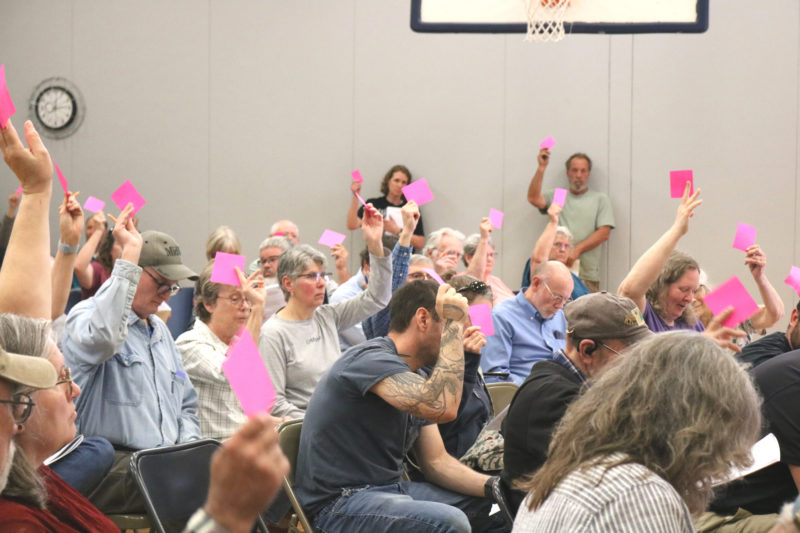
Somerville voters hold up a pink card to indicate their vote during the annual town meeting on Saturday, June 20. The meeting lasted four hours, with multiple questions around the state of the town financial accounts. (Christine Simmonds photo)
Over the course of a four-hour annual town meeting at Somerville Elementary School on Saturday, June 20, voters rejected a proposed solar and food sovereignty ordinances, as well as a paving reserve account.
The municipal budget of $772,292, an increase of $12,427 or 1.64% from last year, was approved, as were upgrades to the town computer system.
The majority of discussions focused on the status of municipal accounts and when the town would be ready for fiscal audits, which have not been completed since 2021.
Last year the town hired Christopher Backman, a former municipal auditor and current town manager of Orrington, to organize the financial records in preparation for the five years of audits.
The first of two $18,000 payments to Backman for his services was approved at the 2025 annual town meeting as a standalone warrant article. The second $18,000 payment was approved at the June 20 town meeting as part of the 2026-2027 fiscal year municipal budget.
Backman said he was about 40% finished making the town ready for the audits.
“I’m plugging the holes,” he said.
Backman said there were years of deposits into bank accounts, handwritten checks to unknown individuals, and some payments that were not recorded anywhere. He said he found bank accounts where the only person with access has been dead for 10 years.
After Backman’s comments, Town Clerk Erin Pellerin said Maine Municipal Bond Bank had informed her the town was in danger of no longer being able to take bonds out.
Somerville Select Board Chair Willard Pierpont said he was told the town was being audited each year, but after being elected he discovered the audits were not being done. No auditor would touch the town accounts in their current state, according to Pierpont.
Voters overwhelmingly rejected the proposed solar energy ordinance the planning board drafted. The ordinance would have prohibited commercial solar farms inside the town and allowed residential solar systems of 30 kilowatts or less and residential/business solar systems of 50 kilowatts or less.
The ordinance defined a commercial solar farm as a system that primarily served an offsite user, such as the electric power grid or a nonadjacent parcel.
Due to the wording of the proposed ordinance, residents expressed concern that any home selling excess power back to the Central Maine Power Co. grid would be classified as a commercial solar farm.
Voters also rejected the food sovereignty ordinance the planning board had drafted.
The ordinance would have authorized the town to establish local control over food sales and make exemptions for state licensing and inspection requirements regarding food, except meat and poultry.
Kelly Payson-Roopchand, owner of Pumpkin Vine Family Farm, said she had health and safety concerns regarding the proposed ordinance. The farm is subject to inspections to sell her products, Payson-Roopchand said, and she works with the inspectors to make her products safe.
“I would encourage you to vote this down and to go buy local foods,” Payson-Roopchand said. “We as farmers do not want to make any people sick. Food sovereignty sounds great, but you don’t want to be the farm that kills someone with your cheese.”
Voters approved the municipal budget, which totaled $772,292. In assisting with the preparation of the budget this year, Backman said he shifted some line items between cost centers to coincide with the proposed new accounting software and to make the budget process easier to understand in the future.
Personnel totaled $90,999, a decrease of $11,047 or 10.83%.The decrease was primarily due to line items being moved to other parts of the budget. The budget category included the second $18,000 payment to Backman as well as a $20,000 allocation for an auditor. Both are new line items this year.
Budget committee member Catherine Ladd said the cost of an auditor had increased exponentially since last year, so the town was trying to build in some reserves to avoid being hit with a huge bill at the end of the auditing process.
The assessing agent cost for this year was $12,000, an increase of $5,000 or 71.43%. In a previous interview, Backman said the town’s former assessing agent left the position, and the new assessing agent cost more.
Voters approved a public safety budget of $104,350. The category is new for this year, as all items were previously in other categories.
Town roads totaled $302,650, a decrease of $74,750 or 19.81%. Backman said previously the budget was separated into a paving reserve, sand, salt, and plowing. Residents voted down the paving reserve, which was a separate article.
The plowing contract, which was previously listed under “snow/ice removal,” increased by $7,250 or 4.53%. Winter salt was added to this budget, increasing the total by $12,000.
Capital road construction and capital road equipment were both moved to the town reserve accounts.
Insurances, a new category for this year, totaled $25,927. Payroll taxes and workers compensation both moved from personnel.
Voters amended Articles 11, 13, 18, and 19 to change the fiscal year listings of “FY26” to “FY27” and “FY25” to “FY26.”
Pellerin said all previous town reports she had seen listed the fiscal year by the earlier year. She said on Monday, June 22 that her main concern was record keeping moving forward, if the dates did not match from one year to the next. She had contacted Maine Municipal Association, who is now waiting to hear back from a lawyer on the matter.
The next Somerville Select Board meeting is at 6 p.m. on Wednesday, July 1 at the town office. For more information, call 549-3828 or go to somervillemaine.org.

