

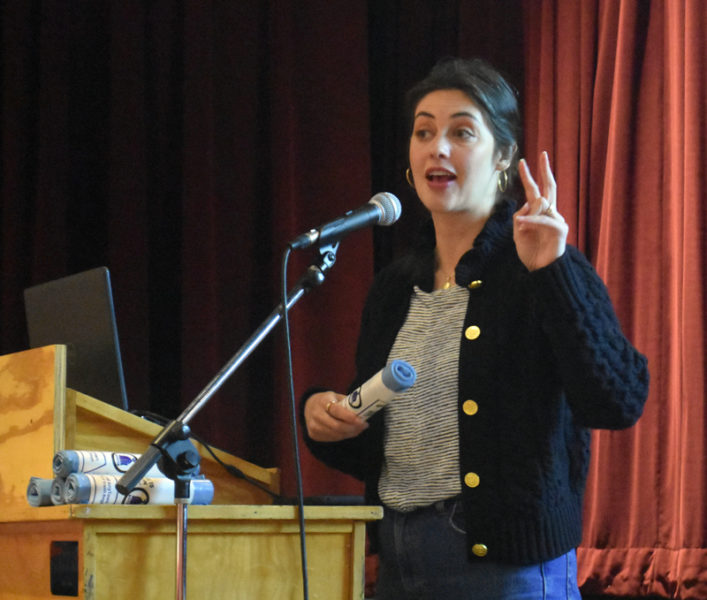
Taylor Millspaugh, director of municipal partnerships with material and waste management company WasteZero, speaks about pay-as-you-throw waste disposal at Medomak Valley High School on Tuesday, May 20. WasteZero manufactures trash bags using recycled plastic for sale to municipalities. Millspaugh said she believes pay-as-you-throw is the only “fair” way to handle trash disposal. (Molly Rains photo)
In a world where waste production continues to rise and disposal options grow fewer and more expensive, who should bear the cost of trash?
About 20 Waldoboro residents and town officials, and two Cushing residents, gathered at Medomak Valley High School the evening of Tuesday, May 20 to continue that discussion, which has been ongoing in Waldoboro for decades.
“We’ve been talking about pay as you throw for 30 years that I know of,” said John Daigle, Waldoboro’s director of public works. “The prices are getting ridiculous. I don’t know where we’re going to put the trash.”
The operating budget for the Waldoboro, Cushing, and Friendship transfer station surpassed $1 million for the first time in fiscal year 2025, a mark it will hit again for next fiscal year. Waldoboro’s proposed share transfer station’s fiscal year 2026 budget is about $602,000.
During budget deliberations, the Waldoboro Budget Committee decided to invite a third party speaker to town to discuss pay-as-you-throw as a potential remedy to the high budget, according to an advertisement for the meeting provided by the town office.
“People stay with pay-as-you-throw because it works. It makes sense,” said Taylor Millspaugh, director of municipal partnerships with waste management company WasteZero. The South Carolina-based company manufactures trash bags in the U.S. for use in pay-as-you-throw programs.
In such a program, as described by Millspaugh, residents must purchase trash bags through the town and use only those bags to dispose of garbage. The bags are colorful and recognizable, usually orange, blue, or green, helping staff at the transfer station enforce their use.
A municipality can set the cost of the bags, though they typically range from one to two dollars per bag, Millspaugh said.
According to Millspaugh, communities that implement pay-as-you-throw waste disposal see a reduction in overall garbage of about 44% on average, as well as increased recycling. Pay-as-you-throw incentivizes recycling by making garbage more expensive, she said.
Proponents said it was “fair” to require residents to pay for what they produce in garbage.
“It’s your stuff. It doesn’t belong to me. It doesn’t belong to anyone else in this room. It’s yours,” said Waldoboro Select Board member Bob Butler, who called pay-as-you-throw “the most fair, most equitable program.”
Critics said the program would unfairly redistribute the cost of waste management onto residents who are already disadvantaged, such as those living in homes without running water who must use paper plates and therefore generate more waste.
Waldoboro Select Board member Michael Thayer called the program a “regressive tax,” which is a tax that extracts more value from lower-income people than from higher-income people.
He also pointed out the program would affect young families, who must contend with higher volumes of garbage produced by babies, citing diapers as an example.
“That really hurts parents,” he said.
“What pay-as-you-throw does is it shifts the tax burden onto poor people away from people who own their third home on the water in Cushing, or Waldoboro or Friendship,” said Waldoboro resident Brendan McGuirl, who is also a member of the town’s planning board. “It’s kind of a crazy idea that we would be considering raising taxes on poor people at a moment where all of the support systems are being cut in the federal government.”
Butler said he disagreed, saying his definition of equity was tied to personal responsibility for the volume of waste produced.
Millspaugh said some municipalities chose to give away a certain number of bags to residents every year or issue vouchers for low-income residents.
Waldoboro Select Board member John Blodgett said he wanted the town to “focus on recycling first” as a way to reduce the volume of garbage handled by the transfer station.
He said that he heard very few complaints about the transfer station budget.
The fourth Waldoboro Select Board member present, Rebecca Stephens, said she shared Thayer’s concerns and was worried about the impact on individuals without running water.
Another attendee said she was worried that implementing the program would lead more residents to begin burning their trash.
“I worry about the impact on those who can’t afford the bags, and I worry about the impact on our environment if everybody goes out and burns their trash,” she said.
Millspaugh said other pay-as-you-throw programs her company oversaw had not resulted in an increase in dumping, though she said she did not have data on burning.
Ultimately, she urged the town to continue with the conversation, citing a worsening “waste crisis” in New England characterized by closing landfills and waste processing plants.
Daigle echoed these concerns, and said he believed the model would be a way to significantly cut the transfer station budget.
However, Town Manager Julie Keizer said any conversations going forward would have to include representatives from Cushing and Friendship, who were sparsely represented at the May 20 meeting.
For more information, go to waldoboromaine.org or call 832-5369. The next meeting of the Waldoboro Select Board will be held at 6 p.m. on Tuesday, May 27 at the town office.

