

-
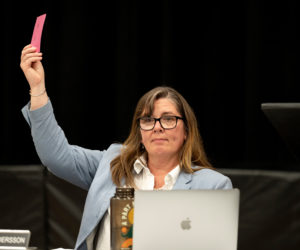
- Wiscasset Superintendent of Schools Dr. Kimberly Andersson votes in favor of an article during a special town meeting to consider the education budget on Wednesday, April 29. Im relieved that it passed, Andersson said. And now we have one more hurdle, which is June 9th. (Bisi Cameron Yee photo)
-

- Ed Polewarczyk speaks in opposition to the proposed education budget during a special town meeting in Wiscasset on Wednesday, April 29. Citing the proposed per student cost of a little over $32,000 along with deficiencies in academic performance, Polewarczyk said “parents ought to be furious that their children are not meeting expectations in core subjects. (Bisi Cameron Yee photo)
-
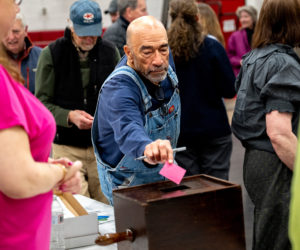
- Jorge Pena drops his vote into the ballot box during a special town meeting to consider the Wiscasset education budget on Wednesday, April 29. Article 14, which authorized the town to raise and appropriate additional local funds in excess of the state minimum requirements required a written ballot vote. (Bisi Cameron Yee photo)
Wiscasset voters approved each of the 20 education budget articles put before them during a special town meeting on Wednesday, April 29. The $11.2 million budget still requires final validation by voters at the polls on Tuesday, June 9.
The total amount requested by the Wiscasset School Department for the 2027 fiscal year is $11,217,742, an increase of 4.41% or $473,623 over 2026. The Wiscasset School Department includes both the elementary school and the middle high school and covers pre-K through 12th grade education. The money to fund the budget comes from a combination of anticipated revenue and local tax dollars.
The total anticipated revenue of $3,700,802 is a decrease of $83,646 or 2.21%. State subsidy totals $1,943,652, down $7,302 or 0.37%.
The total amount to be raised through local taxes is $7,516,940, up $557,269 or 8.01%. The required town contribution is $3,950,277, up $338,467 or 8.57%. According to an explanatory note in the warrant, the town contribution is the amount of money determined by state law to be the minimum amount the town must raise to receive the full amount of state dollars.
Additional revenue sources are estimated, according to Superintendent of Schools Dr. Kimberly Andersson. These include tuition at $550,000, down $50,000 or 8.30%; special education tuition at $350,000, down $100,000 or 28.57%; and a fund balance of $500,000, down $100,000 or 20%.
Revenue from interest at $62,500 is up 400% from last year.
“We are now able to get interest on our fund balance money that sits in the town’s account,” Andersson explained at an informational meeting held just prior to the vote.
Revenue from bus operations and repair is expected to increase by $10,000 or 25% as a result of sharing mechanic services with Edgecomb and potentially Boothbay. Revenue from the Sheepscot
Regional Education Program, which Andersson said is a special purpose primary school that rents space from the Wiscasset School Department, totals $24,150, up $1,150 or 4.76% due to an increase in rent. Anticipated other revenue totals $310,000, up $112,506 or 36.29%.
Andersson said the revenue comes from direct reimbursement from the state of Maine for all pre-K special education costs, as well as a special fund from the town that pays for high school band.
Miscellaneous revenue is even to last year at $10,500.
During the April 29 meeting, Wiscasset voters had the opportunity to approve the budget line by line, voting on each of 11 cost centers.
Wiscasset voters approved expending $3,793,799 for regular instruction, an increase of $134,067 or 3.66%. The bulk of the increase came from pre-K instruction at $339,170, an increase of $92,829 or 37.68%. Grades 3-8 were budgeted at $1,407,231, up $53,336.20 or 3.94%. Kindergarten through second grade totaled $681,213, up $6,982 or 1.04%. Secondary education, at $1,366,184, decreased by $19,080 or 1.38%.
Ed Polewarczyk, a Wiscasset resident, spoke in opposition to Article 2, which covered expenditures for regular instruction. Polewarczyk questioned the accuracy of enrollment numbers
and student to teacher ratios, and called Wiscasset’s cost per student “excessive.” He also expressed disappointment with the school’s academic performance and the percentage of students failing to meet expectations in core subjects.
“My conclusion: performance is unacceptable; cost is excessive. I urge the assembly to vote against the motion,” he said.
Responding to Polewarczyk’s comments during the vote, Andersson said Wiscasset students are “not far off the state average” and that the better thing is to look at the growth from fall to fall and
spring to spring.
“Our kids are improving,” she said.
She cited the “COVID hangover” as a factor in performance and stressed that the hiring of interventionists to provide additional individualized instruction is leading to improvement.
“We’re working on it,” she said. “We have a lot of work… But we have a plan.”
The cost center that saw the largest increase in both dollars and percentage was special education instruction, budgeted at $2,866,900, an increase of $274,324 or 10.58%.
According to Andersson, the increase is due to additional out-of-district placement costs for elementary and secondary special education students.
Other instruction, which includes athletics as well as the alternative education and the gifted and talented programs, came in at $401,604, an increase of $1,945 or 0.49%. According to Andersson,
a restructuring of the gifted and talented program mitigated some increases in salaries and benefits, resulting in a $30,000 budget, $19,503 or 39.40% less than last year.
Student and staff support was budgeted at $843,550, an increase of $54,199 or 6.87%, of which technology was responsible for $218,330, up $40,502 or 22.78%.
System administration was budgeted at $548,895, up $24,651 or 4.7%. Andersson said the charge for the annual audit increased “by a lot” and that the audit would likely go out to bid next year to mitigate the expense in the future.
School administration was budgeted at $630,984, an increase of $16,118 or 2.62%. Andersson pointed to a new centralized office supply closet as one way the school department is trying to keep costs down.
Two cost centers decreased from last year. Transportation and buses totaled $663,858, down $34,578 or 4.95%, and facilities and maintenance, at $1,392,151, was down $23,104 or 1.63%.
A $50,000 warrant article for “all other expenditures – other food service transfer” is flat to 2026.
Andersson said the $50,000 offsets the portion of the $368,000 food service program that is not covered by federal funds. Two cost centers – debt service for locally funded school construction
projects and career and technical facilities, which includes expenses for the Bath Career and Technical Center each totaled $0. There are no current construction projects and the cost of the Bath Career and Technical Center is now paid directly by the state.
Voters approved raising $26,000 toward the Boothbay-Wiscasset Regional Adult Education program. An additional $8,000 to cover the cost of the program will come from the town’s existing fund balance.
Program costs are shared between Wiscasset and Boothbay based on population. Andersson said that by raising money locally instead of pulling from the town’s fund balance, the adult education program will be eligible to receive more money in subsidy from the state in the future.
Votes by school committee members continued to reflect the split seen in previous meetings, with Vice Chair Jonathan Barnes and committee member Brycson Grover voting consistently in opposition to the more substantive line items while Chair Tracey Whitney and committee members Doug Merrill and Christopher Hart supported all articles.
“I’m so impressed by the turnout in our town,” said Andersson after the meeting. “There’s an interest in public education. The sea of pink tickets lets me know people support what we’re doing here and that’s wonderful.”
Andersson said one of the biggest opportunities to offset budget increases is to recruit more students to the centrally located school system. A number of surrounding towns have school choice and “I believe that they should choose Wiscasset,” she said.
Representing those who voted against the budget, Barnes recognized that “the majority rules, the crowd voted, the town will vote in June. I would ask for a no vote. Short and sweet.”
The final vote to approve the education budget will take place at the polls on Tuesday, June 9, when voters will consider whether to validate the budget. The education budget is posted in its entirety along with related documents and a line by line breakdown of costs at tinyurl.com/mr2hwejy.
(Bisi Cameron Yee is a freelance photojournalist and reporter based in Nobleboro. To contact her, email cameronyeephotography@gmail.com.)

