

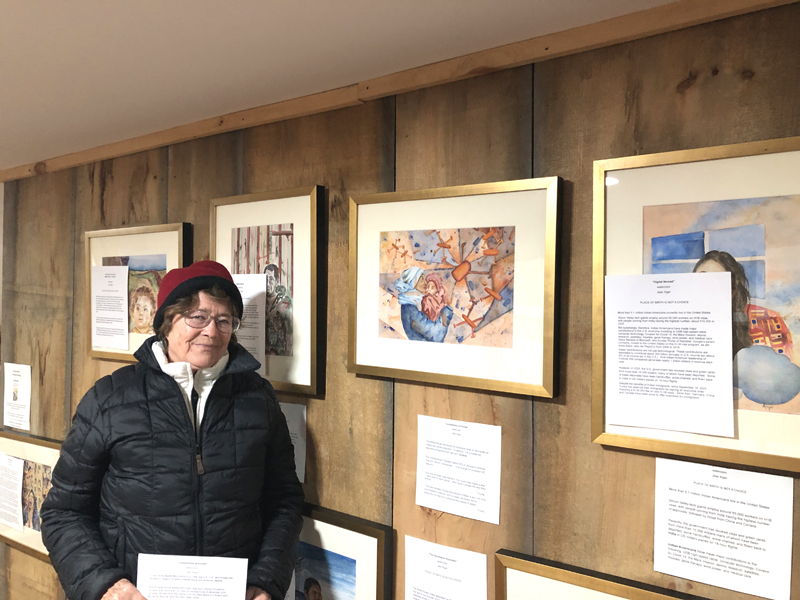
Waldoboro artist Jean Kigel poses in her Back Cove gallery next Constellation of Drones, one of 11 portraits she created to capture various current immigrant experiences in the United States and beyond in Displacement: Immigrant Portraits. The exhibition is on display through January at Skidompha Public Library in Damariscotta. (Sarah Masters photo)
“Displacement: Immigrant Portraits,” a watercolor series by Waldoboro artist Jean Kigel, is now on display at Skidompha Public Library in Damariscotta.
Kigel is usually known for elegant, peaceful compositions. She has tackled watercolor kayaks and dories, Maine crustaceans, meadows, and lichen. She has been fascinated with fragile flowers and whimsical attic windows, seascapes and other vistas, Acadia National Park and Monhegan Island.
Kigel has always painted to capture the images she sees. Growing up on a 200-acre farm in Warren, her first subjects were farm houses, fields, and shores. Travels in Japan, China, Latvia, and Jordan all influenced her style and subjects.
In January 2025, Kigel saw a rapid increase in the detention and deportation of immigrants living in the United States. The suffering and terror moved Kigel to paint one of her very first portraits. She imagined a woman who had fled her country of origin to seek refuge and opportunity in the United States.
“She thought it was going to be a beautiful, Disneyland-like place,” Kigel said.
Instead, the woman has been separated from her family and placed in detention.
“The anguish on her face, and determination, it gets in my mind all the time,” Kigel said.
“Displacement: Immigrant Portraits” portrays 11 different scenarios that would push people to emigrate. Each painting is accompanied by a short essay with immigration facts and figures.
Kigel’s own grandparents were immigrants who came to the United States to seek a better future. All four of her grandparents were born in Latvia and immigrated to Massachusetts. Kigel’s mother and father then moved to Warren.
“All my friends and neighbors when I was a kid were Finnish or German. They were farmers, poultry farmers,” Kigel said.
At the Oak Grove School in Vassalboro where Kigel boarded in the late 1950s and early 1960s, 80% of her teachers were foreign, Kigel said. Her teachers were Thai, Indian, Norwegian, Spanish, and more, all young immigrants on work visas. Many of the students were also foreign born, including peers from Nicaragua and El Salvador.
Migration is normal as our species is a mobile species, from the original migration from Africa, she said. England was settled by Celts, Normans, Anglos and Saxons.
The United States has been a county of immigrants since the beginning, Kigel said. The country itself was created through colonization, which is immigration, she said. People come here to work and live for a variety of reasons.
“Digital Nomad” represents the millions of Indian immigrants living in the U.S., many of whom work in technology. Indian immigrants contribute 6% of all income tax in the U.S.
Many immigrants come to the United States because they have been displaced. Kigel said it makes sense that many immigrants would not have proper documentation.
“If you live in a country with war, famine, natural disaster, you’re just barely surviving, why not move to a place you might make money and be safer? You’d do anything you can,” she said.
“Mineral Wars” tackles the conflicts which have displaced 7 million people from the Democratic Republic of Congo as other countries extract the land’s natural resources. Refugees who have been granted asylum and permitted to live in the United States are left in limbo as their cases drag on for years. Educated people, including doctors and nurses, are not permitted to work with their status.
“Willing to Work” portrays a Hispanic man carrying a tote full of produce. The accompanying text states undocumented workers conduct 50% of the meat and 40% of the poultry processing in addition to half of the farm labor and 40% of construction work in the United States each year. Undocumented workers and their employers pay $59 billion in payroll taxes and $26 billion in Social Security taxes.
Kigel said one of her friends who is an immigrant is afraid to participate in public protests like the ongoing demonstrations on the Damariscotta-Newcastle bridge. She said the woman does not have any accent and is quiet elderly, but in a time of masked men rounding people up without warrants, her friend is afraid.
Kigel felt really strongly about this work, to stand up and her use talent with art as a sort of protest, her husband Dan Bolita said.
“It comes from the heart,” said Bolita.
For more information about “Displacement: Immigrant Portraits” or the artist, go to jeankigel.com.

