

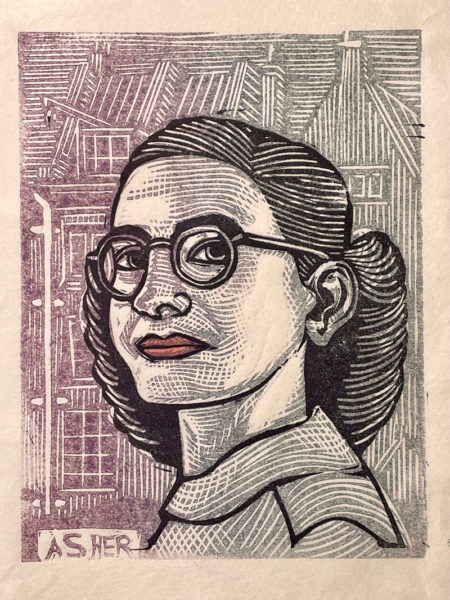
Margot Frank, age 18, older sister of diarist Anne Frank, depicted in a linocut illustration by Monhegan artist Asher Briant for his newest book, “The Dissident Draftsman. The book spotlights visual artists under oppressive regimes throughout history. (Photo courtesy Asher Briant)
Artist and author Asher Briant feels his entire art career has led to his latest book, “The Dissident Draftsman,” about visual artists working under oppressive regimes. Told mostly through Briant’s illustrations, “The Dissident Draftsman” features real historical artists who suffered under authoritarian regimes in an imagined singular tale.
Briant spent his summer on Monhegan working on “The Dissident Draftsman” after the idea came to him this spring. The project draws from the many threads of Briant’s long art career, back to the earliest influences on his art education, he said.
Briant earned his art degree at the University of the Arts London in the early 1970s, right as 1920s German expressionist art was having an influence on popular culture.
In London, Briant saw a big exhibition from Germany’s New Objectivity art movement, which was labeled “degenerate art” by the National Socialist German Workers’ Party, a far-right political party also known as the Nazi Party. During a school trip to Berlin, Briant learned more about these artists, including Max Beckmann, Otto Dix, and George Grosz.
German artist Peter Strausfeld was Briant’s first art school teacher. Strausfeld had studied at The Staatliches Bauhaus art school before fleeing Nazi Germany in 1938. Strausfeld then gained international fame through linocut film posters he created for a London art theater.
These influences permeated Briant’s style as it developed in school and beyond. Briant worked an illustrator in London for a decade then he lived and worked in New York, N.Y. for many years.
Briant’s wife, Lisa Jahn-Clough, is also an artist and author. Briant has spent the past 10 summers on Monhegan with Jahn-Clough in a home she inherited from her mother, Elena Jahn.
The house was built around 1920 and still pretty original, Briant said. There is not enough electricity to power studio lights, so the studio is outside on the porch.
“I get the longest day by actually being outside,” Briant said. “I can’t work if there’s a nor’easter blowing, but as long as it’s dry and not too windy, it’s fine.”
Monhegan has inspired Briant to paint, create art books, and write books about the island’s birds and flowers. In May, after several years splitting their time between New Jersey, Portland, and Monhegan, Briant and Jahn-Clough moved to Maine full time.
In 2021, Briant wrote “Messages from No-Man’s Land” about his grandparents’ experiences during First World War. He wrote prose and verse and created linocut illustrations.
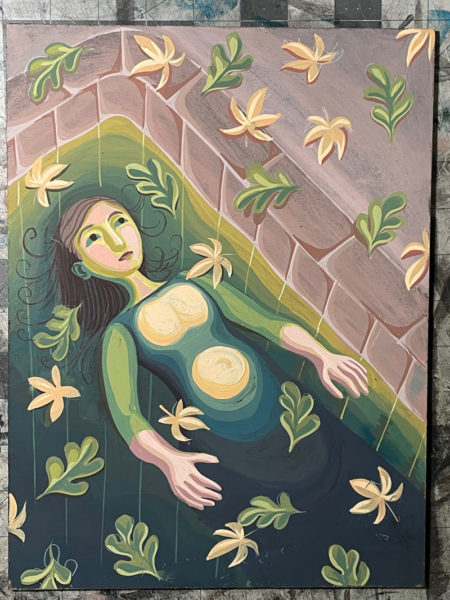
An artist floats and drifts amongst falling leaves in one of Monhegan artist and author Asher Briant’s colorful painted illustrations in The Dissident Draftsman, his new book about artists working under oppressive regimes. (Photo courtesy Asher Briant)
This spring, Briant felt called to honor visual artists who have worked against dictators throughout history. “The Dissident Draftsman” grew out of Briant’s experience, research, linocuts, and paintings.
Briant was partially inspired by American regionalism era printmaker Lynd Ward, who created wordless novels with woodblock print illustrations.
“The Dissident Draftsman” is available in multiple versions. Briant himself prints and binds two entirely linocut versions, a 12-page textless version, and a 24-page version that has single lines of text. A commercially printed version is significantly longer, with more story and information about each artist accompanied by full-color illustrations.
Eufrosinia Kersnovskaya is on the cover of “The Dissident Draftsman.” Kersnovskaya documented her life during 12 years imprisonment in Soviet gulags under Joseph Stalin, Briant said.
“Vera Ermolaeva, she was sent to the gulag. She was a children’s author and illustrator and she was shot,” said Briant.
Aleksandr Drevin was a Latvian-Russian painter killed in The Great Purge under Stalin.
Czech-Jewish portrait painter Mulva Schalek refused an order to paint a Nazi officer’s portrait, so she was sent to Auschwitz and not heard of again, Briant said.
At the Theresienstadt concentration camp, Jewish artists were given materials to create art depicting a flattering view of life in the ghetto. Some of the artists used those materials in the middle of the night to create art that showed the realities of their lives. The artists paid local villagers to smuggle out the art or hid the work, some to be found years later.
In particular, Czech-Jewish illustrator Bedrich Fritta created works that appear like a surrealist nightmares, but it is not, it was reality, Briant said. Fritta was killed in 1944 at Auschwitz.
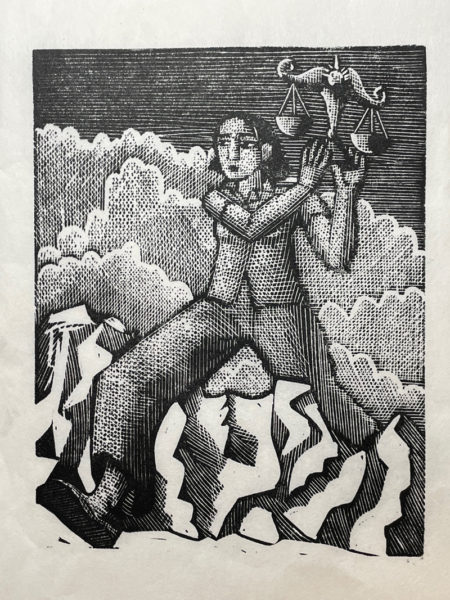
Vera marches across the continent carrying the scales of justice in this linocut print from author artist Asher Briants new book, The Dissident Draftsman, which features visual artists working under authoritarian regimes through history. (Photo courtesy Asher Briant)
Britain has also had oppressive regimes, Briant said. In the 1860s in London, gay painter Simeon Solomon was arrested for soliciting. His art career ended and he fled to Paris, France, where he was further shunned for his sexuality.
The United States in 1930s was an authoritarian regime for African American painters, said Briant. In Briant’s opinion, Charles W. White was America’s best cubist. Reporters would want to write about White until they found out he was Black.
As Briant worked on the book this summer, he continually shared his progress through social media. The feedback from his friends and colleagues somewhat shaped “The Dissident Draftsman,” he said. Several people told Briant he should try to end on something hopeful.
After working on that idea, Briant does feel there is now a hopeful message to take away from “The Dissident Draftsman.”
For a long time, Briant had felt there was nothing happy or hopeful about the story, which led to him getting pretty depressed while working on the project, he said. He fought this by taking a break to go outside and draw some of Monhegan’s rocks and trees and the ocean, he said.
“It’s a wonderful place,” Briant said. “Every day I’m out there, I’m so grateful.”
To learn more about Briant or “The Dissident Draftsman,” find the artist on Instagram or go to asherbriant.substack.com.

